

268
6 Growth
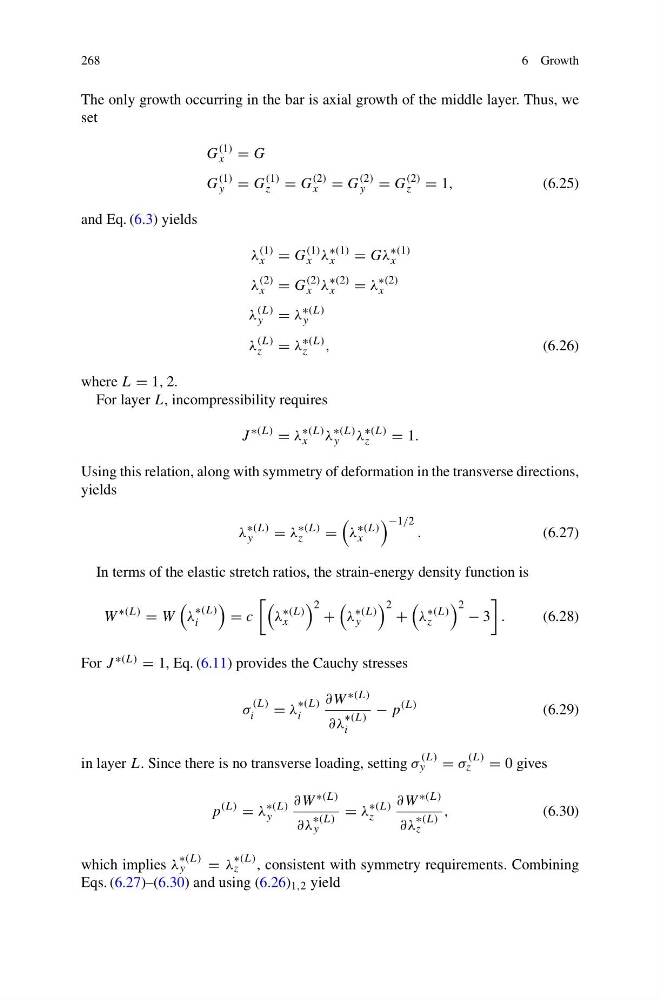
The only growth occurring in the bar is axial growth of the middle layer. Thus, we
set
G
(1)
x = G
G
(1)
y = G
(1)
z = G
(2)
x = G
(2)
y = G
(2)
z = 1,
(6.25)
and Eq. (6.3) yields
λ
(1)
x = G
(1)
x λ
∗(1)
x
= Gλ
∗(1)
x
λ
(2)
x = G
(2)
x λ
∗(2)
x
= λ
∗(2)
x
λ
(L)
y = λ
∗(L)
y
λ
(L)
z = λ
∗(L)
z
,
(6.26)
where L = 1, 2.
For layer L, incompressibility requires
J
∗(L)
= λ
∗(L)
x
λ
∗(L)
y
λ
∗(L)
z
= 1.
Using this relation, along with symmetry of deformation in the transverse directions,
yields
λ
∗(L)
y
= λ
∗(L)
z
=
λ
∗(L)
x
−1/2
.
(6.27)
In terms of the elastic stretch ratios, the strain-energy density function is
W
∗(L)
= W
λ
∗(L)
i
= c
λ
∗(L)
x
2 +
λ
∗(L)
y
2 +
λ
∗(L)
z
2 − 3
.
(6.28)
For J ∗(L) = 1, Eq. (6.11) provides the Cauchy stresses
σ
(L)
i
= λ
∗(L)
i
∂W ∗(L)
∂λ
∗(L)
i
− p
(L)
(6.29)
in layer L. Since there is no transverse loading, setting σ
(L)
y
= σ
(L)
z
= 0 gives
p
(L)
= λ
∗(L)
y
∂W ∗(L)
∂λ
∗(L)
y
= λ
∗(L)
z
∂W ∗(L)
∂λ
∗(L)
z
,
(6.30)
which implies λ
∗(L)
y
= λ
∗(L)
z
, consistent with symmetry requirements. Combining
Eqs. (6.27)–(6.30) and using (6.26) 1,2 yield
6 Growth
The only growth occurring in the bar is axial growth of the middle layer. Thus, we
set
G
(1)
x = G
G
(1)
y = G
(1)
z = G
(2)
x = G
(2)
y = G
(2)
z = 1,
(6.25)
and Eq. (6.3) yields
λ
(1)
x = G
(1)
x λ
∗(1)
x
= Gλ
∗(1)
x
λ
(2)
x = G
(2)
x λ
∗(2)
x
= λ
∗(2)
x
λ
(L)
y = λ
∗(L)
y
λ
(L)
z = λ
∗(L)
z
,
(6.26)
where L = 1, 2.
For layer L, incompressibility requires
J
∗(L)
= λ
∗(L)
x
λ
∗(L)
y
λ
∗(L)
z
= 1.
Using this relation, along with symmetry of deformation in the transverse directions,
yields
λ
∗(L)
y
= λ
∗(L)
z
=
λ
∗(L)
x
−1/2
.
(6.27)
In terms of the elastic stretch ratios, the strain-energy density function is
W
∗(L)
= W
λ
∗(L)
i
= c
λ
∗(L)
x
2 +
λ
∗(L)
y
2 +
λ
∗(L)
z
2 − 3
.
(6.28)
For J ∗(L) = 1, Eq. (6.11) provides the Cauchy stresses
σ
(L)
i
= λ
∗(L)
i
∂W ∗(L)
∂λ
∗(L)
i
− p
(L)
(6.29)
in layer L. Since there is no transverse loading, setting σ
(L)
y
= σ
(L)
z
= 0 gives
p
(L)
= λ
∗(L)
y
∂W ∗(L)
∂λ
∗(L)
y
= λ
∗(L)
z
∂W ∗(L)
∂λ
∗(L)
z
,
(6.30)
which implies λ
∗(L)
y
= λ
∗(L)
z
, consistent with symmetry requirements. Combining
Eqs. (6.27)–(6.30) and using (6.26) 1,2 yield