

266
6 Growth
6.4.3 Stresses Generated by Differential Growth in an
Unconstrained Bar
Next, we consider a rectangular bar composed of three layers having the same
material properties and initial geometry (Fig. 6.4a, top). The bar is free of external
loads and constraints. The middle layer grows uniformly, but the other layers do not
grow. Because of symmetry about the middle surface (XZ-plane), the bar remains
straight as it grows.
This problem involves differential growth that varies in a direction normal to the
growth direction, i.e., G x = G x (Y, t). As shown in Example 6.1, an unconstrained
bar with a growth pattern of the form G x (X, t) does not develop stress, but the
behavior of the multilayered bar is more complex.
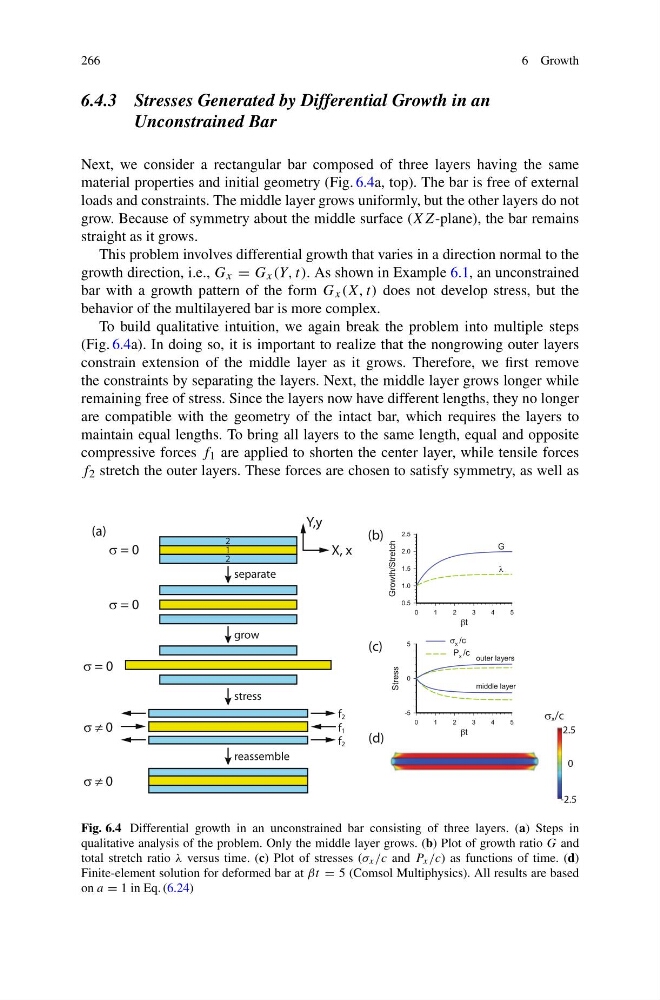
To build qualitative intuition, we again break the problem into multiple steps
(Fig. 6.4a). In doing so, it is important to realize that the nongrowing outer layers
constrain extension of the middle layer as it grows. Therefore, we first remove
the constraints by separating the layers. Next, the middle layer grows longer while
remaining free of stress. Since the layers now have different lengths, they no longer
are compatible with the geometry of the intact bar, which requires the layers to
maintain equal lengths. To bring all layers to the same length, equal and opposite
compressive forces f 1 are applied to shorten the center layer, while tensile forces
f 2 stretch the outer layers. These forces are chosen to satisfy symmetry, as well as
f 1
f 2
f 2
(a)
(b)
(d)
2.5
0
-2.5
σ x /c
2
2
1
X, x
separate
grow
stress
reassemble
(c)
σ = 0
σ = 0
σ = 0
σ ≠ 0
σ ≠ 0
Y,y
Fig. 6.4 Differential growth in an unconstrained bar consisting of three layers. (a) Steps in
qualitative analysis of the problem. Only the middle layer grows. (b) Plot of growth ratio G and
total stretch ratio λ versus time. (c) Plot of stresses (σ x /c and P x /c) as functions of time. (d)
Finite-element solution for deformed bar at βt = 5 (Comsol Multiphysics). All results are based
on a = 1 in Eq. (6.24)
6 Growth
6.4.3 Stresses Generated by Differential Growth in an
Unconstrained Bar
Next, we consider a rectangular bar composed of three layers having the same
material properties and initial geometry (Fig. 6.4a, top). The bar is free of external
loads and constraints. The middle layer grows uniformly, but the other layers do not
grow. Because of symmetry about the middle surface (XZ-plane), the bar remains
straight as it grows.
This problem involves differential growth that varies in a direction normal to the
growth direction, i.e., G x = G x (Y, t). As shown in Example 6.1, an unconstrained
bar with a growth pattern of the form G x (X, t) does not develop stress, but the
behavior of the multilayered bar is more complex.
To build qualitative intuition, we again break the problem into multiple steps
(Fig. 6.4a). In doing so, it is important to realize that the nongrowing outer layers
constrain extension of the middle layer as it grows. Therefore, we first remove
the constraints by separating the layers. Next, the middle layer grows longer while
remaining free of stress. Since the layers now have different lengths, they no longer
are compatible with the geometry of the intact bar, which requires the layers to
maintain equal lengths. To bring all layers to the same length, equal and opposite
compressive forces f 1 are applied to shorten the center layer, while tensile forces
f 2 stretch the outer layers. These forces are chosen to satisfy symmetry, as well as
f 1
f 2
f 2
(a)
(b)
(d)
2.5
0
-2.5
σ x /c
2
2
1
X, x
separate
grow
stress
reassemble
(c)
σ = 0
σ = 0
σ = 0
σ ≠ 0
σ ≠ 0
Y,y
Fig. 6.4 Differential growth in an unconstrained bar consisting of three layers. (a) Steps in
qualitative analysis of the problem. Only the middle layer grows. (b) Plot of growth ratio G and
total stretch ratio λ versus time. (c) Plot of stresses (σ x /c and P x /c) as functions of time. (d)
Finite-element solution for deformed bar at βt = 5 (Comsol Multiphysics). All results are based
on a = 1 in Eq. (6.24)