

264
6 Growth
(b)
(a)
X, x
free
grow
stress
σ x
σ = 0
σ = 0
σ = 0
σ ≠ 0
σ ≠ 0
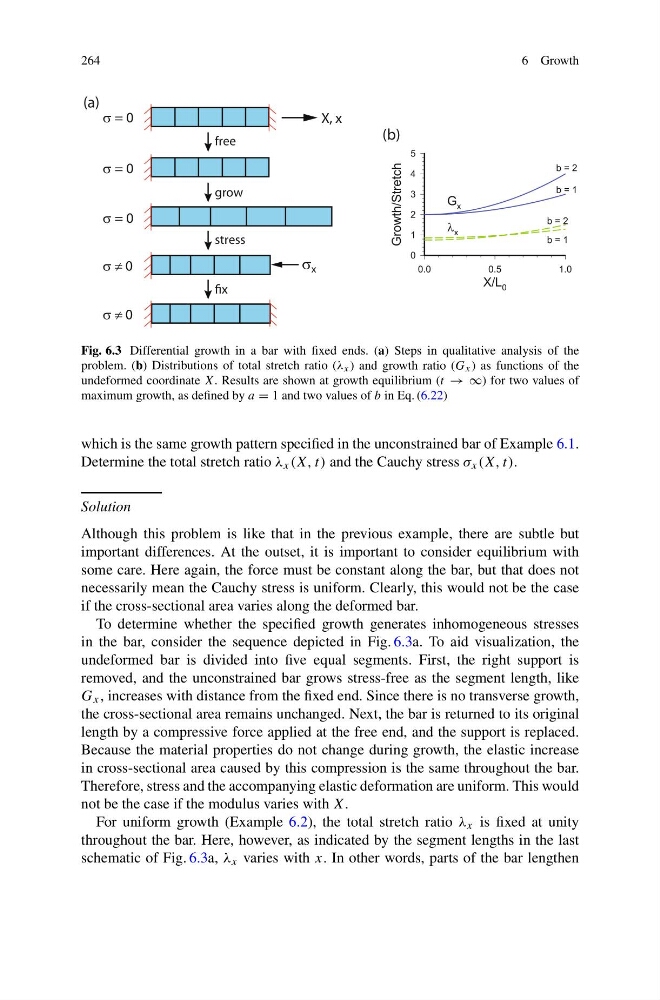
Fig. 6.3 Differential growth in a bar with fixed ends. (a) Steps in qualitative analysis of the
problem. (b) Distributions of total stretch ratio (λ x ) and growth ratio (G x ) as functions of the
undeformed coordinate X. Results are shown at growth equilibrium (t → ∞) for two values of
maximum growth, as defined by a = 1 and two values of b in Eq. (6.22)
which is the same growth pattern specified in the unconstrained bar of Example 6.1.
Determine the total stretch ratio λ x (X, t) and the Cauchy stress σ x (X, t).
Solution
Although this problem is like that in the previous example, there are subtle but
important differences. At the outset, it is important to consider equilibrium with
some care. Here again, the force must be constant along the bar, but that does not
necessarily mean the Cauchy stress is uniform. Clearly, this would not be the case
if the cross-sectional area varies along the deformed bar.
To determine whether the specified growth generates inhomogeneous stresses
in the bar, consider the sequence depicted in Fig. 6.3a. To aid visualization, the
undeformed bar is divided into five equal segments. First, the right support is
removed, and the unconstrained bar grows stress-free as the segment length, like
G x , increases with distance from the fixed end. Since there is no transverse growth,
the cross-sectional area remains unchanged. Next, the bar is returned to its original
length by a compressive force applied at the free end, and the support is replaced.
Because the material properties do not change during growth, the elastic increase
in cross-sectional area caused by this compression is the same throughout the bar.
Therefore, stress and the accompanying elastic deformation are uniform. This would
not be the case if the modulus varies with X.
For uniform growth (Example 6.2), the total stretch ratio λ x is fixed at unity
throughout the bar. Here, however, as indicated by the segment lengths in the last
schematic of Fig. 6.3a, λ x varies with x. In other words, parts of the bar lengthen
6 Growth
(b)
(a)
X, x
free
grow
stress
σ x
σ = 0
σ = 0
σ = 0
σ ≠ 0
σ ≠ 0
Fig. 6.3 Differential growth in a bar with fixed ends. (a) Steps in qualitative analysis of the
problem. (b) Distributions of total stretch ratio (λ x ) and growth ratio (G x ) as functions of the
undeformed coordinate X. Results are shown at growth equilibrium (t → ∞) for two values of
maximum growth, as defined by a = 1 and two values of b in Eq. (6.22)
which is the same growth pattern specified in the unconstrained bar of Example 6.1.
Determine the total stretch ratio λ x (X, t) and the Cauchy stress σ x (X, t).
Solution
Although this problem is like that in the previous example, there are subtle but
important differences. At the outset, it is important to consider equilibrium with
some care. Here again, the force must be constant along the bar, but that does not
necessarily mean the Cauchy stress is uniform. Clearly, this would not be the case
if the cross-sectional area varies along the deformed bar.
To determine whether the specified growth generates inhomogeneous stresses
in the bar, consider the sequence depicted in Fig. 6.3a. To aid visualization, the
undeformed bar is divided into five equal segments. First, the right support is
removed, and the unconstrained bar grows stress-free as the segment length, like
G x , increases with distance from the fixed end. Since there is no transverse growth,
the cross-sectional area remains unchanged. Next, the bar is returned to its original
length by a compressive force applied at the free end, and the support is replaced.
Because the material properties do not change during growth, the elastic increase
in cross-sectional area caused by this compression is the same throughout the bar.
Therefore, stress and the accompanying elastic deformation are uniform. This would
not be the case if the modulus varies with X.
For uniform growth (Example 6.2), the total stretch ratio λ x is fixed at unity
throughout the bar. Here, however, as indicated by the segment lengths in the last
schematic of Fig. 6.3a, λ x varies with x. In other words, parts of the bar lengthen