

5.5 Case Study: Cardiac Mechanics
239
where λ f and λ ∗
f are the total and elastic fiber stretch ratios, and I 1 is the first strain
invariant.
5.5.5 Analysis
The helical fibers cause the LV to twist as it inflates, and many of the equations
developed in Sect. 4.5 for a bar undergoing extension and torsion apply here without
modification. The main changes involve boundary conditions at the inner wall and
constitutive relations for off-axis anisotropy and contraction. The equations from
Sect. 4.5 that remain the same for the present problem are given below without
derivation. Otherwise, any needed changes are described in detail.
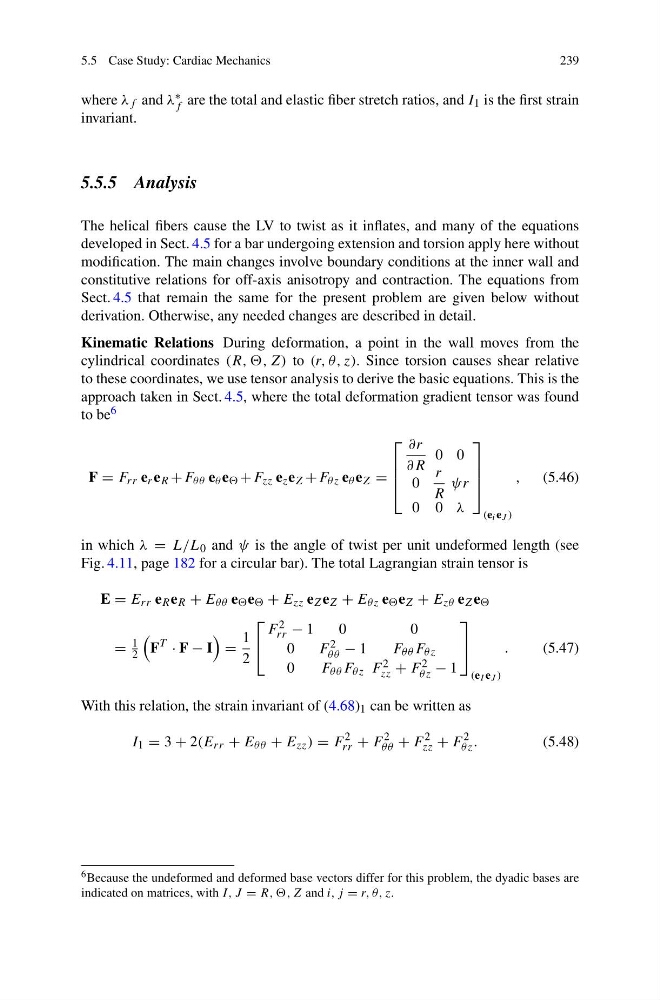
Kinematic Relations During deformation, a point in the wall moves from the
cylindrical coordinates (R, ,, Z) to (r, θ, z). Since torsion causes shear relative
to these coordinates, we use tensor analysis to derive the basic equations. This is the
approach taken in Sect. 4.5, where the total deformation gradient tensor was found
to be 6
F = F rr e r e R +F θθ e θ e +F zz e z e Z +F θz e θ e Z =
⎡
⎢
⎢
⎣
∂r
∂R
0 0
0
r
R
ψr
0 0 λ
⎤
⎥
⎥
⎦
(e i e J )
,
(5.46)
in which λ = L/L 0 and ψ is the angle of twist per unit undeformed length (see
Fig. 4.11, page 182 for a circular bar). The total Lagrangian strain tensor is
E = E rr e R e R + E θθ e e + E zz e Z e Z + E θz e e Z + E zθ e Z e
=
1
2
F
T
· F − I
=
1
2
⎡
⎣
F 2
rr − 1
0
0
0
F 2
θθ − 1
F θθ F θz
0
F θθ F θz F 2
zz + F 2
θz − 1
⎤
⎦
(e I e J )
.
(5.47)
With this relation, the strain invariant of (4.68) 1 can be written as
I 1 = 3 + 2(E rr + E θθ + E zz ) = F
2
rr + F
2
θθ + F
2
zz + F
2
θz .
(5.48)
6 Because the undeformed and deformed base vectors differ for this problem, the dyadic bases are
indicated on matrices, with I, J = R, ,, Z and i, j = r, θ, z.
239
where λ f and λ ∗
f are the total and elastic fiber stretch ratios, and I 1 is the first strain
invariant.
5.5.5 Analysis
The helical fibers cause the LV to twist as it inflates, and many of the equations
developed in Sect. 4.5 for a bar undergoing extension and torsion apply here without
modification. The main changes involve boundary conditions at the inner wall and
constitutive relations for off-axis anisotropy and contraction. The equations from
Sect. 4.5 that remain the same for the present problem are given below without
derivation. Otherwise, any needed changes are described in detail.
Kinematic Relations During deformation, a point in the wall moves from the
cylindrical coordinates (R, ,, Z) to (r, θ, z). Since torsion causes shear relative
to these coordinates, we use tensor analysis to derive the basic equations. This is the
approach taken in Sect. 4.5, where the total deformation gradient tensor was found
to be 6
F = F rr e r e R +F θθ e θ e +F zz e z e Z +F θz e θ e Z =
⎡
⎢
⎢
⎣
∂r
∂R
0 0
0
r
R
ψr
0 0 λ
⎤
⎥
⎥
⎦
(e i e J )
,
(5.46)
in which λ = L/L 0 and ψ is the angle of twist per unit undeformed length (see
Fig. 4.11, page 182 for a circular bar). The total Lagrangian strain tensor is
E = E rr e R e R + E θθ e e + E zz e Z e Z + E θz e e Z + E zθ e Z e
=
1
2
F
T
· F − I
=
1
2
⎡
⎣
F 2
rr − 1
0
0
0
F 2
θθ − 1
F θθ F θz
0
F θθ F θz F 2
zz + F 2
θz − 1
⎤
⎦
(e I e J )
.
(5.47)
With this relation, the strain invariant of (4.68) 1 can be written as
I 1 = 3 + 2(E rr + E θθ + E zz ) = F
2
rr + F
2
θθ + F
2
zz + F
2
θz .
(5.48)
6 Because the undeformed and deformed base vectors differ for this problem, the dyadic bases are
indicated on matrices, with I, J = R, ,, Z and i, j = r, θ, z.