

5.5 Case Study: Cardiac Mechanics
235
Pressure
Volume
EDPVR
ESPVR
Pressure
Volume
EDPVR
ESPVR
systole
diastole
(a)
(b)
.
.
.
.
Vp
Va
}
.
.
.
t = t 1
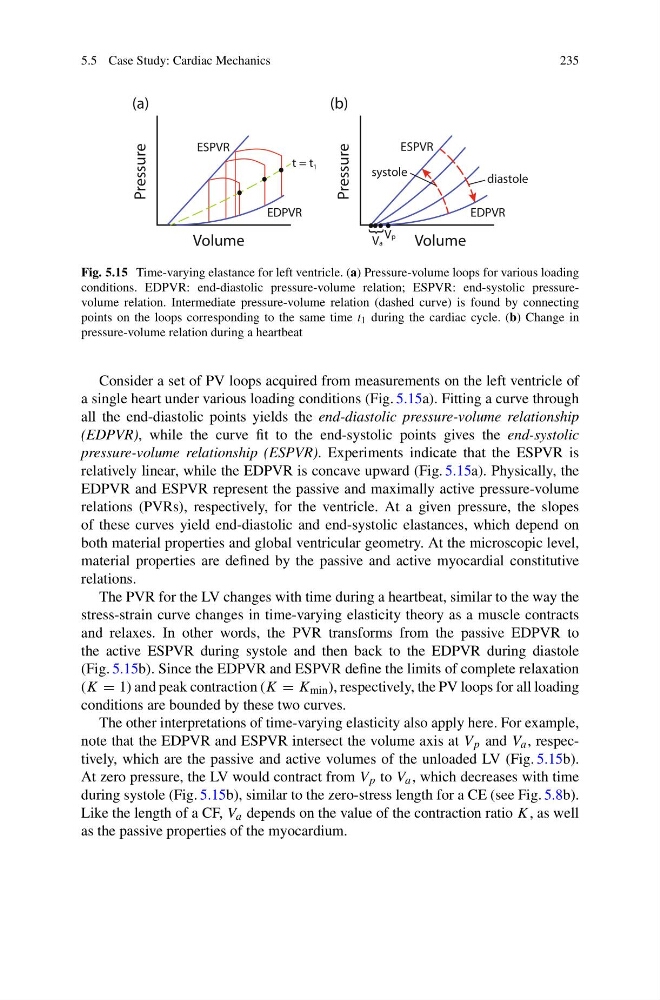
Fig. 5.15 Time-varying elastance for left ventricle. (a) Pressure-volume loops for various loading
conditions. EDPVR: end-diastolic pressure-volume relation; ESPVR: end-systolic pressurevolume relation. Intermediate pressure-volume relation (dashed curve) is found by connecting
points on the loops corresponding to the same time t 1 during the cardiac cycle. (b) Change in
pressure-volume relation during a heartbeat
Consider a set of PV loops acquired from measurements on the left ventricle of
a single heart under various loading conditions (Fig. 5.15a). Fitting a curve through
all the end-diastolic points yields the end-diastolic pressure-volume relationship
(EDPVR), while the curve fit to the end-systolic points gives the end-systolic
pressure-volume relationship (ESPVR). Experiments indicate that the ESPVR is
relatively linear, while the EDPVR is concave upward (Fig. 5.15a). Physically, the
EDPVR and ESPVR represent the passive and maximally active pressure-volume
relations (PVRs), respectively, for the ventricle. At a given pressure, the slopes
of these curves yield end-diastolic and end-systolic elastances, which depend on
both material properties and global ventricular geometry. At the microscopic level,
material properties are defined by the passive and active myocardial constitutive
relations.
The PVR for the LV changes with time during a heartbeat, similar to the way the
stress-strain curve changes in time-varying elasticity theory as a muscle contracts
and relaxes. In other words, the PVR transforms from the passive EDPVR to
the active ESPVR during systole and then back to the EDPVR during diastole
(Fig. 5.15b). Since the EDPVR and ESPVR define the limits of complete relaxation
(K = 1) and peak contraction (K = K min ), respectively, the PV loops for all loading
conditions are bounded by these two curves.
The other interpretations of time-varying elasticity also apply here. For example,
note that the EDPVR and ESPVR intersect the volume axis at V p and V a , respectively, which are the passive and active volumes of the unloaded LV (Fig. 5.15b).
At zero pressure, the LV would contract from V p to V a , which decreases with time
during systole (Fig. 5.15b), similar to the zero-stress length for a CE (see Fig. 5.8b).
Like the length of a CF, V a depends on the value of the contraction ratio K, as well
as the passive properties of the myocardium.
235
Pressure
Volume
EDPVR
ESPVR
Pressure
Volume
EDPVR
ESPVR
systole
diastole
(a)
(b)
.
.
.
.
Vp
Va
}
.
.
.
t = t 1
Fig. 5.15 Time-varying elastance for left ventricle. (a) Pressure-volume loops for various loading
conditions. EDPVR: end-diastolic pressure-volume relation; ESPVR: end-systolic pressurevolume relation. Intermediate pressure-volume relation (dashed curve) is found by connecting
points on the loops corresponding to the same time t 1 during the cardiac cycle. (b) Change in
pressure-volume relation during a heartbeat
Consider a set of PV loops acquired from measurements on the left ventricle of
a single heart under various loading conditions (Fig. 5.15a). Fitting a curve through
all the end-diastolic points yields the end-diastolic pressure-volume relationship
(EDPVR), while the curve fit to the end-systolic points gives the end-systolic
pressure-volume relationship (ESPVR). Experiments indicate that the ESPVR is
relatively linear, while the EDPVR is concave upward (Fig. 5.15a). Physically, the
EDPVR and ESPVR represent the passive and maximally active pressure-volume
relations (PVRs), respectively, for the ventricle. At a given pressure, the slopes
of these curves yield end-diastolic and end-systolic elastances, which depend on
both material properties and global ventricular geometry. At the microscopic level,
material properties are defined by the passive and active myocardial constitutive
relations.
The PVR for the LV changes with time during a heartbeat, similar to the way the
stress-strain curve changes in time-varying elasticity theory as a muscle contracts
and relaxes. In other words, the PVR transforms from the passive EDPVR to
the active ESPVR during systole and then back to the EDPVR during diastole
(Fig. 5.15b). Since the EDPVR and ESPVR define the limits of complete relaxation
(K = 1) and peak contraction (K = K min ), respectively, the PV loops for all loading
conditions are bounded by these two curves.
The other interpretations of time-varying elasticity also apply here. For example,
note that the EDPVR and ESPVR intersect the volume axis at V p and V a , respectively, which are the passive and active volumes of the unloaded LV (Fig. 5.15b).
At zero pressure, the LV would contract from V p to V a , which decreases with time
during systole (Fig. 5.15b), similar to the zero-stress length for a CE (see Fig. 5.8b).
Like the length of a CF, V a depends on the value of the contraction ratio K, as well
as the passive properties of the myocardium.