

5.4 Mechanical Properties of Contractile Fibers
231
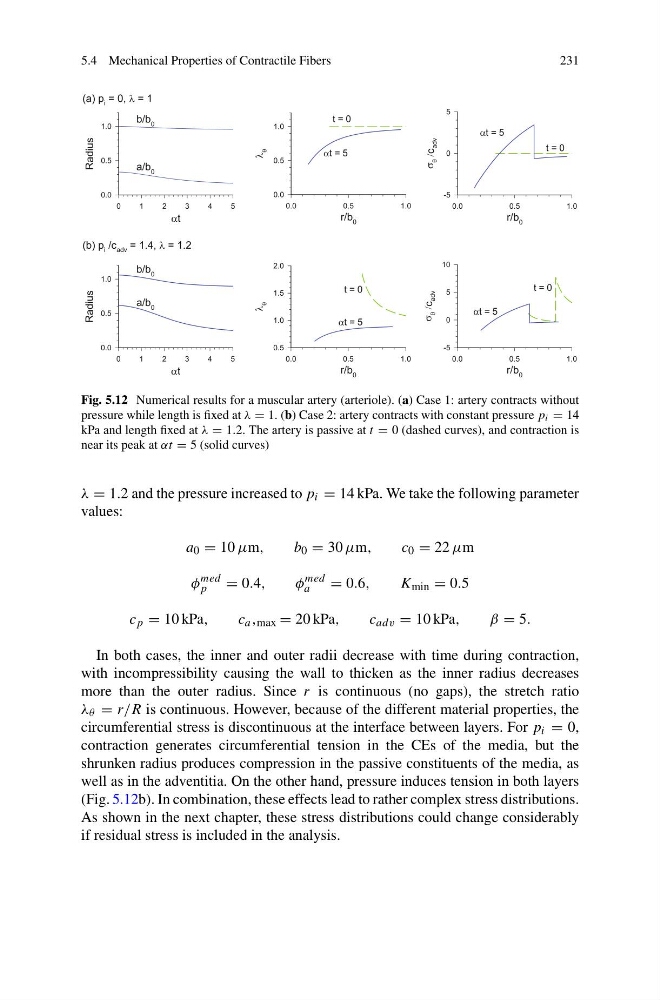
Fig. 5.12 Numerical results for a muscular artery (arteriole). (a) Case 1: artery contracts without
pressure while length is fixed at λ = 1. (b) Case 2: artery contracts with constant pressure p i = 14
kPa and length fixed at λ = 1.2. The artery is passive at t = 0 (dashed curves), and contraction is
near its peak at αt = 5 (solid curves)
λ = 1.2 and the pressure increased to p i = 14 kPa. We take the following parameter
values:
a 0 = 10 μm,
b 0 = 30 μm,
c 0 = 22 μm
φ
med
p
= 0.4,
φ
med
a
= 0.6,
K min = 0.5
c p = 10 kPa,
c a , max = 20 kPa,
c adv = 10 kPa,
β = 5.
In both cases, the inner and outer radii decrease with time during contraction,
with incompressibility causing the wall to thicken as the inner radius decreases
more than the outer radius. Since r is continuous (no gaps), the stretch ratio
λ θ = r/R is continuous. However, because of the different material properties, the
circumferential stress is discontinuous at the interface between layers. For p i = 0,
contraction generates circumferential tension in the CEs of the media, but the
shrunken radius produces compression in the passive constituents of the media, as
well as in the adventitia. On the other hand, pressure induces tension in both layers
(Fig. 5.12b). In combination, these effects lead to rather complex stress distributions.
As shown in the next chapter, these stress distributions could change considerably
if residual stress is included in the analysis.
231
Fig. 5.12 Numerical results for a muscular artery (arteriole). (a) Case 1: artery contracts without
pressure while length is fixed at λ = 1. (b) Case 2: artery contracts with constant pressure p i = 14
kPa and length fixed at λ = 1.2. The artery is passive at t = 0 (dashed curves), and contraction is
near its peak at αt = 5 (solid curves)
λ = 1.2 and the pressure increased to p i = 14 kPa. We take the following parameter
values:
a 0 = 10 μm,
b 0 = 30 μm,
c 0 = 22 μm
φ
med
p
= 0.4,
φ
med
a
= 0.6,
K min = 0.5
c p = 10 kPa,
c a , max = 20 kPa,
c adv = 10 kPa,
β = 5.
In both cases, the inner and outer radii decrease with time during contraction,
with incompressibility causing the wall to thicken as the inner radius decreases
more than the outer radius. Since r is continuous (no gaps), the stretch ratio
λ θ = r/R is continuous. However, because of the different material properties, the
circumferential stress is discontinuous at the interface between layers. For p i = 0,
contraction generates circumferential tension in the CEs of the media, but the
shrunken radius produces compression in the passive constituents of the media, as
well as in the adventitia. On the other hand, pressure induces tension in both layers
(Fig. 5.12b). In combination, these effects lead to rather complex stress distributions.
As shown in the next chapter, these stress distributions could change considerably
if residual stress is included in the analysis.