

4.7 Bending of a Block
207
(c) Suppose the tube is composed of transversely isotropic material with a
strain-energy density function given by Eq. (4.46). Compute and plot the
stress σ θ across the wall in the inverted tube for a 0 = 1 cm, b 0 = 1.5 cm,
c 1 = 200 kPa, c 3 = 0 and 200 kPa, and c 4 = 2. Since the inverted tube is
free of external loads, these plots show distributions of residual stress.
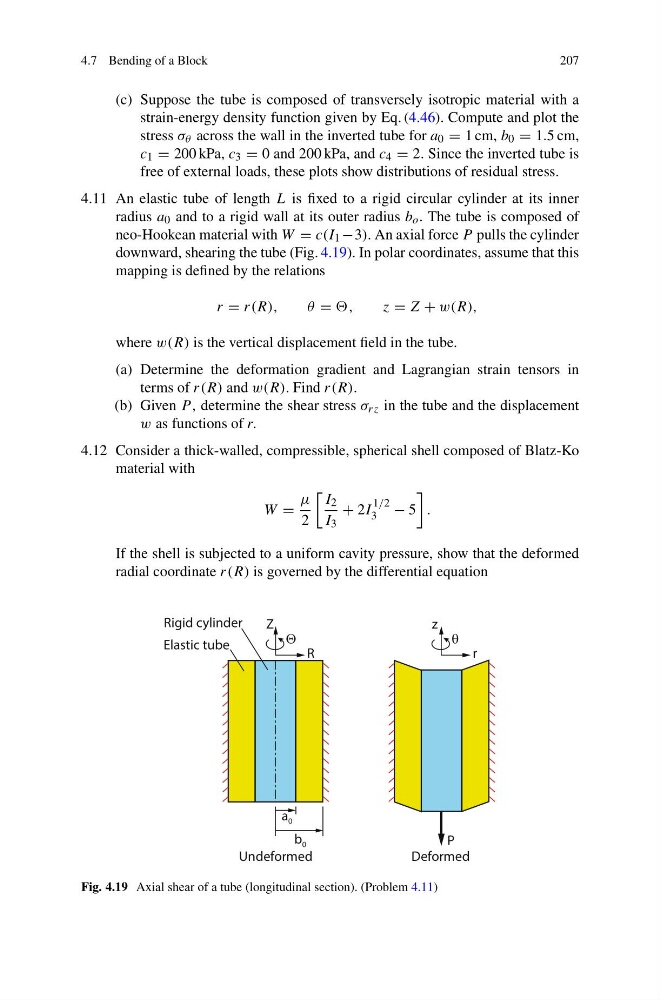
4.11 An elastic tube of length L is fixed to a rigid circular cylinder at its inner
radius a 0 and to a rigid wall at its outer radius b o . The tube is composed of
neo-Hookean material with W = c(I 1 −3). An axial force P pulls the cylinder
downward, shearing the tube (Fig. 4.19). In polar coordinates, assume that this
mapping is defined by the relations
r = r(R),
θ = ,
z = Z + w(R),
where w(R) is the vertical displacement field in the tube.
(a) Determine the deformation gradient and Lagrangian strain tensors in
terms of r(R) and w(R). Find r(R).
(b) Given P , determine the shear stress σ rz in the tube and the displacement
w as functions of r.
4.12 Consider a thick-walled, compressible, spherical shell composed of Blatz-Ko
material with
W =
μ
2
I 2
I 3
+ 2I
1/2
3 − 5
.
If the shell is subjected to a uniform cavity pressure, show that the deformed
radial coordinate r(R) is governed by the differential equation
a 0
b 0
Z
4
R
z
T
r
P
Undeformed
Deformed
Elastic tube
Rigid cylinder
Fig. 4.19 Axial shear of a tube (longitudinal section). (Problem 4.11)
207
(c) Suppose the tube is composed of transversely isotropic material with a
strain-energy density function given by Eq. (4.46). Compute and plot the
stress σ θ across the wall in the inverted tube for a 0 = 1 cm, b 0 = 1.5 cm,
c 1 = 200 kPa, c 3 = 0 and 200 kPa, and c 4 = 2. Since the inverted tube is
free of external loads, these plots show distributions of residual stress.
4.11 An elastic tube of length L is fixed to a rigid circular cylinder at its inner
radius a 0 and to a rigid wall at its outer radius b o . The tube is composed of
neo-Hookean material with W = c(I 1 −3). An axial force P pulls the cylinder
downward, shearing the tube (Fig. 4.19). In polar coordinates, assume that this
mapping is defined by the relations
r = r(R),
θ = ,
z = Z + w(R),
where w(R) is the vertical displacement field in the tube.
(a) Determine the deformation gradient and Lagrangian strain tensors in
terms of r(R) and w(R). Find r(R).
(b) Given P , determine the shear stress σ rz in the tube and the displacement
w as functions of r.
4.12 Consider a thick-walled, compressible, spherical shell composed of Blatz-Ko
material with
W =
μ
2
I 2
I 3
+ 2I
1/2
3 − 5
.
If the shell is subjected to a uniform cavity pressure, show that the deformed
radial coordinate r(R) is governed by the differential equation
a 0
b 0
Z
4
R
z
T
r
P
Undeformed
Deformed
Elastic tube
Rigid cylinder
Fig. 4.19 Axial shear of a tube (longitudinal section). (Problem 4.11)