

4.7 Bending of a Block
197
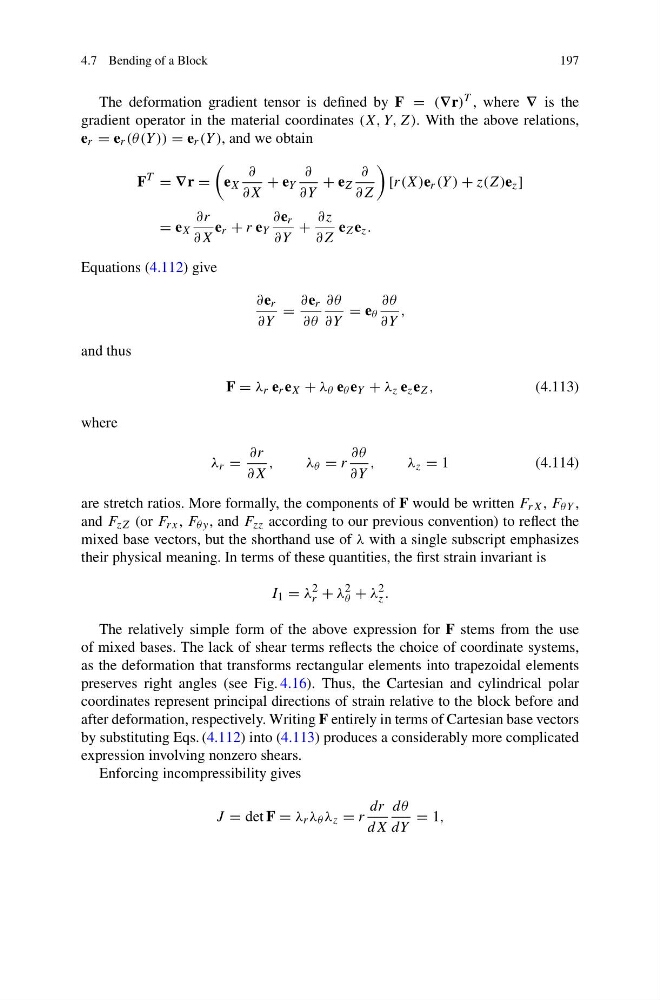
The deformation gradient tensor is defined by F = (∇r) T , where ∇ is the
gradient operator in the material coordinates (X, Y, Z). With the above relations,
e r = e r (θ (Y )) = e r (Y ), and we obtain
F
T
= ∇r =
e X
∂
∂X
+ e Y
∂
∂Y
+ e Z
∂
∂Z
[r(X)e r (Y ) + z(Z)e z ]
= e X
∂r
∂X
e r + r e Y
∂e r
∂Y
+
∂z
∂Z
e Z e z .
Equations (4.112) give
∂e r
∂Y
=
∂e r
∂θ
∂θ
∂Y
= e θ
∂θ
∂Y
,
and thus
F = λ r e r e X + λ θ e θ e Y + λ z e z e Z ,
(4.113)
where
λ r =
∂r
∂X
,
λ θ = r
∂θ
∂Y
,
λ z = 1
(4.114)
are stretch ratios. More formally, the components of F would be written F rX , F θY ,
and F zZ (or F rx , F θy , and F zz according to our previous convention) to reflect the
mixed base vectors, but the shorthand use of λ with a single subscript emphasizes
their physical meaning. In terms of these quantities, the first strain invariant is
I 1 = λ
2
r + λ
2
θ + λ
2
z .
The relatively simple form of the above expression for F stems from the use
of mixed bases. The lack of shear terms reflects the choice of coordinate systems,
as the deformation that transforms rectangular elements into trapezoidal elements
preserves right angles (see Fig. 4.16). Thus, the Cartesian and cylindrical polar
coordinates represent principal directions of strain relative to the block before and
after deformation, respectively. Writing F entirely in terms of Cartesian base vectors
by substituting Eqs. (4.112) into (4.113) produces a considerably more complicated
expression involving nonzero shears.
Enforcing incompressibility gives
J = det F = λ r λ θ λ z = r
dr
dX
dθ
dY
= 1,
197
The deformation gradient tensor is defined by F = (∇r) T , where ∇ is the
gradient operator in the material coordinates (X, Y, Z). With the above relations,
e r = e r (θ (Y )) = e r (Y ), and we obtain
F
T
= ∇r =
e X
∂
∂X
+ e Y
∂
∂Y
+ e Z
∂
∂Z
[r(X)e r (Y ) + z(Z)e z ]
= e X
∂r
∂X
e r + r e Y
∂e r
∂Y
+
∂z
∂Z
e Z e z .
Equations (4.112) give
∂e r
∂Y
=
∂e r
∂θ
∂θ
∂Y
= e θ
∂θ
∂Y
,
and thus
F = λ r e r e X + λ θ e θ e Y + λ z e z e Z ,
(4.113)
where
λ r =
∂r
∂X
,
λ θ = r
∂θ
∂Y
,
λ z = 1
(4.114)
are stretch ratios. More formally, the components of F would be written F rX , F θY ,
and F zZ (or F rx , F θy , and F zz according to our previous convention) to reflect the
mixed base vectors, but the shorthand use of λ with a single subscript emphasizes
their physical meaning. In terms of these quantities, the first strain invariant is
I 1 = λ
2
r + λ
2
θ + λ
2
z .
The relatively simple form of the above expression for F stems from the use
of mixed bases. The lack of shear terms reflects the choice of coordinate systems,
as the deformation that transforms rectangular elements into trapezoidal elements
preserves right angles (see Fig. 4.16). Thus, the Cartesian and cylindrical polar
coordinates represent principal directions of strain relative to the block before and
after deformation, respectively. Writing F entirely in terms of Cartesian base vectors
by substituting Eqs. (4.112) into (4.113) produces a considerably more complicated
expression involving nonzero shears.
Enforcing incompressibility gives
J = det F = λ r λ θ λ z = r
dr
dX
dθ
dY
= 1,