

180
4 Problems in Soft Tissue Biomechanics
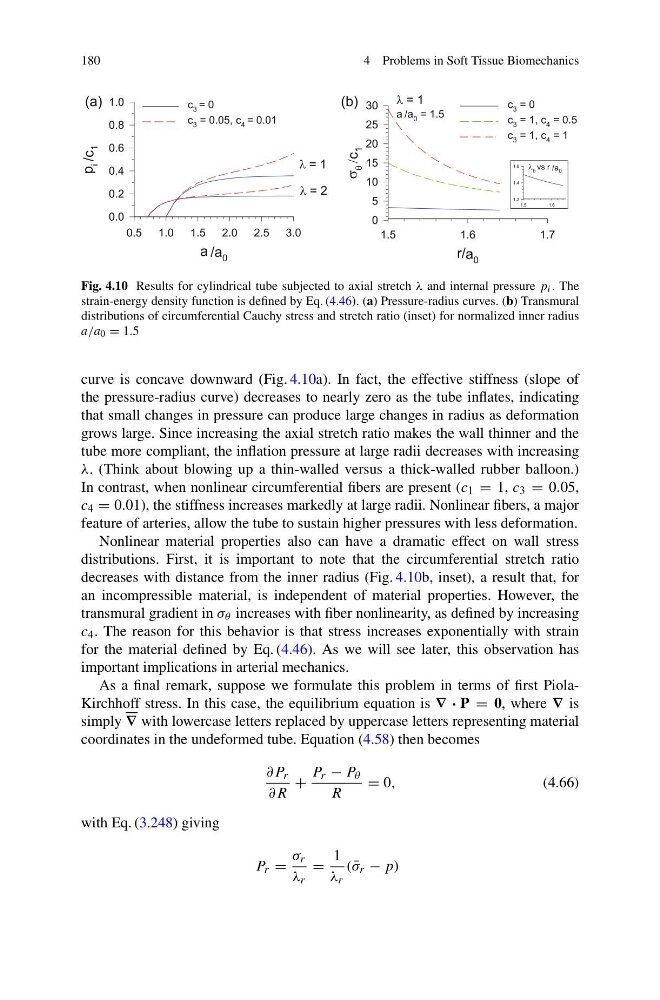
Fig. 4.10 Results for cylindrical tube subjected to axial stretch λ and internal pressure p i . The
strain-energy density function is defined by Eq. (4.46). (a) Pressure-radius curves. (b) Transmural
distributions of circumferential Cauchy stress and stretch ratio (inset) for normalized inner radius
a/a 0 = 1.5
curve is concave downward (Fig. 4.10a). In fact, the effective stiffness (slope of
the pressure-radius curve) decreases to nearly zero as the tube inflates, indicating
that small changes in pressure can produce large changes in radius as deformation
grows large. Since increasing the axial stretch ratio makes the wall thinner and the
tube more compliant, the inflation pressure at large radii decreases with increasing
λ. (Think about blowing up a thin-walled versus a thick-walled rubber balloon.)
In contrast, when nonlinear circumferential fibers are present (c 1 = 1, c 3 = 0.05,
c 4 = 0.01), the stiffness increases markedly at large radii. Nonlinear fibers, a major
feature of arteries, allow the tube to sustain higher pressures with less deformation.
Nonlinear material properties also can have a dramatic effect on wall stress
distributions. First, it is important to note that the circumferential stretch ratio
decreases with distance from the inner radius (Fig. 4.10b, inset), a result that, for
an incompressible material, is independent of material properties. However, the
transmural gradient in σ θ increases with fiber nonlinearity, as defined by increasing
c 4 . The reason for this behavior is that stress increases exponentially with strain
for the material defined by Eq. (4.46). As we will see later, this observation has
important implications in arterial mechanics.
As a final remark, suppose we formulate this problem in terms of first PiolaKirchhoff stress. In this case, the equilibrium equation is ∇ · P = 0, where ∇ is
simply ∇ with lowercase letters replaced by uppercase letters representing material
coordinates in the undeformed tube. Equation (4.58) then becomes
∂P r
∂R
+
P r − P θ
R
= 0,
(4.66)
with Eq. (3.248) giving
P r =
σ r
λ r
=
1
λ r
( ¯
σ r − p)
4 Problems in Soft Tissue Biomechanics
Fig. 4.10 Results for cylindrical tube subjected to axial stretch λ and internal pressure p i . The
strain-energy density function is defined by Eq. (4.46). (a) Pressure-radius curves. (b) Transmural
distributions of circumferential Cauchy stress and stretch ratio (inset) for normalized inner radius
a/a 0 = 1.5
curve is concave downward (Fig. 4.10a). In fact, the effective stiffness (slope of
the pressure-radius curve) decreases to nearly zero as the tube inflates, indicating
that small changes in pressure can produce large changes in radius as deformation
grows large. Since increasing the axial stretch ratio makes the wall thinner and the
tube more compliant, the inflation pressure at large radii decreases with increasing
λ. (Think about blowing up a thin-walled versus a thick-walled rubber balloon.)
In contrast, when nonlinear circumferential fibers are present (c 1 = 1, c 3 = 0.05,
c 4 = 0.01), the stiffness increases markedly at large radii. Nonlinear fibers, a major
feature of arteries, allow the tube to sustain higher pressures with less deformation.
Nonlinear material properties also can have a dramatic effect on wall stress
distributions. First, it is important to note that the circumferential stretch ratio
decreases with distance from the inner radius (Fig. 4.10b, inset), a result that, for
an incompressible material, is independent of material properties. However, the
transmural gradient in σ θ increases with fiber nonlinearity, as defined by increasing
c 4 . The reason for this behavior is that stress increases exponentially with strain
for the material defined by Eq. (4.46). As we will see later, this observation has
important implications in arterial mechanics.
As a final remark, suppose we formulate this problem in terms of first PiolaKirchhoff stress. In this case, the equilibrium equation is ∇ · P = 0, where ∇ is
simply ∇ with lowercase letters replaced by uppercase letters representing material
coordinates in the undeformed tube. Equation (4.58) then becomes
∂P r
∂R
+
P r − P θ
R
= 0,
(4.66)
with Eq. (3.248) giving
P r =
σ r
λ r
=
1
λ r
( ¯
σ r − p)