

176
4 Problems in Soft Tissue Biomechanics
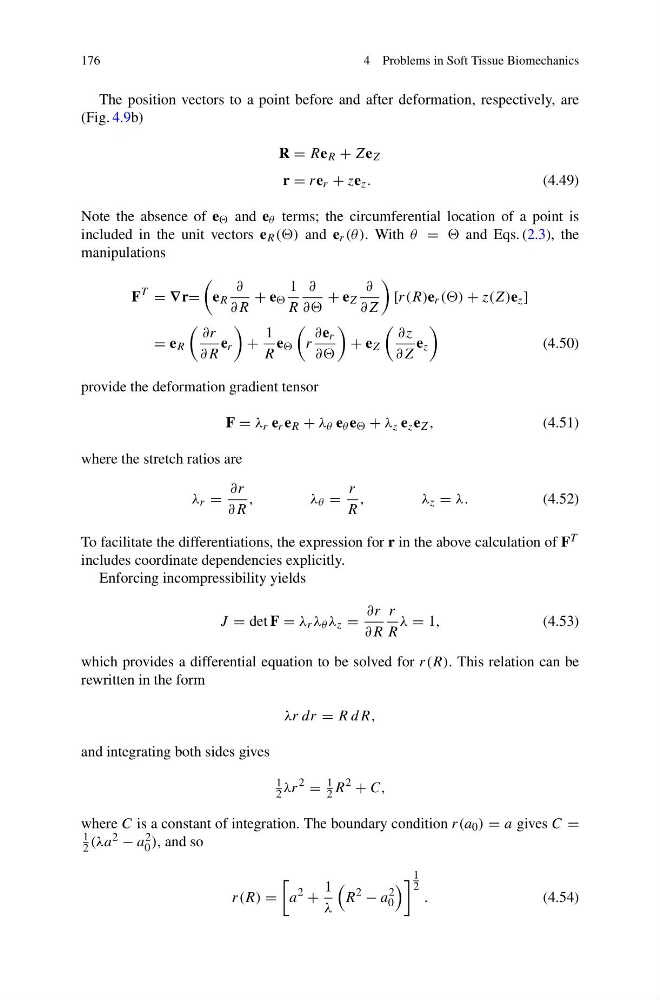
The position vectors to a point before and after deformation, respectively, are
(Fig. 4.9b)
R = Re R + Ze Z
r = re r + ze z .
(4.49)
Note the absence of e and e θ terms; the circumferential location of a point is
included in the unit vectors e R (() and e r (θ ). With θ = and Eqs. (2.3), the
manipulations
F
T
= ∇r=
e R
∂
∂R
+ e
1
R
∂
∂∂
+ e Z
∂
∂Z
[r(R)e r (() + z(Z)e z ]
= e R
∂r
∂R
e r
+
1
R
e
r
∂e r
∂∂
+ e Z
∂z
∂Z
e z
(4.50)
provide the deformation gradient tensor
F = λ r e r e R + λ θ e θ e + λ z e z e Z ,
(4.51)
where the stretch ratios are
λ r =
∂r
∂R
,
λ θ =
r
R
,
λ z = λ.
(4.52)
To facilitate the differentiations, the expression for r in the above calculation of F T
includes coordinate dependencies explicitly.
Enforcing incompressibility yields
J = det F = λ r λ θ λ z =
∂r
∂R
r
R
λ = 1,
(4.53)
which provides a differential equation to be solved for r(R). This relation can be
rewritten in the form
λr dr = R dR,
and integrating both sides gives
1
2 λr
2
=
1
2 R
2
+ C,
where C is a constant of integration. The boundary condition r(a 0 ) = a gives C =
1
2 (λa 2 − a 2
0 ), and so
r(R) =
a
2
+
1
λ
R
2
− a
2
0
1
2
.
(4.54)
4 Problems in Soft Tissue Biomechanics
The position vectors to a point before and after deformation, respectively, are
(Fig. 4.9b)
R = Re R + Ze Z
r = re r + ze z .
(4.49)
Note the absence of e and e θ terms; the circumferential location of a point is
included in the unit vectors e R (() and e r (θ ). With θ = and Eqs. (2.3), the
manipulations
F
T
= ∇r=
e R
∂
∂R
+ e
1
R
∂
∂∂
+ e Z
∂
∂Z
[r(R)e r (() + z(Z)e z ]
= e R
∂r
∂R
e r
+
1
R
e
r
∂e r
∂∂
+ e Z
∂z
∂Z
e z
(4.50)
provide the deformation gradient tensor
F = λ r e r e R + λ θ e θ e + λ z e z e Z ,
(4.51)
where the stretch ratios are
λ r =
∂r
∂R
,
λ θ =
r
R
,
λ z = λ.
(4.52)
To facilitate the differentiations, the expression for r in the above calculation of F T
includes coordinate dependencies explicitly.
Enforcing incompressibility yields
J = det F = λ r λ θ λ z =
∂r
∂R
r
R
λ = 1,
(4.53)
which provides a differential equation to be solved for r(R). This relation can be
rewritten in the form
λr dr = R dR,
and integrating both sides gives
1
2 λr
2
=
1
2 R
2
+ C,
where C is a constant of integration. The boundary condition r(a 0 ) = a gives C =
1
2 (λa 2 − a 2
0 ), and so
r(R) =
a
2
+
1
λ
R
2
− a
2
0
1
2
.
(4.54)