

4.3 Shear of a Block
169
which requires the term
F
−1
· F
−T
= F
−1
· (F
−1 )
T
=
⎡
⎣
1 + k 2 −k 0
−k 1 0
0
0 1
⎤
⎦ .
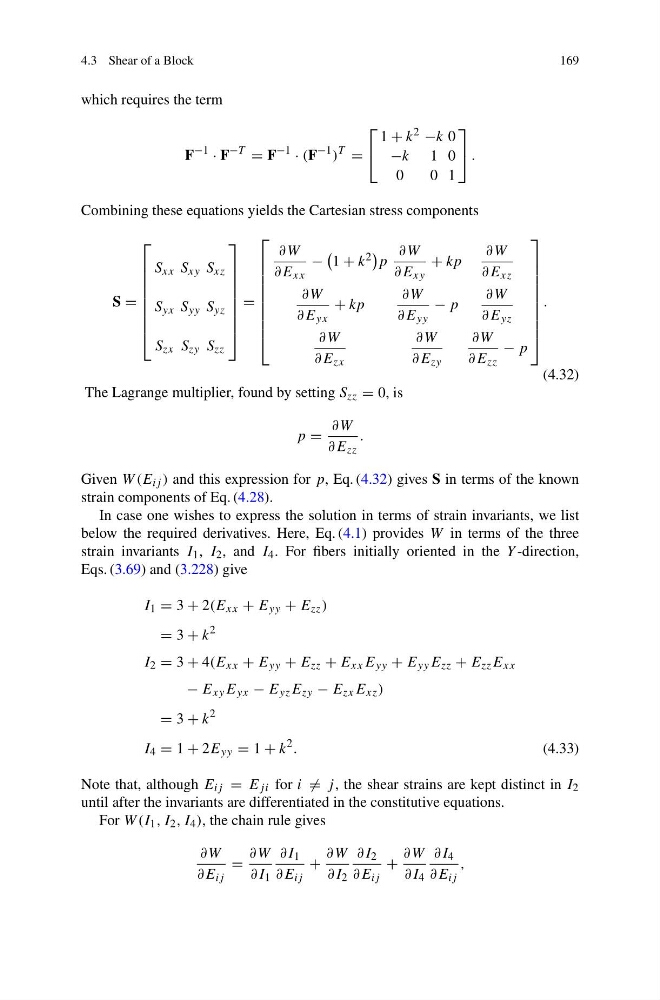
Combining these equations yields the Cartesian stress components
S =
⎡
⎢
⎢
⎢
⎢
⎢
⎢
⎢
⎣
S xx S xy S xz
S yx S yy S yz
S zx S zy S zz
⎤
⎥
⎥
⎥
⎥
⎥
⎥
⎥
⎦
=
⎡
⎢
⎢
⎢
⎢
⎢
⎢
⎢
⎢
⎣
∂W
∂E xx
−
1 + k 2
p
∂W
∂E xy
+ kp
∂W
∂E xz
∂W
∂E yx
+ kp
∂W
∂E yy
− p
∂W
∂E yz
∂W
∂E zx
∂W
∂E zy
∂W
∂E zz
− p
⎤
⎥
⎥
⎥
⎥
⎥
⎥
⎥
⎥
⎦
.
(4.32)
The Lagrange multiplier, found by setting S zz = 0, is
p =
∂W
∂E zz
.
Given W (E ij ) and this expression for p, Eq. (4.32) gives S in terms of the known
strain components of Eq. (4.28).
In case one wishes to express the solution in terms of strain invariants, we list
below the required derivatives. Here, Eq. (4.1) provides W in terms of the three
strain invariants I 1 , I 2 , and I 4 . For fibers initially oriented in the Y -direction,
Eqs. (3.69) and (3.228) give
I 1 = 3 + 2(E xx + E yy + E zz )
= 3 + k
2
I 2 = 3 + 4(E xx + E yy + E zz + E xx E yy + E yy E zz + E zz E xx
− E xy E yx − E yz E zy − E zx E xz )
= 3 + k
2
I 4 = 1 + 2E yy = 1 + k
2 .
(4.33)
Note that, although E ij = E ji for i = j , the shear strains are kept distinct in I 2
until after the invariants are differentiated in the constitutive equations.
For W (I 1 , I 2 , I 4 ), the chain rule gives
∂W
∂E ij
=
∂W
∂I 1
∂I 1
∂E ij
+
∂W
∂I 2
∂I 2
∂E ij
+
∂W
∂I 4
∂I 4
∂E ij
,
169
which requires the term
F
−1
· F
−T
= F
−1
· (F
−1 )
T
=
⎡
⎣
1 + k 2 −k 0
−k 1 0
0
0 1
⎤
⎦ .
Combining these equations yields the Cartesian stress components
S =
⎡
⎢
⎢
⎢
⎢
⎢
⎢
⎢
⎣
S xx S xy S xz
S yx S yy S yz
S zx S zy S zz
⎤
⎥
⎥
⎥
⎥
⎥
⎥
⎥
⎦
=
⎡
⎢
⎢
⎢
⎢
⎢
⎢
⎢
⎢
⎣
∂W
∂E xx
−
1 + k 2
p
∂W
∂E xy
+ kp
∂W
∂E xz
∂W
∂E yx
+ kp
∂W
∂E yy
− p
∂W
∂E yz
∂W
∂E zx
∂W
∂E zy
∂W
∂E zz
− p
⎤
⎥
⎥
⎥
⎥
⎥
⎥
⎥
⎥
⎦
.
(4.32)
The Lagrange multiplier, found by setting S zz = 0, is
p =
∂W
∂E zz
.
Given W (E ij ) and this expression for p, Eq. (4.32) gives S in terms of the known
strain components of Eq. (4.28).
In case one wishes to express the solution in terms of strain invariants, we list
below the required derivatives. Here, Eq. (4.1) provides W in terms of the three
strain invariants I 1 , I 2 , and I 4 . For fibers initially oriented in the Y -direction,
Eqs. (3.69) and (3.228) give
I 1 = 3 + 2(E xx + E yy + E zz )
= 3 + k
2
I 2 = 3 + 4(E xx + E yy + E zz + E xx E yy + E yy E zz + E zz E xx
− E xy E yx − E yz E zy − E zx E xz )
= 3 + k
2
I 4 = 1 + 2E yy = 1 + k
2 .
(4.33)
Note that, although E ij = E ji for i = j , the shear strains are kept distinct in I 2
until after the invariants are differentiated in the constitutive equations.
For W (I 1 , I 2 , I 4 ), the chain rule gives
∂W
∂E ij
=
∂W
∂I 1
∂I 1
∂E ij
+
∂W
∂I 2
∂I 2
∂E ij
+
∂W
∂I 4
∂I 4
∂E ij
,