

164
4 Problems in Soft Tissue Biomechanics
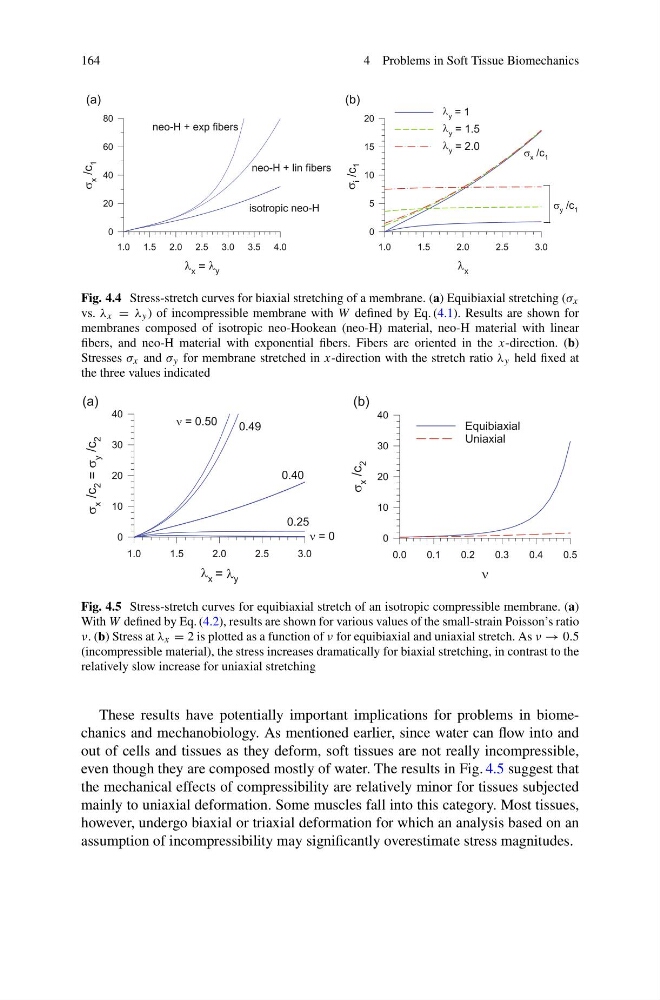
Fig. 4.4 Stress-stretch curves for biaxial stretching of a membrane. (a) Equibiaxial stretching (σ x
vs. λ x = λ y ) of incompressible membrane with W defined by Eq. (4.1). Results are shown for
membranes composed of isotropic neo-Hookean (neo-H) material, neo-H material with linear
fibers, and neo-H material with exponential fibers. Fibers are oriented in the x-direction. (b)
Stresses σ x and σ y for membrane stretched in x-direction with the stretch ratio λ y held fixed at
the three values indicated
Fig. 4.5 Stress-stretch curves for equibiaxial stretch of an isotropic compressible membrane. (a)
With W defined by Eq. (4.2), results are shown for various values of the small-strain Poisson’s ratio
ν. (b) Stress at λ x = 2 is plotted as a function of ν for equibiaxial and uniaxial stretch. As ν → 0.5
(incompressible material), the stress increases dramatically for biaxial stretching, in contrast to the
relatively slow increase for uniaxial stretching
These results have potentially important implications for problems in biomechanics and mechanobiology. As mentioned earlier, since water can flow into and
out of cells and tissues as they deform, soft tissues are not really incompressible,
even though they are composed mostly of water. The results in Fig. 4.5 suggest that
the mechanical effects of compressibility are relatively minor for tissues subjected
mainly to uniaxial deformation. Some muscles fall into this category. Most tissues,
however, undergo biaxial or triaxial deformation for which an analysis based on an
assumption of incompressibility may significantly overestimate stress magnitudes.
4 Problems in Soft Tissue Biomechanics
Fig. 4.4 Stress-stretch curves for biaxial stretching of a membrane. (a) Equibiaxial stretching (σ x
vs. λ x = λ y ) of incompressible membrane with W defined by Eq. (4.1). Results are shown for
membranes composed of isotropic neo-Hookean (neo-H) material, neo-H material with linear
fibers, and neo-H material with exponential fibers. Fibers are oriented in the x-direction. (b)
Stresses σ x and σ y for membrane stretched in x-direction with the stretch ratio λ y held fixed at
the three values indicated
Fig. 4.5 Stress-stretch curves for equibiaxial stretch of an isotropic compressible membrane. (a)
With W defined by Eq. (4.2), results are shown for various values of the small-strain Poisson’s ratio
ν. (b) Stress at λ x = 2 is plotted as a function of ν for equibiaxial and uniaxial stretch. As ν → 0.5
(incompressible material), the stress increases dramatically for biaxial stretching, in contrast to the
relatively slow increase for uniaxial stretching
These results have potentially important implications for problems in biomechanics and mechanobiology. As mentioned earlier, since water can flow into and
out of cells and tissues as they deform, soft tissues are not really incompressible,
even though they are composed mostly of water. The results in Fig. 4.5 suggest that
the mechanical effects of compressibility are relatively minor for tissues subjected
mainly to uniaxial deformation. Some muscles fall into this category. Most tissues,
however, undergo biaxial or triaxial deformation for which an analysis based on an
assumption of incompressibility may significantly overestimate stress magnitudes.