

160
4 Problems in Soft Tissue Biomechanics
Since the transverse stretch ratios are equal, this relation gives
λ y = λ z = λ
−ν
x ,
(4.16)
which also satisfies P y = 0, and Eq. (4.14) 1 becomes
P x = μ
λ
−1+2ν
x
− λ
−3
x
.
(4.17)
Finally, with Eq. (4.16) giving J = λ x λ y λ z = λ 1−2ν
x
, Eq. (3.248) provides the
Cauchy stress
σ x =
λ x
J
P x = μλ
2ν
x P x .
(4.18)
4.1.3 Illustrative Results
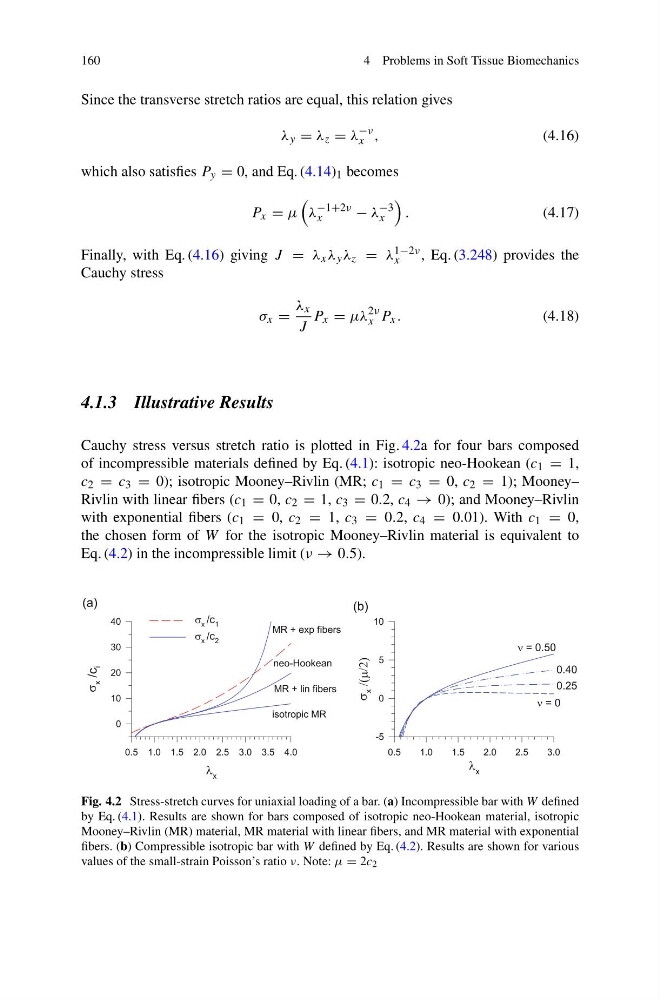
Cauchy stress versus stretch ratio is plotted in Fig. 4.2a for four bars composed
of incompressible materials defined by Eq. (4.1): isotropic neo-Hookean (c 1 = 1,
c 2 = c 3 = 0); isotropic Mooney–Rivlin (MR; c 1 = c 3 = 0, c 2 = 1); Mooney–
Rivlin with linear fibers (c 1 = 0, c 2 = 1, c 3 = 0.2, c 4 → 0); and Mooney–Rivlin
with exponential fibers (c 1 = 0, c 2 = 1, c 3 = 0.2, c 4 = 0.01). With c 1 = 0,
the chosen form of W for the isotropic Mooney–Rivlin material is equivalent to
Eq. (4.2) in the incompressible limit (ν → 0.5).
Fig. 4.2 Stress-stretch curves for uniaxial loading of a bar. (a) Incompressible bar with W defined
by Eq. (4.1). Results are shown for bars composed of isotropic neo-Hookean material, isotropic
Mooney–Rivlin (MR) material, MR material with linear fibers, and MR material with exponential
fibers. (b) Compressible isotropic bar with W defined by Eq. (4.2). Results are shown for various
values of the small-strain Poisson’s ratio ν. Note: μ = 2c 2
4 Problems in Soft Tissue Biomechanics
Since the transverse stretch ratios are equal, this relation gives
λ y = λ z = λ
−ν
x ,
(4.16)
which also satisfies P y = 0, and Eq. (4.14) 1 becomes
P x = μ
λ
−1+2ν
x
− λ
−3
x
.
(4.17)
Finally, with Eq. (4.16) giving J = λ x λ y λ z = λ 1−2ν
x
, Eq. (3.248) provides the
Cauchy stress
σ x =
λ x
J
P x = μλ
2ν
x P x .
(4.18)
4.1.3 Illustrative Results
Cauchy stress versus stretch ratio is plotted in Fig. 4.2a for four bars composed
of incompressible materials defined by Eq. (4.1): isotropic neo-Hookean (c 1 = 1,
c 2 = c 3 = 0); isotropic Mooney–Rivlin (MR; c 1 = c 3 = 0, c 2 = 1); Mooney–
Rivlin with linear fibers (c 1 = 0, c 2 = 1, c 3 = 0.2, c 4 → 0); and Mooney–Rivlin
with exponential fibers (c 1 = 0, c 2 = 1, c 3 = 0.2, c 4 = 0.01). With c 1 = 0,
the chosen form of W for the isotropic Mooney–Rivlin material is equivalent to
Eq. (4.2) in the incompressible limit (ν → 0.5).
Fig. 4.2 Stress-stretch curves for uniaxial loading of a bar. (a) Incompressible bar with W defined
by Eq. (4.1). Results are shown for bars composed of isotropic neo-Hookean material, isotropic
Mooney–Rivlin (MR) material, MR material with linear fibers, and MR material with exponential
fibers. (b) Compressible isotropic bar with W defined by Eq. (4.2). Results are shown for various
values of the small-strain Poisson’s ratio ν. Note: μ = 2c 2