

156
4 Problems in Soft Tissue Biomechanics
Please Note For convenience, unless stated otherwise, the summation convention
is suspended throughout the remainder of this book.
4.1 Uniaxial Extension of a Bar
Certain biological structures can be treated as bars containing longitudinally aligned
fibers. Examples include skeletal muscle, papillary muscles (located in the heart),
tendons, and stress fibers. Sometimes bar-shaped samples of skin or arteries
are loaded uniaxially in experiments used to determine stress-strain relations.
Biaxial tests are more appropriate for these tissues, however, because they undergo
multiaxial loading in vivo.
4.1.1 Problem Statement
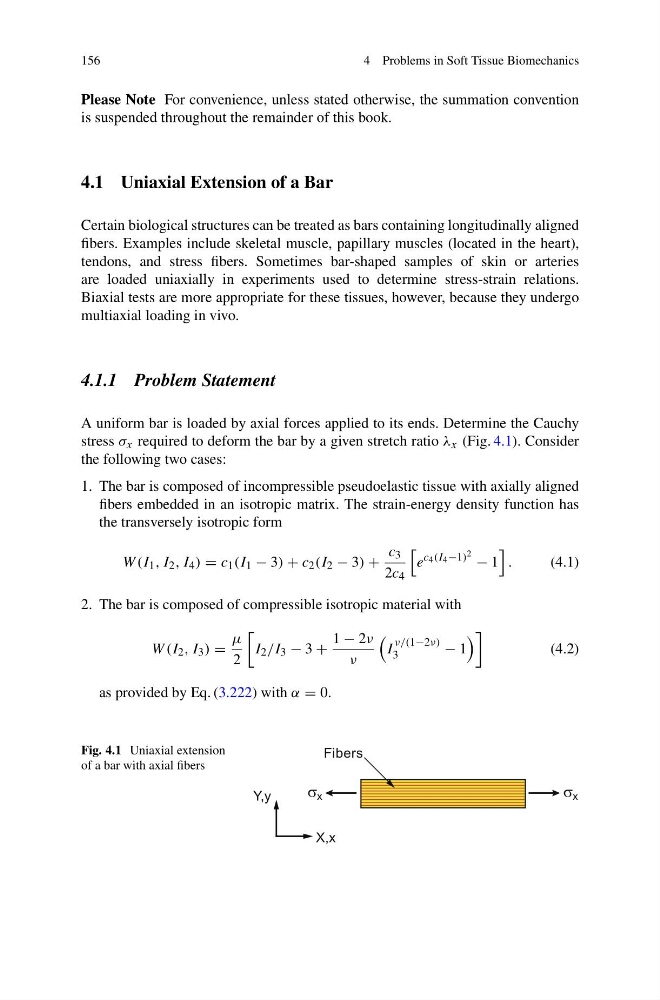
A uniform bar is loaded by axial forces applied to its ends. Determine the Cauchy
stress σ x required to deform the bar by a given stretch ratio λ x (Fig. 4.1). Consider
the following two cases:
1. The bar is composed of incompressible pseudoelastic tissue with axially aligned
fibers embedded in an isotropic matrix. The strain-energy density function has
the transversely isotropic form
W (I 1 , I 2 , I 4 ) = c 1 (I 1 − 3) + c 2 (I 2 − 3) +
c 3
2c 4
e
c 4 (I 4 −1) 2 − 1
.
(4.1)
2. The bar is composed of compressible isotropic material with
W (I 2 , I 3 ) =
μ
2
I 2 /I 3 − 3 +
1 − 2ν
ν
I
ν/(1−2ν)
3
− 1
(4.2)
as provided by Eq. (3.222) with α = 0.
Fig. 4.1 Uniaxial extension
of a bar with axial fibers
Fibers
X,x
Y,y
σ x
σ x
4 Problems in Soft Tissue Biomechanics
Please Note For convenience, unless stated otherwise, the summation convention
is suspended throughout the remainder of this book.
4.1 Uniaxial Extension of a Bar
Certain biological structures can be treated as bars containing longitudinally aligned
fibers. Examples include skeletal muscle, papillary muscles (located in the heart),
tendons, and stress fibers. Sometimes bar-shaped samples of skin or arteries
are loaded uniaxially in experiments used to determine stress-strain relations.
Biaxial tests are more appropriate for these tissues, however, because they undergo
multiaxial loading in vivo.
4.1.1 Problem Statement
A uniform bar is loaded by axial forces applied to its ends. Determine the Cauchy
stress σ x required to deform the bar by a given stretch ratio λ x (Fig. 4.1). Consider
the following two cases:
1. The bar is composed of incompressible pseudoelastic tissue with axially aligned
fibers embedded in an isotropic matrix. The strain-energy density function has
the transversely isotropic form
W (I 1 , I 2 , I 4 ) = c 1 (I 1 − 3) + c 2 (I 2 − 3) +
c 3
2c 4
e
c 4 (I 4 −1) 2 − 1
.
(4.1)
2. The bar is composed of compressible isotropic material with
W (I 2 , I 3 ) =
μ
2
I 2 /I 3 − 3 +
1 − 2ν
ν
I
ν/(1−2ν)
3
− 1
(4.2)
as provided by Eq. (3.222) with α = 0.
Fig. 4.1 Uniaxial extension
of a bar with axial fibers
Fibers
X,x
Y,y
σ x
σ x