

3.7 Boundary Value Problems
151
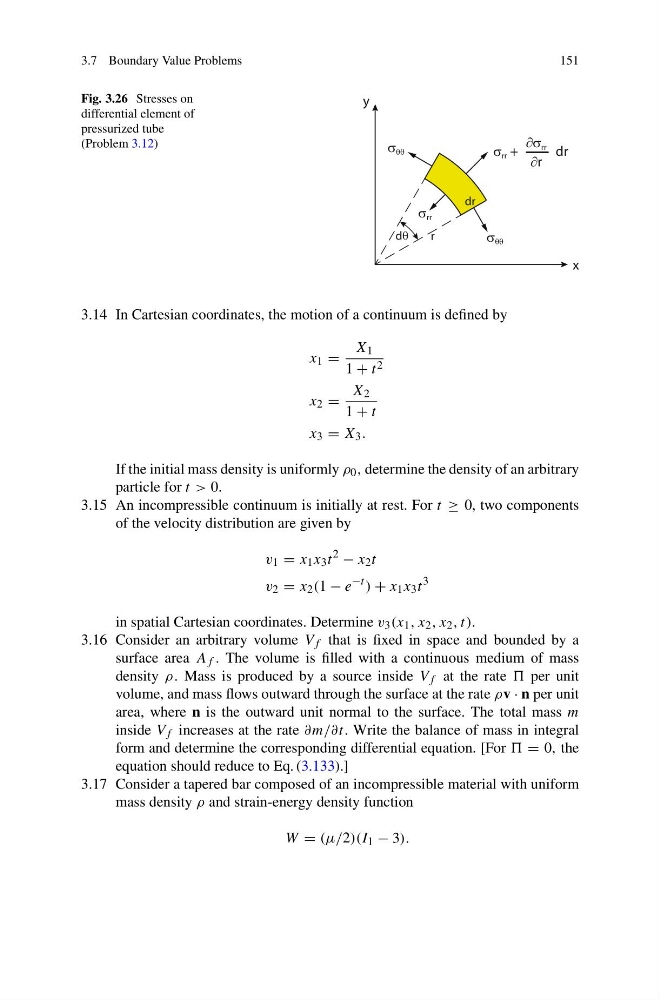
Fig. 3.26 Stresses on
differential element of
pressurized tube
(Problem 3.12)
dr
dT
V TT
y
x
V rr +
wV rr
wr
dr
V rr
V TT
r
3.14 In Cartesian coordinates, the motion of a continuum is defined by
x 1 =
X 1
1 + t 2
x 2 =
X 2
1 + t
x 3 = X 3 .
If the initial mass density is uniformly ρ 0 , determine the density of an arbitrary
particle for t > 0.
3.15 An incompressible continuum is initially at rest. For t ≥ 0, two components
of the velocity distribution are given by
v 1 = x 1 x 3 t
2
− x 2 t
v 2 = x 2 (1 − e
−t ) + x 1 x 3 t
3
in spatial Cartesian coordinates. Determine v 3 (x 1 , x 2 , x 2 , t).
3.16 Consider an arbitrary volume V f that is fixed in space and bounded by a
surface area A f . The volume is filled with a continuous medium of mass
density ρ. Mass is produced by a source inside V f at the rate per unit
volume, and mass flows outward through the surface at the rate ρv · n per unit
area, where n is the outward unit normal to the surface. The total mass m
inside V f increases at the rate ∂m/∂t. Write the balance of mass in integral
form and determine the corresponding differential equation. [For = 0, the
equation should reduce to Eq. (3.133).]
3.17 Consider a tapered bar composed of an incompressible material with uniform
mass density ρ and strain-energy density function
W = (μ/2)(I 1 − 3).
151
Fig. 3.26 Stresses on
differential element of
pressurized tube
(Problem 3.12)
dr
dT
V TT
y
x
V rr +
wV rr
wr
dr
V rr
V TT
r
3.14 In Cartesian coordinates, the motion of a continuum is defined by
x 1 =
X 1
1 + t 2
x 2 =
X 2
1 + t
x 3 = X 3 .
If the initial mass density is uniformly ρ 0 , determine the density of an arbitrary
particle for t > 0.
3.15 An incompressible continuum is initially at rest. For t ≥ 0, two components
of the velocity distribution are given by
v 1 = x 1 x 3 t
2
− x 2 t
v 2 = x 2 (1 − e
−t ) + x 1 x 3 t
3
in spatial Cartesian coordinates. Determine v 3 (x 1 , x 2 , x 2 , t).
3.16 Consider an arbitrary volume V f that is fixed in space and bounded by a
surface area A f . The volume is filled with a continuous medium of mass
density ρ. Mass is produced by a source inside V f at the rate per unit
volume, and mass flows outward through the surface at the rate ρv · n per unit
area, where n is the outward unit normal to the surface. The total mass m
inside V f increases at the rate ∂m/∂t. Write the balance of mass in integral
form and determine the corresponding differential equation. [For = 0, the
equation should reduce to Eq. (3.133).]
3.17 Consider a tapered bar composed of an incompressible material with uniform
mass density ρ and strain-energy density function
W = (μ/2)(I 1 − 3).