

3.5 Balance Laws
123
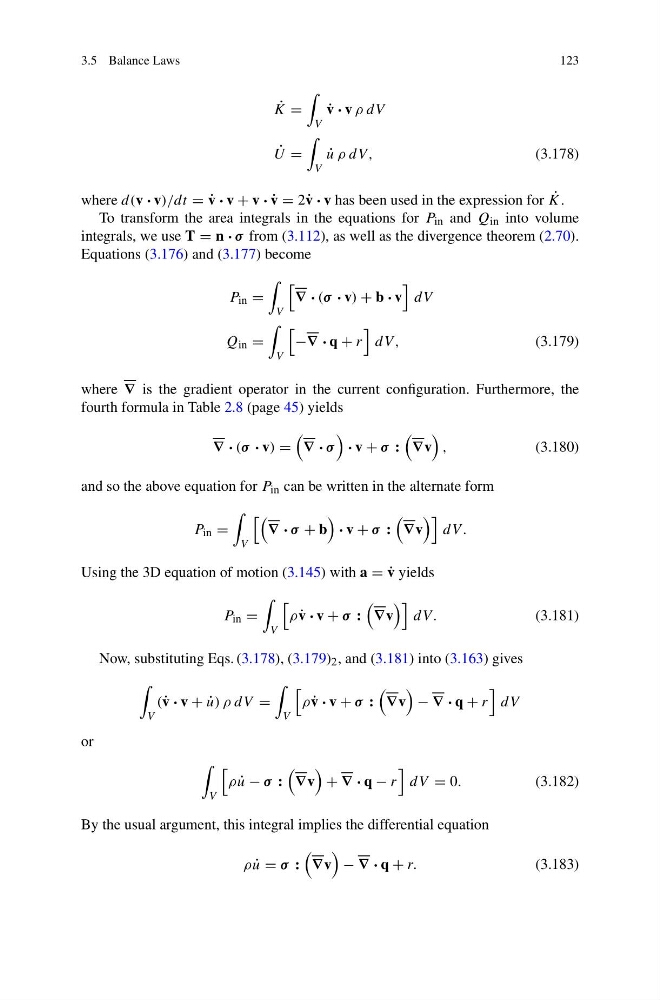
˙
K =
V
˙
v · v ρ dV
˙
U =
V
˙
u ρ dV ,
(3.178)
where d(v · v)/dt = ˙
v · v + v · ˙
v = 2˙ v · v has been used in the expression for ˙
K.
To transform the area integrals in the equations for P in and Q in into volume
integrals, we use T = n · σ from (3.112), as well as the divergence theorem (2.70).
Equations (3.176) and (3.177) become
P in =
V
∇ · (σ · v) + b · v
dV
Q in =
V
−∇ · q + r
dV ,
(3.179)
where ∇ is the gradient operator in the current configuration. Furthermore, the
fourth formula in Table 2.8 (page 45) yields
∇ · (σ · v) =
∇ · σ
· v + σ :
∇v
,
(3.180)
and so the above equation for P in can be written in the alternate form
P in =
V
∇ · σ + b
· v + σ :
∇v
dV .
Using the 3D equation of motion (3.145) with a = ˙
v yields
P in =
V
ρ ˙
v · v + σ :
∇v
dV .
(3.181)
Now, substituting Eqs. (3.178), (3.179) 2 , and (3.181) into (3.163) gives
V
(˙ v · v + ˙
u) ρ dV =
V
ρ ˙
v · v + σ :
∇v
− ∇ · q + r
dV
or
V
ρ ˙
u − σ :
∇v
+ ∇ · q − r
dV = 0.
(3.182)
By the usual argument, this integral implies the differential equation
ρ ˙
u = σ :
∇v
− ∇ · q + r.
(3.183)
123
˙
K =
V
˙
v · v ρ dV
˙
U =
V
˙
u ρ dV ,
(3.178)
where d(v · v)/dt = ˙
v · v + v · ˙
v = 2˙ v · v has been used in the expression for ˙
K.
To transform the area integrals in the equations for P in and Q in into volume
integrals, we use T = n · σ from (3.112), as well as the divergence theorem (2.70).
Equations (3.176) and (3.177) become
P in =
V
∇ · (σ · v) + b · v
dV
Q in =
V
−∇ · q + r
dV ,
(3.179)
where ∇ is the gradient operator in the current configuration. Furthermore, the
fourth formula in Table 2.8 (page 45) yields
∇ · (σ · v) =
∇ · σ
· v + σ :
∇v
,
(3.180)
and so the above equation for P in can be written in the alternate form
P in =
V
∇ · σ + b
· v + σ :
∇v
dV .
Using the 3D equation of motion (3.145) with a = ˙
v yields
P in =
V
ρ ˙
v · v + σ :
∇v
dV .
(3.181)
Now, substituting Eqs. (3.178), (3.179) 2 , and (3.181) into (3.163) gives
V
(˙ v · v + ˙
u) ρ dV =
V
ρ ˙
v · v + σ :
∇v
− ∇ · q + r
dV
or
V
ρ ˙
u − σ :
∇v
+ ∇ · q − r
dV = 0.
(3.182)
By the usual argument, this integral implies the differential equation
ρ ˙
u = σ :
∇v
− ∇ · q + r.
(3.183)