

116
3 Continuum Mechanics and Nonlinear Elasticity
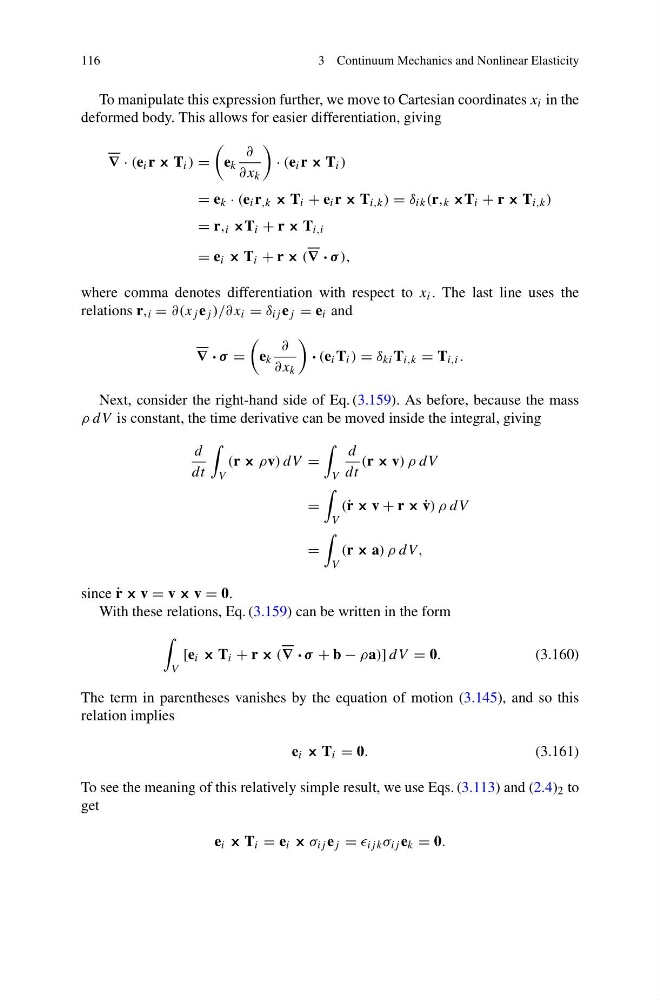
To manipulate this expression further, we move to Cartesian coordinates x i in the
deformed body. This allows for easier differentiation, giving
∇ · (e i r × T i ) =
e k
∂
∂x k
· (e i r × T i )
= e k · (e i r ,k × T i + e i r × T i,k ) = δ ik (r, k ×T i + r × T i,k )
= r, i ×T i + r × T i,i
= e i × T i + r × (∇ · σ ),
where comma denotes differentiation with respect to x i . The last line uses the
relations r, i = ∂(x j e j )/∂x i = δ ij e j = e i and
∇ · σ =
e k
∂
∂x k
· (e i T i ) = δ ki T i,k = T i,i .
Next, consider the right-hand side of Eq. (3.159). As before, because the mass
ρ dV is constant, the time derivative can be moved inside the integral, giving
d
dt
V
(r × ρv) dV =
V
d
dt
(r × v) ρ dV
=
V
(˙ r × v + r × ˙
v) ρ dV
=
V
(r × a) ρ dV ,
since ˙
r × v = v × v = 0.
With these relations, Eq. (3.159) can be written in the form
V
[e i × T i + r × (∇ · σ + b − ρa)] dV = 0.
(3.160)
The term in parentheses vanishes by the equation of motion (3.145), and so this
relation implies
e i × T i = 0.
(3.161)
To see the meaning of this relatively simple result, we use Eqs. (3.113) and (2.4) 2 to
get
e i × T i = e i × σ ij e j = ij k σ ij e k = 0.
3 Continuum Mechanics and Nonlinear Elasticity
To manipulate this expression further, we move to Cartesian coordinates x i in the
deformed body. This allows for easier differentiation, giving
∇ · (e i r × T i ) =
e k
∂
∂x k
· (e i r × T i )
= e k · (e i r ,k × T i + e i r × T i,k ) = δ ik (r, k ×T i + r × T i,k )
= r, i ×T i + r × T i,i
= e i × T i + r × (∇ · σ ),
where comma denotes differentiation with respect to x i . The last line uses the
relations r, i = ∂(x j e j )/∂x i = δ ij e j = e i and
∇ · σ =
e k
∂
∂x k
· (e i T i ) = δ ki T i,k = T i,i .
Next, consider the right-hand side of Eq. (3.159). As before, because the mass
ρ dV is constant, the time derivative can be moved inside the integral, giving
d
dt
V
(r × ρv) dV =
V
d
dt
(r × v) ρ dV
=
V
(˙ r × v + r × ˙
v) ρ dV
=
V
(r × a) ρ dV ,
since ˙
r × v = v × v = 0.
With these relations, Eq. (3.159) can be written in the form
V
[e i × T i + r × (∇ · σ + b − ρa)] dV = 0.
(3.160)
The term in parentheses vanishes by the equation of motion (3.145), and so this
relation implies
e i × T i = 0.
(3.161)
To see the meaning of this relatively simple result, we use Eqs. (3.113) and (2.4) 2 to
get
e i × T i = e i × σ ij e j = ij k σ ij e k = 0.