

88
3 Continuum Mechanics and Nonlinear Elasticity
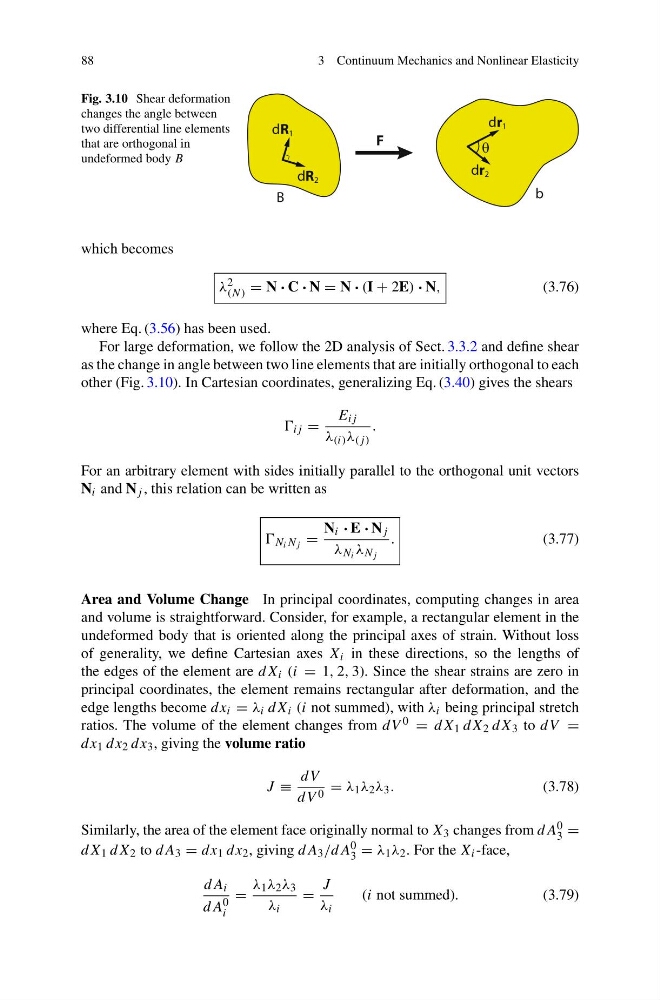
Fig. 3.10 Shear deformation
changes the angle between
two differential line elements
that are orthogonal in
undeformed body B
F
dR 1
B
b
dR 2
dr 1
dr 2
T
which becomes
λ 2
(N ) = N · C · N = N · (I + 2E) · N,
(3.76)
where Eq. (3.56) has been used.
For large deformation, we follow the 2D analysis of Sect. 3.3.2 and define shear
as the change in angle between two line elements that are initially orthogonal to each
other (Fig. 3.10). In Cartesian coordinates, generalizing Eq. (3.40) gives the shears
ij =
E ij
λ (i) λ (j )
.
For an arbitrary element with sides initially parallel to the orthogonal unit vectors
N i and N j , this relation can be written as
N i N j =
N i · E · N j
λ N i λ N j
.
(3.77)
Area and Volume Change In principal coordinates, computing changes in area
and volume is straightforward. Consider, for example, a rectangular element in the
undeformed body that is oriented along the principal axes of strain. Without loss
of generality, we define Cartesian axes X i in these directions, so the lengths of
the edges of the element are dX i (i = 1, 2, 3). Since the shear strains are zero in
principal coordinates, the element remains rectangular after deformation, and the
edge lengths become dx i = λ i dX i (i not summed), with λ i being principal stretch
ratios. The volume of the element changes from dV 0 = dX 1 dX 2 dX 3 to dV =
dx 1 dx 2 dx 3 , giving the volume ratio
J ≡
dV
dV 0 = λ 1 λ 2 λ 3 .
(3.78)
Similarly, the area of the element face originally normal to X 3 changes from dA 0
3 =
dX 1 dX 2 to dA 3 = dx 1 dx 2 , giving dA 3 /dA 0
3 = λ 1 λ 2 . For the X i -face,
dA i
dA 0
i
=
λ 1 λ 2 λ 3
λ i
=
J
λ i
(i not summed).
(3.79)
3 Continuum Mechanics and Nonlinear Elasticity
Fig. 3.10 Shear deformation
changes the angle between
two differential line elements
that are orthogonal in
undeformed body B
F
dR 1
B
b
dR 2
dr 1
dr 2
T
which becomes
λ 2
(N ) = N · C · N = N · (I + 2E) · N,
(3.76)
where Eq. (3.56) has been used.
For large deformation, we follow the 2D analysis of Sect. 3.3.2 and define shear
as the change in angle between two line elements that are initially orthogonal to each
other (Fig. 3.10). In Cartesian coordinates, generalizing Eq. (3.40) gives the shears
ij =
E ij
λ (i) λ (j )
.
For an arbitrary element with sides initially parallel to the orthogonal unit vectors
N i and N j , this relation can be written as
N i N j =
N i · E · N j
λ N i λ N j
.
(3.77)
Area and Volume Change In principal coordinates, computing changes in area
and volume is straightforward. Consider, for example, a rectangular element in the
undeformed body that is oriented along the principal axes of strain. Without loss
of generality, we define Cartesian axes X i in these directions, so the lengths of
the edges of the element are dX i (i = 1, 2, 3). Since the shear strains are zero in
principal coordinates, the element remains rectangular after deformation, and the
edge lengths become dx i = λ i dX i (i not summed), with λ i being principal stretch
ratios. The volume of the element changes from dV 0 = dX 1 dX 2 dX 3 to dV =
dx 1 dx 2 dx 3 , giving the volume ratio
J ≡
dV
dV 0 = λ 1 λ 2 λ 3 .
(3.78)
Similarly, the area of the element face originally normal to X 3 changes from dA 0
3 =
dX 1 dX 2 to dA 3 = dx 1 dx 2 , giving dA 3 /dA 0
3 = λ 1 λ 2 . For the X i -face,
dA i
dA 0
i
=
λ 1 λ 2 λ 3
λ i
=
J
λ i
(i not summed).
(3.79)