

86
6 Cooperative Active-Sites Mechanism
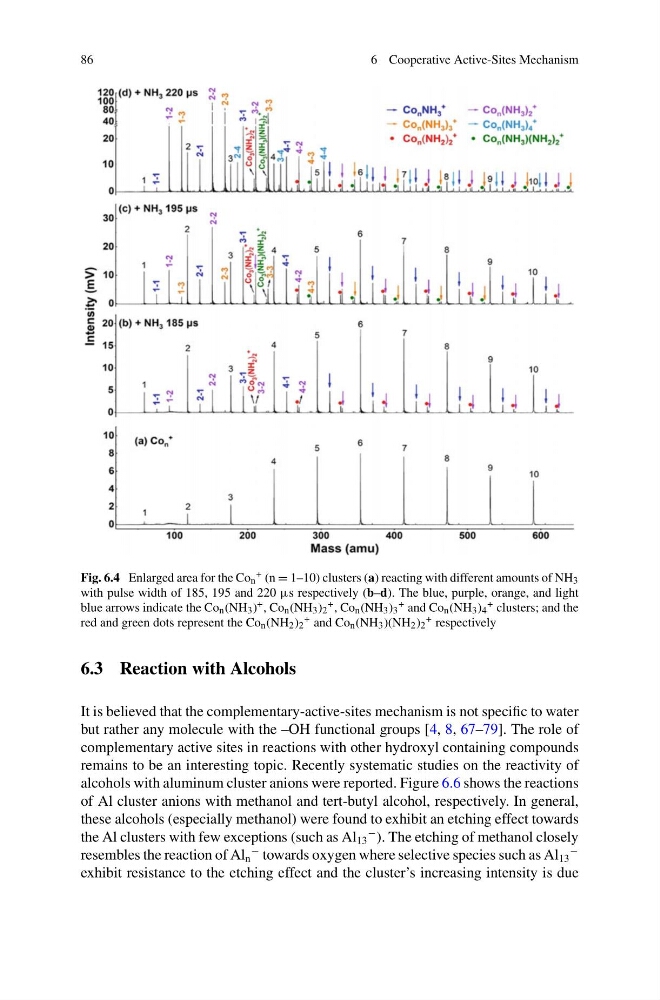
Fig. 6.4 Enlarged area for the Co n
+ (n = 1–10) clusters (a) reacting with different amounts of NH 3
with pulse width of 185, 195 and 220 µs respectively (b–d). The blue, purple, orange, and light
blue arrows indicate the Co n (NH 3 ) + , Co n (NH 3 ) 2
+ , Co n (NH 3 ) 3
+ and Co n (NH 3 ) 4
+ clusters; and the
red and green dots represent the Co n (NH 2 ) 2
+ and Co n (NH 3 )(NH 2 ) 2
+ respectively
6.3 Reaction with Alcohols
It is believed that the complementary-active-sites mechanism is not specific to water
but rather any molecule with the –OH functional groups [4, 8, 67–79]. The role of
complementary active sites in reactions with other hydroxyl containing compounds
remains to be an interesting topic. Recently systematic studies on the reactivity of
alcohols with aluminum cluster anions were reported. Figure 6.6 shows the reactions
of Al cluster anions with methanol and tert-butyl alcohol, respectively. In general,
these alcohols (especially methanol) were found to exhibit an etching effect towards
the Al clusters with few exceptions (such as Al 13
− ). The etching of methanol closely
resembles the reaction of Al n
− towards oxygen where selective species such as Al 13
−
exhibit resistance to the etching effect and the cluster’s increasing intensity is due
6 Cooperative Active-Sites Mechanism
Fig. 6.4 Enlarged area for the Co n
+ (n = 1–10) clusters (a) reacting with different amounts of NH 3
with pulse width of 185, 195 and 220 µs respectively (b–d). The blue, purple, orange, and light
blue arrows indicate the Co n (NH 3 ) + , Co n (NH 3 ) 2
+ , Co n (NH 3 ) 3
+ and Co n (NH 3 ) 4
+ clusters; and the
red and green dots represent the Co n (NH 2 ) 2
+ and Co n (NH 3 )(NH 2 ) 2
+ respectively
6.3 Reaction with Alcohols
It is believed that the complementary-active-sites mechanism is not specific to water
but rather any molecule with the –OH functional groups [4, 8, 67–79]. The role of
complementary active sites in reactions with other hydroxyl containing compounds
remains to be an interesting topic. Recently systematic studies on the reactivity of
alcohols with aluminum cluster anions were reported. Figure 6.6 shows the reactions
of Al cluster anions with methanol and tert-butyl alcohol, respectively. In general,
these alcohols (especially methanol) were found to exhibit an etching effect towards
the Al clusters with few exceptions (such as Al 13
− ). The etching of methanol closely
resembles the reaction of Al n
− towards oxygen where selective species such as Al 13
−
exhibit resistance to the etching effect and the cluster’s increasing intensity is due