

72
5 The Reactivity with Hydrogen and Nitrogen
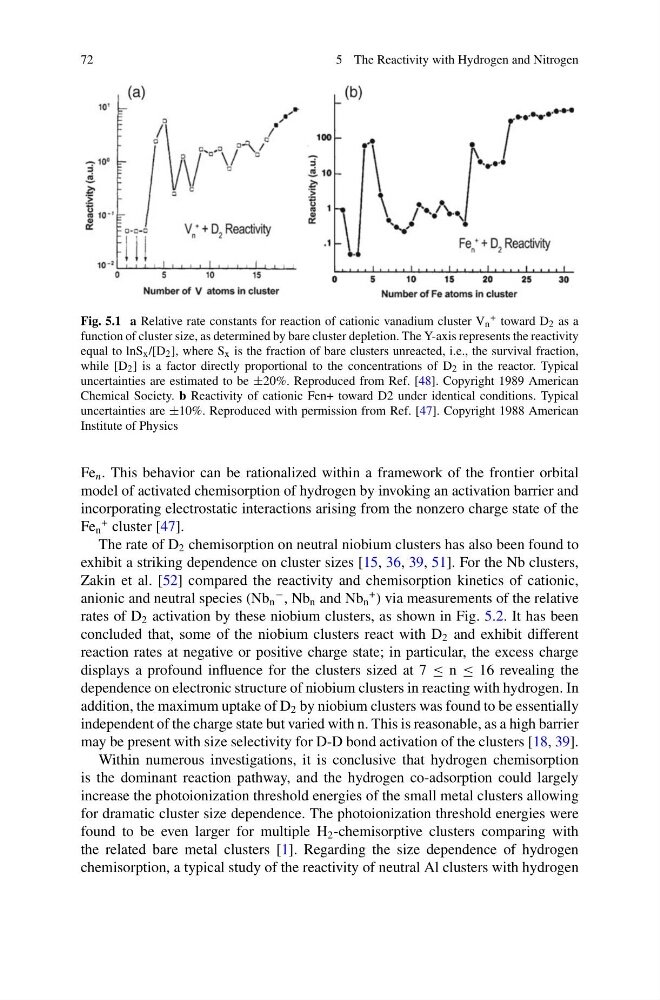
Fig. 5.1 a Relative rate constants for reaction of cationic vanadium cluster V n
+ toward D 2 as a
function of cluster size, as determined by bare cluster depletion. The Y-axis represents the reactivity
equal to lnS x /[D 2 ], where S x is the fraction of bare clusters unreacted, i.e., the survival fraction,
while [D 2 ] is a factor directly proportional to the concentrations of D 2 in the reactor. Typical
uncertainties are estimated to be ±20%. Reproduced from Ref. [48]. Copyright 1989 American
Chemical Society. b Reactivity of cationic Fen+ toward D2 under identical conditions. Typical
uncertainties are ±10%. Reproduced with permission from Ref. [47]. Copyright 1988 American
Institute of Physics
Fe n . This behavior can be rationalized within a framework of the frontier orbital
model of activated chemisorption of hydrogen by invoking an activation barrier and
incorporating electrostatic interactions arising from the nonzero charge state of the
Fe n
+ cluster [47].
The rate of D 2 chemisorption on neutral niobium clusters has also been found to
exhibit a striking dependence on cluster sizes [15, 36, 39, 51]. For the Nb clusters,
Zakin et al. [52] compared the reactivity and chemisorption kinetics of cationic,
anionic and neutral species (Nb n
− , Nb n and Nb n
+ ) via measurements of the relative
rates of D 2 activation by these niobium clusters, as shown in Fig. 5.2. It has been
concluded that, some of the niobium clusters react with D 2 and exhibit different
reaction rates at negative or positive charge state; in particular, the excess charge
displays a profound influence for the clusters sized at 7 ≤ n ≤ 16 revealing the
dependence on electronic structure of niobium clusters in reacting with hydrogen. In
addition, the maximum uptake of D 2 by niobium clusters was found to be essentially
independent of the charge state but varied with n. This is reasonable, as a high barrier
may be present with size selectivity for D-D bond activation of the clusters [18, 39].
Within numerous investigations, it is conclusive that hydrogen chemisorption
is the dominant reaction pathway, and the hydrogen co-adsorption could largely
increase the photoionization threshold energies of the small metal clusters allowing
for dramatic cluster size dependence. The photoionization threshold energies were
found to be even larger for multiple H 2 -chemisorptive clusters comparing with
the related bare metal clusters [1]. Regarding the size dependence of hydrogen
chemisorption, a typical study of the reactivity of neutral Al clusters with hydrogen
5 The Reactivity with Hydrogen and Nitrogen
Fig. 5.1 a Relative rate constants for reaction of cationic vanadium cluster V n
+ toward D 2 as a
function of cluster size, as determined by bare cluster depletion. The Y-axis represents the reactivity
equal to lnS x /[D 2 ], where S x is the fraction of bare clusters unreacted, i.e., the survival fraction,
while [D 2 ] is a factor directly proportional to the concentrations of D 2 in the reactor. Typical
uncertainties are estimated to be ±20%. Reproduced from Ref. [48]. Copyright 1989 American
Chemical Society. b Reactivity of cationic Fen+ toward D2 under identical conditions. Typical
uncertainties are ±10%. Reproduced with permission from Ref. [47]. Copyright 1988 American
Institute of Physics
Fe n . This behavior can be rationalized within a framework of the frontier orbital
model of activated chemisorption of hydrogen by invoking an activation barrier and
incorporating electrostatic interactions arising from the nonzero charge state of the
Fe n
+ cluster [47].
The rate of D 2 chemisorption on neutral niobium clusters has also been found to
exhibit a striking dependence on cluster sizes [15, 36, 39, 51]. For the Nb clusters,
Zakin et al. [52] compared the reactivity and chemisorption kinetics of cationic,
anionic and neutral species (Nb n
− , Nb n and Nb n
+ ) via measurements of the relative
rates of D 2 activation by these niobium clusters, as shown in Fig. 5.2. It has been
concluded that, some of the niobium clusters react with D 2 and exhibit different
reaction rates at negative or positive charge state; in particular, the excess charge
displays a profound influence for the clusters sized at 7 ≤ n ≤ 16 revealing the
dependence on electronic structure of niobium clusters in reacting with hydrogen. In
addition, the maximum uptake of D 2 by niobium clusters was found to be essentially
independent of the charge state but varied with n. This is reasonable, as a high barrier
may be present with size selectivity for D-D bond activation of the clusters [18, 39].
Within numerous investigations, it is conclusive that hydrogen chemisorption
is the dominant reaction pathway, and the hydrogen co-adsorption could largely
increase the photoionization threshold energies of the small metal clusters allowing
for dramatic cluster size dependence. The photoionization threshold energies were
found to be even larger for multiple H 2 -chemisorptive clusters comparing with
the related bare metal clusters [1]. Regarding the size dependence of hydrogen
chemisorption, a typical study of the reactivity of neutral Al clusters with hydrogen