

4.4 Ionic Crystal Growth of Cu n Cl n+1
−
65
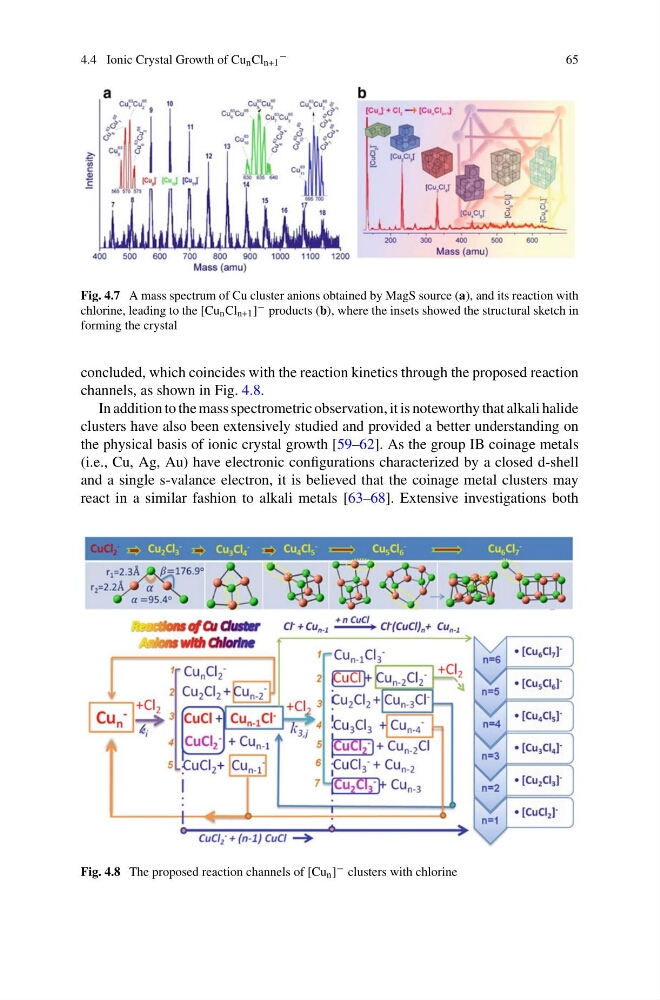
Fig. 4.7 A mass spectrum of Cu cluster anions obtained by MagS source (a), and its reaction with
chlorine, leading to the [Cu n Cl n+1 ] − products (b), where the insets showed the structural sketch in
forming the crystal
concluded, which coincides with the reaction kinetics through the proposed reaction
channels, as shown in Fig. 4.8.
In addition to the mass spectrometric observation, it is noteworthy that alkali halide
clusters have also been extensively studied and provided a better understanding on
the physical basis of ionic crystal growth [59–62]. As the group IB coinage metals
(i.e., Cu, Ag, Au) have electronic configurations characterized by a closed d-shell
and a single s-valance electron, it is believed that the coinage metal clusters may
react in a similar fashion to alkali metals [63–68]. Extensive investigations both
Fig. 4.8 The proposed reaction channels of [Cu n ] − clusters with chlorine
−
65
Fig. 4.7 A mass spectrum of Cu cluster anions obtained by MagS source (a), and its reaction with
chlorine, leading to the [Cu n Cl n+1 ] − products (b), where the insets showed the structural sketch in
forming the crystal
concluded, which coincides with the reaction kinetics through the proposed reaction
channels, as shown in Fig. 4.8.
In addition to the mass spectrometric observation, it is noteworthy that alkali halide
clusters have also been extensively studied and provided a better understanding on
the physical basis of ionic crystal growth [59–62]. As the group IB coinage metals
(i.e., Cu, Ag, Au) have electronic configurations characterized by a closed d-shell
and a single s-valance electron, it is believed that the coinage metal clusters may
react in a similar fashion to alkali metals [63–68]. Extensive investigations both
Fig. 4.8 The proposed reaction channels of [Cu n ] − clusters with chlorine