

4.2 Metal Clusters Reacting with HX
59
4.2 Metal Clusters Reacting with HX
Utilizing flow-tube reaction apparatus, the halogenation of aluminum clusters have
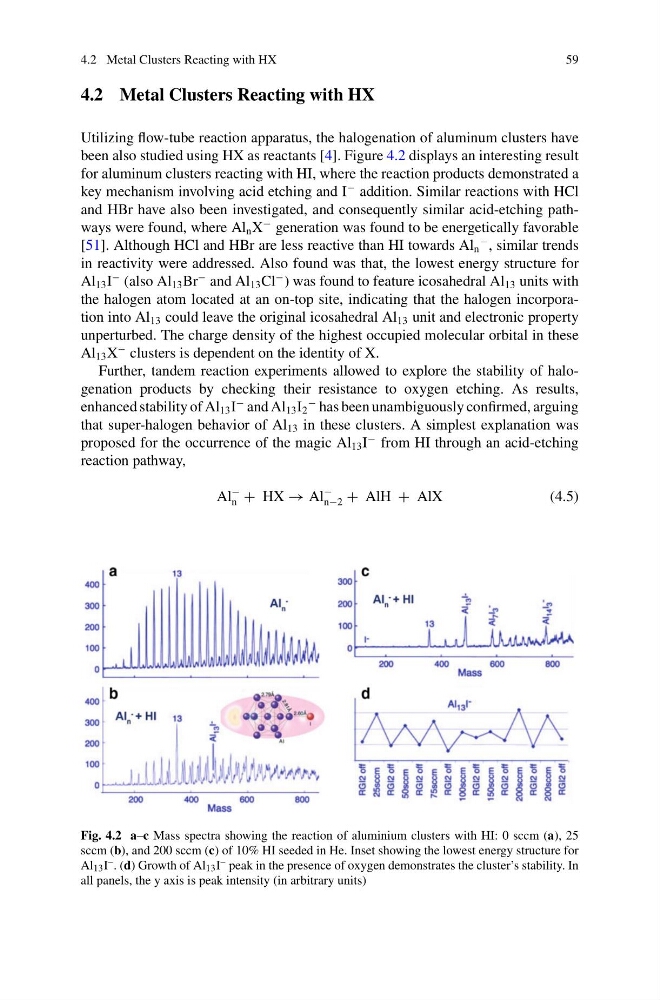
been also studied using HX as reactants [4]. Figure 4.2 displays an interesting result
for aluminum clusters reacting with HI, where the reaction products demonstrated a
key mechanism involving acid etching and I
− addition. Similar reactions with HCl
and HBr have also been investigated, and consequently similar acid-etching pathways were found, where Al n X
− generation was found to be energetically favorable
[51]. Although HCl and HBr are less reactive than HI towards Al n
− , similar trends
in reactivity were addressed. Also found was that, the lowest energy structure for
Al 13 I
− (also Al 13 Br
− and Al 13 Cl
− ) was found to feature icosahedral Al 13 units with
the halogen atom located at an on-top site, indicating that the halogen incorporation into Al 13 could leave the original icosahedral Al 13 unit and electronic property
unperturbed. The charge density of the highest occupied molecular orbital in these
Al 13 X
− clusters is dependent on the identity of X.
Further, tandem reaction experiments allowed to explore the stability of halogenation products by checking their resistance to oxygen etching. As results,
enhanced stability of Al 13 I
− and Al 13 I 2
− has been unambiguously confirmed, arguing
that super-halogen behavior of Al 13 in these clusters. A simplest explanation was
proposed for the occurrence of the magic Al 13 I
− from HI through an acid-etching
reaction pathway,
Al
−
n + HX → Al
−
n−2 + AlH + AlX
(4.5)
Fig. 4.2 a–c Mass spectra showing the reaction of aluminium clusters with HI: 0 sccm (a), 25
sccm (b), and 200 sccm (c) of 10% HI seeded in He. Inset showing the lowest energy structure for
Al 13 I – . (d) Growth of Al 13 I – peak in the presence of oxygen demonstrates the cluster’s stability. In
all panels, the y axis is peak intensity (in arbitrary units)
59
4.2 Metal Clusters Reacting with HX
Utilizing flow-tube reaction apparatus, the halogenation of aluminum clusters have
been also studied using HX as reactants [4]. Figure 4.2 displays an interesting result
for aluminum clusters reacting with HI, where the reaction products demonstrated a
key mechanism involving acid etching and I
− addition. Similar reactions with HCl
and HBr have also been investigated, and consequently similar acid-etching pathways were found, where Al n X
− generation was found to be energetically favorable
[51]. Although HCl and HBr are less reactive than HI towards Al n
− , similar trends
in reactivity were addressed. Also found was that, the lowest energy structure for
Al 13 I
− (also Al 13 Br
− and Al 13 Cl
− ) was found to feature icosahedral Al 13 units with
the halogen atom located at an on-top site, indicating that the halogen incorporation into Al 13 could leave the original icosahedral Al 13 unit and electronic property
unperturbed. The charge density of the highest occupied molecular orbital in these
Al 13 X
− clusters is dependent on the identity of X.
Further, tandem reaction experiments allowed to explore the stability of halogenation products by checking their resistance to oxygen etching. As results,
enhanced stability of Al 13 I
− and Al 13 I 2
− has been unambiguously confirmed, arguing
that super-halogen behavior of Al 13 in these clusters. A simplest explanation was
proposed for the occurrence of the magic Al 13 I
− from HI through an acid-etching
reaction pathway,
Al
−
n + HX → Al
−
n−2 + AlH + AlX
(4.5)
Fig. 4.2 a–c Mass spectra showing the reaction of aluminium clusters with HI: 0 sccm (a), 25
sccm (b), and 200 sccm (c) of 10% HI seeded in He. Inset showing the lowest energy structure for
Al 13 I – . (d) Growth of Al 13 I – peak in the presence of oxygen demonstrates the cluster’s stability. In
all panels, the y axis is peak intensity (in arbitrary units)