

44
3 Metal Cluster Reacting with Oxygen
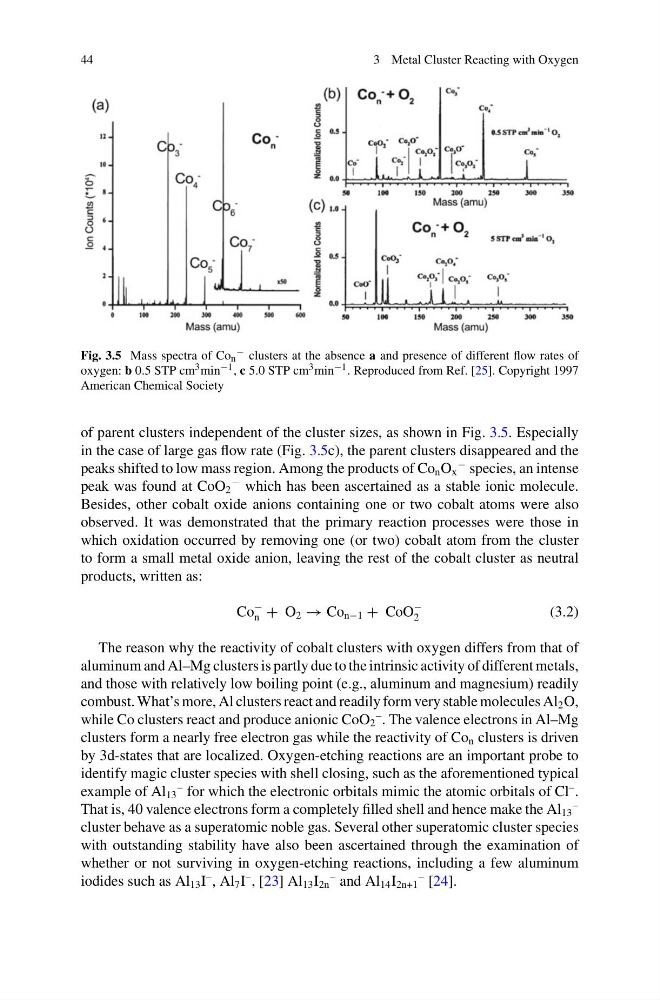
Fig. 3.5 Mass spectra of Co n
− clusters at the absence a and presence of different flow rates of
oxygen: b 0.5 STP cm 3 min −1 , c 5.0 STP cm 3 min −1 . Reproduced from Ref. [25]. Copyright 1997
American Chemical Society
of parent clusters independent of the cluster sizes, as shown in Fig. 3.5. Especially
in the case of large gas flow rate (Fig. 3.5c), the parent clusters disappeared and the
peaks shifted to low mass region. Among the products of Co n O x
− species, an intense
peak was found at CoO 2
− which has been ascertained as a stable ionic molecule.
Besides, other cobalt oxide anions containing one or two cobalt atoms were also
observed. It was demonstrated that the primary reaction processes were those in
which oxidation occurred by removing one (or two) cobalt atom from the cluster
to form a small metal oxide anion, leaving the rest of the cobalt cluster as neutral
products, written as:
Co
−
n + O 2 → Co n−1 + CoO
−
2
(3.2)
The reason why the reactivity of cobalt clusters with oxygen differs from that of
aluminum and Al–Mg clusters is partly due to the intrinsic activity of different metals,
and those with relatively low boiling point (e.g., aluminum and magnesium) readily
combust. What’s more, Al clusters react and readily form very stable molecules Al 2 O,
while Co clusters react and produce anionic CoO 2
– . The valence electrons in Al–Mg
clusters form a nearly free electron gas while the reactivity of Co n clusters is driven
by 3d-states that are localized. Oxygen-etching reactions are an important probe to
identify magic cluster species with shell closing, such as the aforementioned typical
example of Al 13
– for which the electronic orbitals mimic the atomic orbitals of Cl
– .
That is, 40 valence electrons form a completely filled shell and hence make the Al 13
–
cluster behave as a superatomic noble gas. Several other superatomic cluster species
with outstanding stability have also been ascertained through the examination of
whether or not surviving in oxygen-etching reactions, including a few aluminum
iodides such as Al 13 I
– , Al 7 I
– , [23] Al 13 I 2n
– and Al 14 I 2n+1
– [24].
3 Metal Cluster Reacting with Oxygen
Fig. 3.5 Mass spectra of Co n
− clusters at the absence a and presence of different flow rates of
oxygen: b 0.5 STP cm 3 min −1 , c 5.0 STP cm 3 min −1 . Reproduced from Ref. [25]. Copyright 1997
American Chemical Society
of parent clusters independent of the cluster sizes, as shown in Fig. 3.5. Especially
in the case of large gas flow rate (Fig. 3.5c), the parent clusters disappeared and the
peaks shifted to low mass region. Among the products of Co n O x
− species, an intense
peak was found at CoO 2
− which has been ascertained as a stable ionic molecule.
Besides, other cobalt oxide anions containing one or two cobalt atoms were also
observed. It was demonstrated that the primary reaction processes were those in
which oxidation occurred by removing one (or two) cobalt atom from the cluster
to form a small metal oxide anion, leaving the rest of the cobalt cluster as neutral
products, written as:
Co
−
n + O 2 → Co n−1 + CoO
−
2
(3.2)
The reason why the reactivity of cobalt clusters with oxygen differs from that of
aluminum and Al–Mg clusters is partly due to the intrinsic activity of different metals,
and those with relatively low boiling point (e.g., aluminum and magnesium) readily
combust. What’s more, Al clusters react and readily form very stable molecules Al 2 O,
while Co clusters react and produce anionic CoO 2
– . The valence electrons in Al–Mg
clusters form a nearly free electron gas while the reactivity of Co n clusters is driven
by 3d-states that are localized. Oxygen-etching reactions are an important probe to
identify magic cluster species with shell closing, such as the aforementioned typical
example of Al 13
– for which the electronic orbitals mimic the atomic orbitals of Cl
– .
That is, 40 valence electrons form a completely filled shell and hence make the Al 13
–
cluster behave as a superatomic noble gas. Several other superatomic cluster species
with outstanding stability have also been ascertained through the examination of
whether or not surviving in oxygen-etching reactions, including a few aluminum
iodides such as Al 13 I
– , Al 7 I
– , [23] Al 13 I 2n
– and Al 14 I 2n+1
– [24].