

2.1 Cluster Sources
17
an electric current of ~10–30 mA to ground. Such sputtering sources were found to
take advantages for producing noble metal clusters (Fig. 2.4b).
(b) Magnetron sputtering (MagS)
The discovery of magnetron sputtering (MagS) that a magnetic field could confine
plasma to the target surface and amplify the rate of evaporation has attracted reasonable interest in thin-film deposition and related materials [104]. Compared with usual
chemical vapor deposition (CVD) which has existed over a century, MagS bears
advantages in that it requires less amounts of energy to evaporate the target medium
especially those metals. In particular, MagS source is controllable of the correlated
parameters such as voltage and working gas, which enables to attain tunable size
distribution of clusters/particles [105–107]. Advances in this field has made the round
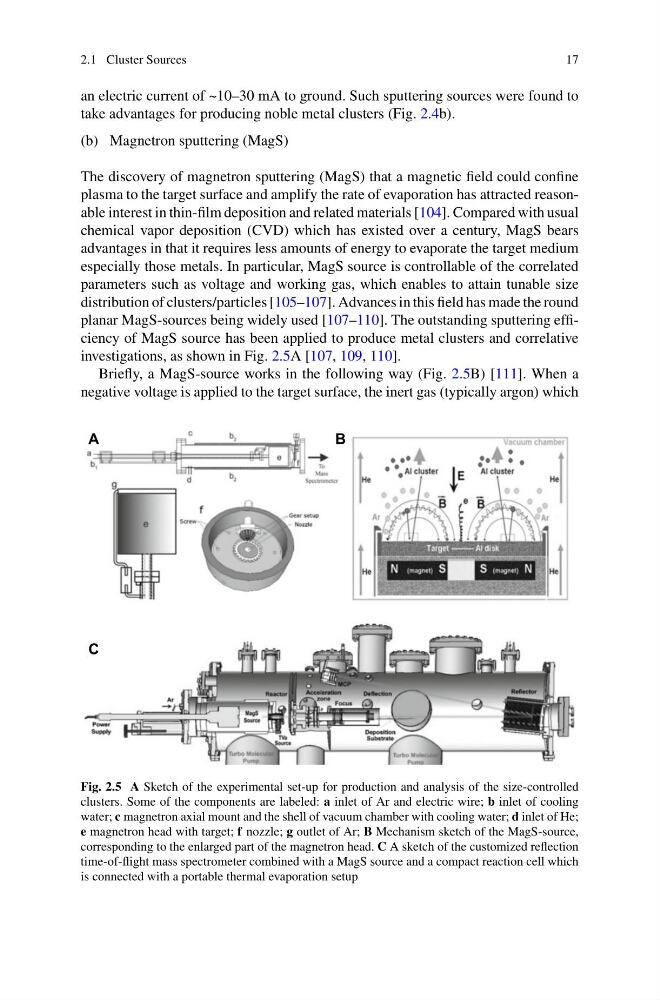
planar MagS-sources being widely used [107–110]. The outstanding sputtering efficiency of MagS source has been applied to produce metal clusters and correlative
investigations, as shown in Fig. 2.5A [107, 109, 110].
Briefly, a MagS-source works in the following way (Fig. 2.5B) [111]. When a
negative voltage is applied to the target surface, the inert gas (typically argon) which
A
C
B
Fig. 2.5 A Sketch of the experimental set-up for production and analysis of the size-controlled
clusters. Some of the components are labeled: a inlet of Ar and electric wire; b inlet of cooling
water; c magnetron axial mount and the shell of vacuum chamber with cooling water; d inlet of He;
e magnetron head with target; f nozzle; g outlet of Ar; B Mechanism sketch of the MagS-source,
corresponding to the enlarged part of the magnetron head. C A sketch of the customized reflection
time-of-flight mass spectrometer combined with a MagS source and a compact reaction cell which
is connected with a portable thermal evaporation setup
17
an electric current of ~10–30 mA to ground. Such sputtering sources were found to
take advantages for producing noble metal clusters (Fig. 2.4b).
(b) Magnetron sputtering (MagS)
The discovery of magnetron sputtering (MagS) that a magnetic field could confine
plasma to the target surface and amplify the rate of evaporation has attracted reasonable interest in thin-film deposition and related materials [104]. Compared with usual
chemical vapor deposition (CVD) which has existed over a century, MagS bears
advantages in that it requires less amounts of energy to evaporate the target medium
especially those metals. In particular, MagS source is controllable of the correlated
parameters such as voltage and working gas, which enables to attain tunable size
distribution of clusters/particles [105–107]. Advances in this field has made the round
planar MagS-sources being widely used [107–110]. The outstanding sputtering efficiency of MagS source has been applied to produce metal clusters and correlative
investigations, as shown in Fig. 2.5A [107, 109, 110].
Briefly, a MagS-source works in the following way (Fig. 2.5B) [111]. When a
negative voltage is applied to the target surface, the inert gas (typically argon) which
A
C
B
Fig. 2.5 A Sketch of the experimental set-up for production and analysis of the size-controlled
clusters. Some of the components are labeled: a inlet of Ar and electric wire; b inlet of cooling
water; c magnetron axial mount and the shell of vacuum chamber with cooling water; d inlet of He;
e magnetron head with target; f nozzle; g outlet of Ar; B Mechanism sketch of the MagS-source,
corresponding to the enlarged part of the magnetron head. C A sketch of the customized reflection
time-of-flight mass spectrometer combined with a MagS source and a compact reaction cell which
is connected with a portable thermal evaporation setup