

14.4 Solid-Supported Metal Clusters
255
14.4.4 Characterization of Soft-Landed Clusters
Soft-landed clusters enable morphology characterization as various nanomaterials
and nanoscale surfaces, profiting from the development of nanotechnology especially scanning tunneling microscopy (STM). Combining STM and spectroscopy at
cryogenic (UHV, 4 K) conditions, the cluster conductance with complete control of
their chemical and physical environment can be measured, where thermal broadening of their electronic states as well as their mobility is minimized. For example,
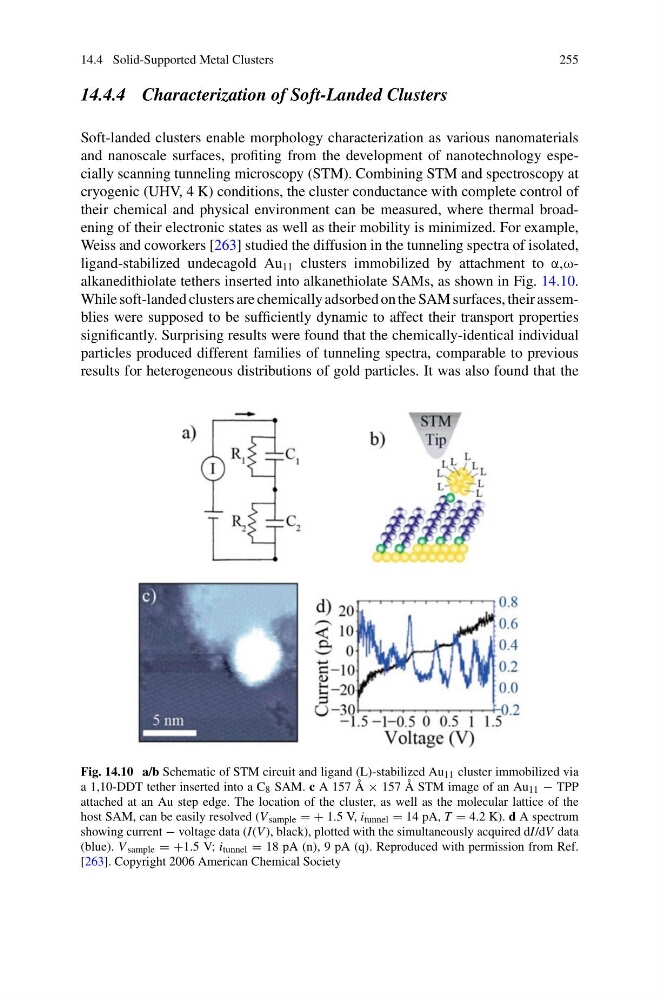
Weiss and coworkers [263] studied the diffusion in the tunneling spectra of isolated,
ligand-stabilized undecagold Au 11 clusters immobilized by attachment to α,ωalkanedithiolate tethers inserted into alkanethiolate SAMs, as shown in Fig. 14.10.
While soft-landed clusters are chemically adsorbed on the SAM surfaces, their assemblies were supposed to be sufficiently dynamic to affect their transport properties
significantly. Surprising results were found that the chemically-identical individual
particles produced different families of tunneling spectra, comparable to previous
results for heterogeneous distributions of gold particles. It was also found that the
Fig. 14.10 a/b Schematic of STM circuit and ligand (L)-stabilized Au 11 cluster immobilized via
a 1,10-DDT tether inserted into a C 8 SAM. c A 157 Å × 157 Å STM image of an Au 11 − TPP
attached at an Au step edge. The location of the cluster, as well as the molecular lattice of the
host SAM, can be easily resolved (V sample = + 1.5 V, i tunnel = 14 pA, T = 4.2 K). d A spectrum
showing current − voltage data (I(V ), black), plotted with the simultaneously acquired dI/dV data
(blue). V sample = +1.5 V; i tunnel = 18 pA (n), 9 pA (q). Reproduced with permission from Ref.
[263]. Copyright 2006 American Chemical Society
255
14.4.4 Characterization of Soft-Landed Clusters
Soft-landed clusters enable morphology characterization as various nanomaterials
and nanoscale surfaces, profiting from the development of nanotechnology especially scanning tunneling microscopy (STM). Combining STM and spectroscopy at
cryogenic (UHV, 4 K) conditions, the cluster conductance with complete control of
their chemical and physical environment can be measured, where thermal broadening of their electronic states as well as their mobility is minimized. For example,
Weiss and coworkers [263] studied the diffusion in the tunneling spectra of isolated,
ligand-stabilized undecagold Au 11 clusters immobilized by attachment to α,ωalkanedithiolate tethers inserted into alkanethiolate SAMs, as shown in Fig. 14.10.
While soft-landed clusters are chemically adsorbed on the SAM surfaces, their assemblies were supposed to be sufficiently dynamic to affect their transport properties
significantly. Surprising results were found that the chemically-identical individual
particles produced different families of tunneling spectra, comparable to previous
results for heterogeneous distributions of gold particles. It was also found that the
Fig. 14.10 a/b Schematic of STM circuit and ligand (L)-stabilized Au 11 cluster immobilized via
a 1,10-DDT tether inserted into a C 8 SAM. c A 157 Å × 157 Å STM image of an Au 11 − TPP
attached at an Au step edge. The location of the cluster, as well as the molecular lattice of the
host SAM, can be easily resolved (V sample = + 1.5 V, i tunnel = 14 pA, T = 4.2 K). d A spectrum
showing current − voltage data (I(V ), black), plotted with the simultaneously acquired dI/dV data
(blue). V sample = +1.5 V; i tunnel = 18 pA (n), 9 pA (q). Reproduced with permission from Ref.
[263]. Copyright 2006 American Chemical Society