

14.4 Solid-Supported Metal Clusters
249
14.4.1 Soft and Reactive Landing on Self-assembled
Monolayers (SAMs)
Soft-landing which was first introduced by Cooks and co-workers [191] refers to
the deposition of intact projectile ions onto targets with or without the retention of
the initial charge onto certain surfaces. In this study, they reported such a method
of preparing modified surfaces, where intact polyatomic ions were deposited from
the gas phase into a monolayer fluorocarbon surface at room temperature [191].
The ions were trapped in the fluorocarbon matrix for certain hours; and then they
were intactly released upon sputtering at low or high energy or by thermal desorption, so that their molecular compositions were confirmed by isotopic labelling and
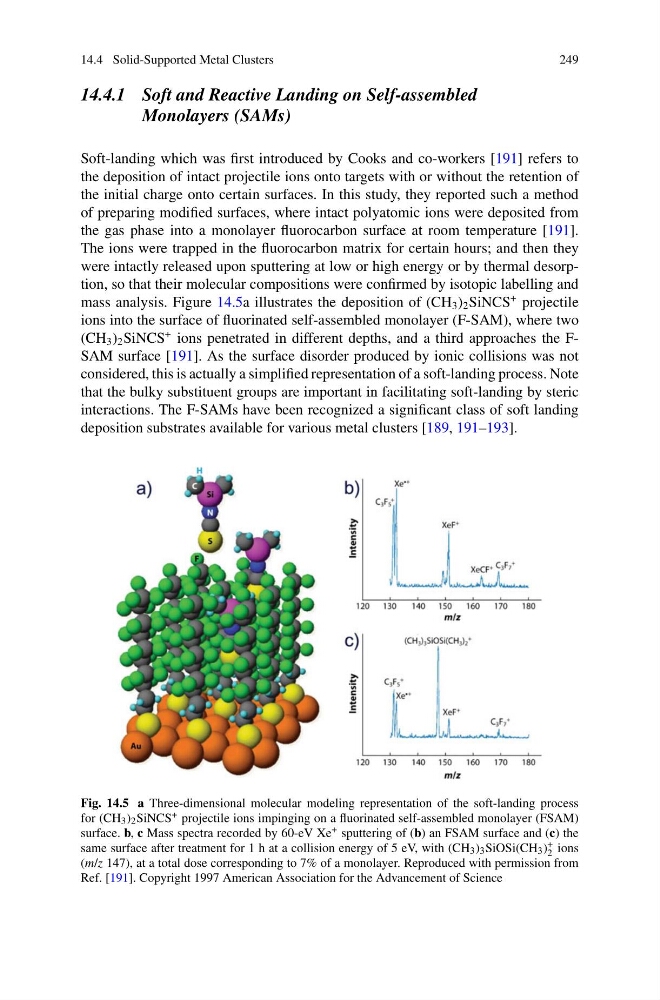
mass analysis. Figure 14.5a illustrates the deposition of (CH 3 ) 2 SiNCS
+ projectile
ions into the surface of fluorinated self-assembled monolayer (F-SAM), where two
(CH 3 ) 2 SiNCS
+ ions penetrated in different depths, and a third approaches the FSAM surface [191]. As the surface disorder produced by ionic collisions was not
considered, this is actually a simplified representation of a soft-landing process. Note
that the bulky substituent groups are important in facilitating soft-landing by steric
interactions. The F-SAMs have been recognized a significant class of soft landing
deposition substrates available for various metal clusters [189, 191–193].
Fig. 14.5 a Three-dimensional molecular modeling representation of the soft-landing process
for (CH 3 ) 2 SiNCS + projectile ions impinging on a fluorinated self-assembled monolayer (FSAM)
surface. b, c Mass spectra recorded by 60-eV Xe + sputtering of (b) an FSAM surface and (c) the
same surface after treatment for 1 h at a collision energy of 5 eV, with (CH 3 ) 3 SiOSi(CH 3 ) +
2 ions
(m/z 147), at a total dose corresponding to 7% of a monolayer. Reproduced with permission from
Ref. [191]. Copyright 1997 American Association for the Advancement of Science
249
14.4.1 Soft and Reactive Landing on Self-assembled
Monolayers (SAMs)
Soft-landing which was first introduced by Cooks and co-workers [191] refers to
the deposition of intact projectile ions onto targets with or without the retention of
the initial charge onto certain surfaces. In this study, they reported such a method
of preparing modified surfaces, where intact polyatomic ions were deposited from
the gas phase into a monolayer fluorocarbon surface at room temperature [191].
The ions were trapped in the fluorocarbon matrix for certain hours; and then they
were intactly released upon sputtering at low or high energy or by thermal desorption, so that their molecular compositions were confirmed by isotopic labelling and
mass analysis. Figure 14.5a illustrates the deposition of (CH 3 ) 2 SiNCS
+ projectile
ions into the surface of fluorinated self-assembled monolayer (F-SAM), where two
(CH 3 ) 2 SiNCS
+ ions penetrated in different depths, and a third approaches the FSAM surface [191]. As the surface disorder produced by ionic collisions was not
considered, this is actually a simplified representation of a soft-landing process. Note
that the bulky substituent groups are important in facilitating soft-landing by steric
interactions. The F-SAMs have been recognized a significant class of soft landing
deposition substrates available for various metal clusters [189, 191–193].
Fig. 14.5 a Three-dimensional molecular modeling representation of the soft-landing process
for (CH 3 ) 2 SiNCS + projectile ions impinging on a fluorinated self-assembled monolayer (FSAM)
surface. b, c Mass spectra recorded by 60-eV Xe + sputtering of (b) an FSAM surface and (c) the
same surface after treatment for 1 h at a collision energy of 5 eV, with (CH 3 ) 3 SiOSi(CH 3 ) +
2 ions
(m/z 147), at a total dose corresponding to 7% of a monolayer. Reproduced with permission from
Ref. [191]. Copyright 1997 American Association for the Advancement of Science