

246
14 Creating Genetic Materials of Metal Clusters
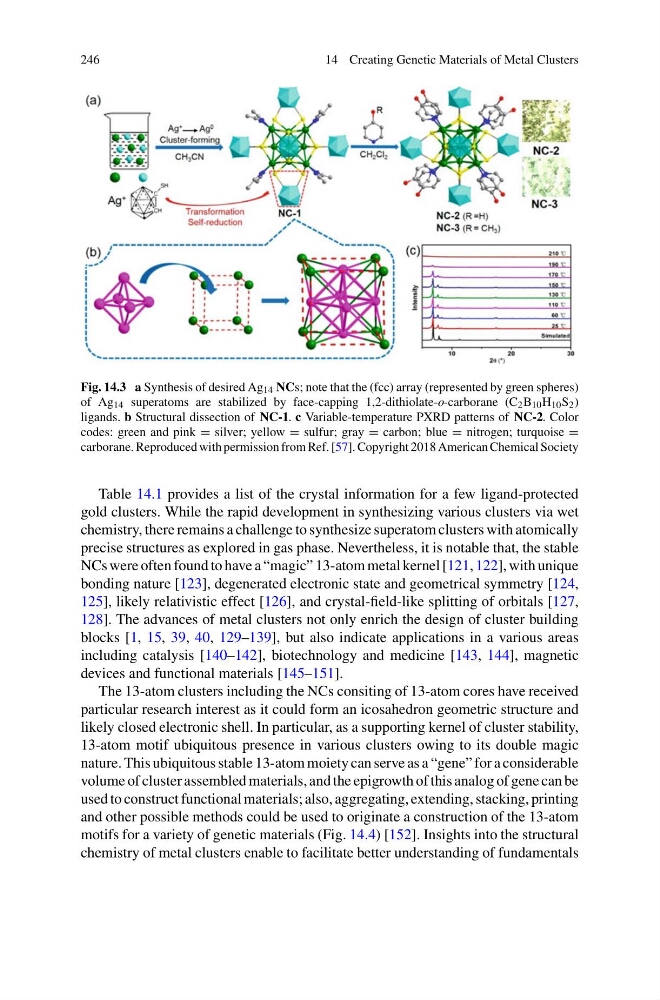
Fig. 14.3 a Synthesis of desired Ag 14 NCs; note that the (fcc) array (represented by green spheres)
of Ag 14 superatoms are stabilized by face-capping 1,2-dithiolate-o-carborane (C 2 B 10 H 10 S 2 )
ligands. b Structural dissection of NC-1. c Variable-temperature PXRD patterns of NC-2. Color
codes: green and pink = silver; yellow = sulfur; gray = carbon; blue = nitrogen; turquoise =
carborane. Reproduced with permission from Ref. [57]. Copyright 2018 American Chemical Society
Table 14.1 provides a list of the crystal information for a few ligand-protected
gold clusters. While the rapid development in synthesizing various clusters via wet
chemistry, there remains a challenge to synthesize superatom clusters with atomically
precise structures as explored in gas phase. Nevertheless, it is notable that, the stable
NCs were often found to have a “magic” 13-atom metal kernel [121, 122], with unique
bonding nature [123], degenerated electronic state and geometrical symmetry [124,
125], likely relativistic effect [126], and crystal-field-like splitting of orbitals [127,
128]. The advances of metal clusters not only enrich the design of cluster building
blocks [1, 15, 39, 40, 129–139], but also indicate applications in a various areas
including catalysis [140–142], biotechnology and medicine [143, 144], magnetic
devices and functional materials [145–151].
The 13-atom clusters including the NCs consiting of 13-atom cores have received
particular research interest as it could form an icosahedron geometric structure and
likely closed electronic shell. In particular, as a supporting kernel of cluster stability,
13-atom motif ubiquitous presence in various clusters owing to its double magic
nature. This ubiquitous stable 13-atom moiety can serve as a “gene” for a considerable
volume of cluster assembled materials, and the epigrowth of this analog of gene can be
used to construct functional materials; also, aggregating, extending, stacking, printing
and other possible methods could be used to originate a construction of the 13-atom
motifs for a variety of genetic materials (Fig. 14.4) [152]. Insights into the structural
chemistry of metal clusters enable to facilitate better understanding of fundamentals
14 Creating Genetic Materials of Metal Clusters
Fig. 14.3 a Synthesis of desired Ag 14 NCs; note that the (fcc) array (represented by green spheres)
of Ag 14 superatoms are stabilized by face-capping 1,2-dithiolate-o-carborane (C 2 B 10 H 10 S 2 )
ligands. b Structural dissection of NC-1. c Variable-temperature PXRD patterns of NC-2. Color
codes: green and pink = silver; yellow = sulfur; gray = carbon; blue = nitrogen; turquoise =
carborane. Reproduced with permission from Ref. [57]. Copyright 2018 American Chemical Society
Table 14.1 provides a list of the crystal information for a few ligand-protected
gold clusters. While the rapid development in synthesizing various clusters via wet
chemistry, there remains a challenge to synthesize superatom clusters with atomically
precise structures as explored in gas phase. Nevertheless, it is notable that, the stable
NCs were often found to have a “magic” 13-atom metal kernel [121, 122], with unique
bonding nature [123], degenerated electronic state and geometrical symmetry [124,
125], likely relativistic effect [126], and crystal-field-like splitting of orbitals [127,
128]. The advances of metal clusters not only enrich the design of cluster building
blocks [1, 15, 39, 40, 129–139], but also indicate applications in a various areas
including catalysis [140–142], biotechnology and medicine [143, 144], magnetic
devices and functional materials [145–151].
The 13-atom clusters including the NCs consiting of 13-atom cores have received
particular research interest as it could form an icosahedron geometric structure and
likely closed electronic shell. In particular, as a supporting kernel of cluster stability,
13-atom motif ubiquitous presence in various clusters owing to its double magic
nature. This ubiquitous stable 13-atom moiety can serve as a “gene” for a considerable
volume of cluster assembled materials, and the epigrowth of this analog of gene can be
used to construct functional materials; also, aggregating, extending, stacking, printing
and other possible methods could be used to originate a construction of the 13-atom
motifs for a variety of genetic materials (Fig. 14.4) [152]. Insights into the structural
chemistry of metal clusters enable to facilitate better understanding of fundamentals