

226
13 Metal Cluster Catalysis
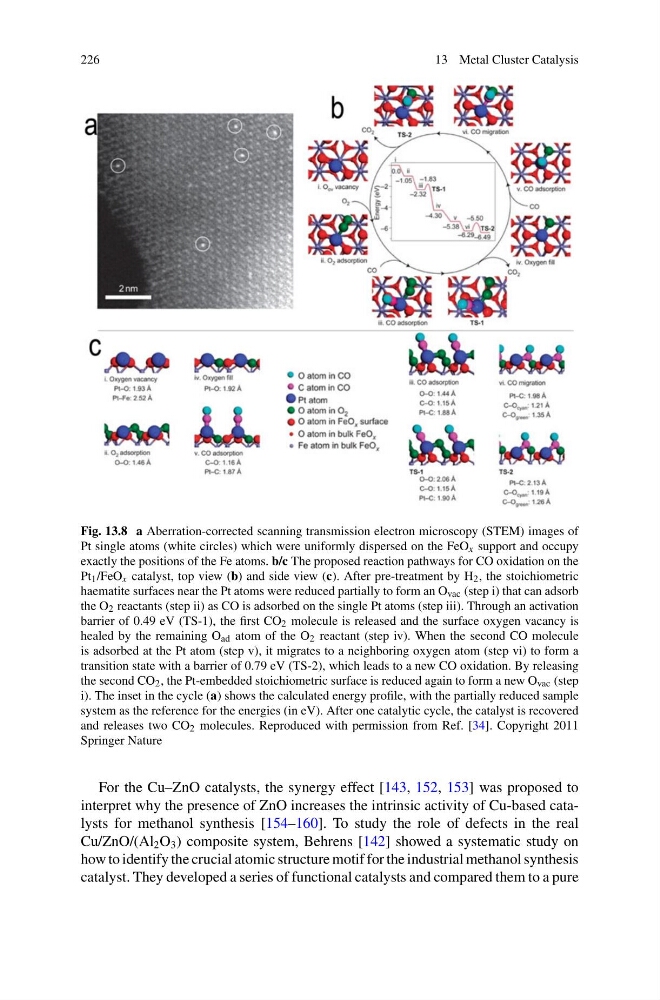
Fig. 13.8 a Aberration-corrected scanning transmission electron microscopy (STEM) images of
Pt single atoms (white circles) which were uniformly dispersed on the FeO x support and occupy
exactly the positions of the Fe atoms. b/c The proposed reaction pathways for CO oxidation on the
Pt 1 /FeO x catalyst, top view (b) and side view (c). After pre-treatment by H 2 , the stoichiometric
haematite surfaces near the Pt atoms were reduced partially to form an O vac (step i) that can adsorb
the O 2 reactants (step ii) as CO is adsorbed on the single Pt atoms (step iii). Through an activation
barrier of 0.49 eV (TS-1), the first CO 2 molecule is released and the surface oxygen vacancy is
healed by the remaining O ad atom of the O 2 reactant (step iv). When the second CO molecule
is adsorbed at the Pt atom (step v), it migrates to a neighboring oxygen atom (step vi) to form a
transition state with a barrier of 0.79 eV (TS-2), which leads to a new CO oxidation. By releasing
the second CO 2 , the Pt-embedded stoichiometric surface is reduced again to form a new O vac (step
i). The inset in the cycle (a) shows the calculated energy profile, with the partially reduced sample
system as the reference for the energies (in eV). After one catalytic cycle, the catalyst is recovered
and releases two CO 2 molecules. Reproduced with permission from Ref. [34]. Copyright 2011
Springer Nature
For the Cu–ZnO catalysts, the synergy effect [143, 152, 153] was proposed to
interpret why the presence of ZnO increases the intrinsic activity of Cu-based catalysts for methanol synthesis [154–160]. To study the role of defects in the real
Cu/ZnO/(Al 2 O 3 ) composite system, Behrens [142] showed a systematic study on
how to identify the crucial atomic structure motif for the industrial methanol synthesis
catalyst. They developed a series of functional catalysts and compared them to a pure
13 Metal Cluster Catalysis
Fig. 13.8 a Aberration-corrected scanning transmission electron microscopy (STEM) images of
Pt single atoms (white circles) which were uniformly dispersed on the FeO x support and occupy
exactly the positions of the Fe atoms. b/c The proposed reaction pathways for CO oxidation on the
Pt 1 /FeO x catalyst, top view (b) and side view (c). After pre-treatment by H 2 , the stoichiometric
haematite surfaces near the Pt atoms were reduced partially to form an O vac (step i) that can adsorb
the O 2 reactants (step ii) as CO is adsorbed on the single Pt atoms (step iii). Through an activation
barrier of 0.49 eV (TS-1), the first CO 2 molecule is released and the surface oxygen vacancy is
healed by the remaining O ad atom of the O 2 reactant (step iv). When the second CO molecule
is adsorbed at the Pt atom (step v), it migrates to a neighboring oxygen atom (step vi) to form a
transition state with a barrier of 0.79 eV (TS-2), which leads to a new CO oxidation. By releasing
the second CO 2 , the Pt-embedded stoichiometric surface is reduced again to form a new O vac (step
i). The inset in the cycle (a) shows the calculated energy profile, with the partially reduced sample
system as the reference for the energies (in eV). After one catalytic cycle, the catalyst is recovered
and releases two CO 2 molecules. Reproduced with permission from Ref. [34]. Copyright 2011
Springer Nature
For the Cu–ZnO catalysts, the synergy effect [143, 152, 153] was proposed to
interpret why the presence of ZnO increases the intrinsic activity of Cu-based catalysts for methanol synthesis [154–160]. To study the role of defects in the real
Cu/ZnO/(Al 2 O 3 ) composite system, Behrens [142] showed a systematic study on
how to identify the crucial atomic structure motif for the industrial methanol synthesis
catalyst. They developed a series of functional catalysts and compared them to a pure