

164
10 Metallo-Carbohedrenes and Their Reactivity
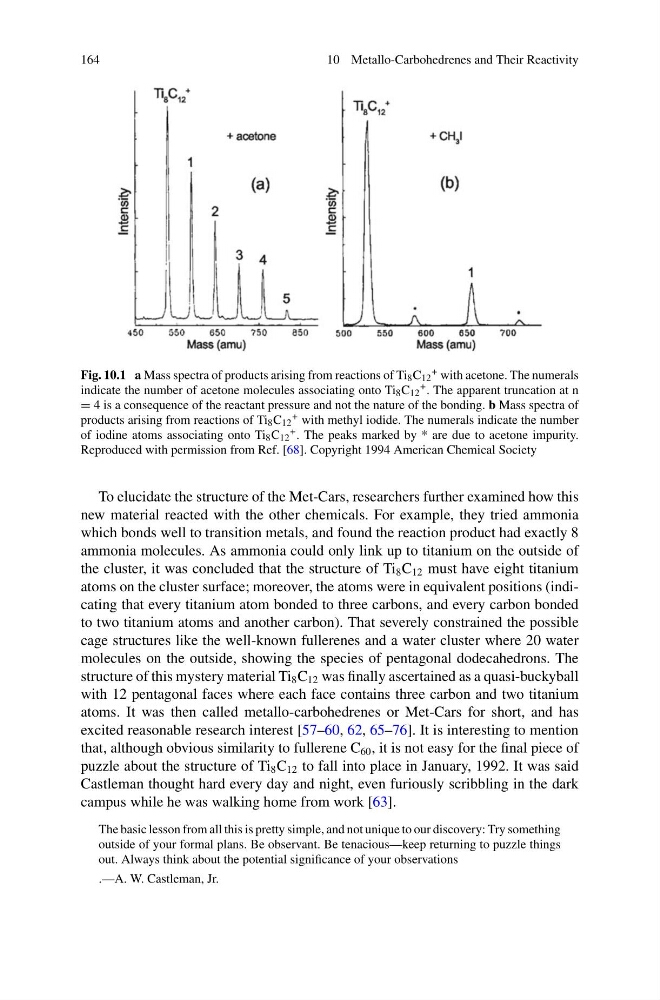
Fig. 10.1 a Mass spectra of products arising from reactions of Ti 8 C 12
+ with acetone. The numerals
indicate the number of acetone molecules associating onto Ti 8 C 12
+ . The apparent truncation at n
= 4 is a consequence of the reactant pressure and not the nature of the bonding. b Mass spectra of
products arising from reactions of Ti 8 C 12
+ with methyl iodide. The numerals indicate the number
of iodine atoms associating onto Ti 8 C 12
+ . The peaks marked by * are due to acetone impurity.
Reproduced with permission from Ref. [68]. Copyright 1994 American Chemical Society
To elucidate the structure of the Met-Cars, researchers further examined how this
new material reacted with the other chemicals. For example, they tried ammonia
which bonds well to transition metals, and found the reaction product had exactly 8
ammonia molecules. As ammonia could only link up to titanium on the outside of
the cluster, it was concluded that the structure of Ti 8 C 12 must have eight titanium
atoms on the cluster surface; moreover, the atoms were in equivalent positions (indicating that every titanium atom bonded to three carbons, and every carbon bonded
to two titanium atoms and another carbon). That severely constrained the possible
cage structures like the well-known fullerenes and a water cluster where 20 water
molecules on the outside, showing the species of pentagonal dodecahedrons. The
structure of this mystery material Ti 8 C 12 was finally ascertained as a quasi-buckyball
with 12 pentagonal faces where each face contains three carbon and two titanium
atoms. It was then called metallo-carbohedrenes or Met-Cars for short, and has
excited reasonable research interest [57–60, 62, 65–76]. It is interesting to mention
that, although obvious similarity to fullerene C 60 , it is not easy for the final piece of
puzzle about the structure of Ti 8 C 12 to fall into place in January, 1992. It was said
Castleman thought hard every day and night, even furiously scribbling in the dark
campus while he was walking home from work [63].
The basic lesson from all this is pretty simple, and not unique to our discovery: Try something
outside of your formal plans. Be observant. Be tenacious—keep returning to puzzle things
out. Always think about the potential significance of your observations
.—A. W. Castleman, Jr.
10 Metallo-Carbohedrenes and Their Reactivity
Fig. 10.1 a Mass spectra of products arising from reactions of Ti 8 C 12
+ with acetone. The numerals
indicate the number of acetone molecules associating onto Ti 8 C 12
+ . The apparent truncation at n
= 4 is a consequence of the reactant pressure and not the nature of the bonding. b Mass spectra of
products arising from reactions of Ti 8 C 12
+ with methyl iodide. The numerals indicate the number
of iodine atoms associating onto Ti 8 C 12
+ . The peaks marked by * are due to acetone impurity.
Reproduced with permission from Ref. [68]. Copyright 1994 American Chemical Society
To elucidate the structure of the Met-Cars, researchers further examined how this
new material reacted with the other chemicals. For example, they tried ammonia
which bonds well to transition metals, and found the reaction product had exactly 8
ammonia molecules. As ammonia could only link up to titanium on the outside of
the cluster, it was concluded that the structure of Ti 8 C 12 must have eight titanium
atoms on the cluster surface; moreover, the atoms were in equivalent positions (indicating that every titanium atom bonded to three carbons, and every carbon bonded
to two titanium atoms and another carbon). That severely constrained the possible
cage structures like the well-known fullerenes and a water cluster where 20 water
molecules on the outside, showing the species of pentagonal dodecahedrons. The
structure of this mystery material Ti 8 C 12 was finally ascertained as a quasi-buckyball
with 12 pentagonal faces where each face contains three carbon and two titanium
atoms. It was then called metallo-carbohedrenes or Met-Cars for short, and has
excited reasonable research interest [57–60, 62, 65–76]. It is interesting to mention
that, although obvious similarity to fullerene C 60 , it is not easy for the final piece of
puzzle about the structure of Ti 8 C 12 to fall into place in January, 1992. It was said
Castleman thought hard every day and night, even furiously scribbling in the dark
campus while he was walking home from work [63].
The basic lesson from all this is pretty simple, and not unique to our discovery: Try something
outside of your formal plans. Be observant. Be tenacious—keep returning to puzzle things
out. Always think about the potential significance of your observations
.—A. W. Castleman, Jr.