

9.4 Microscopic Catalytic Mechanism of Supported Palladium Clusters
155
a
c
b
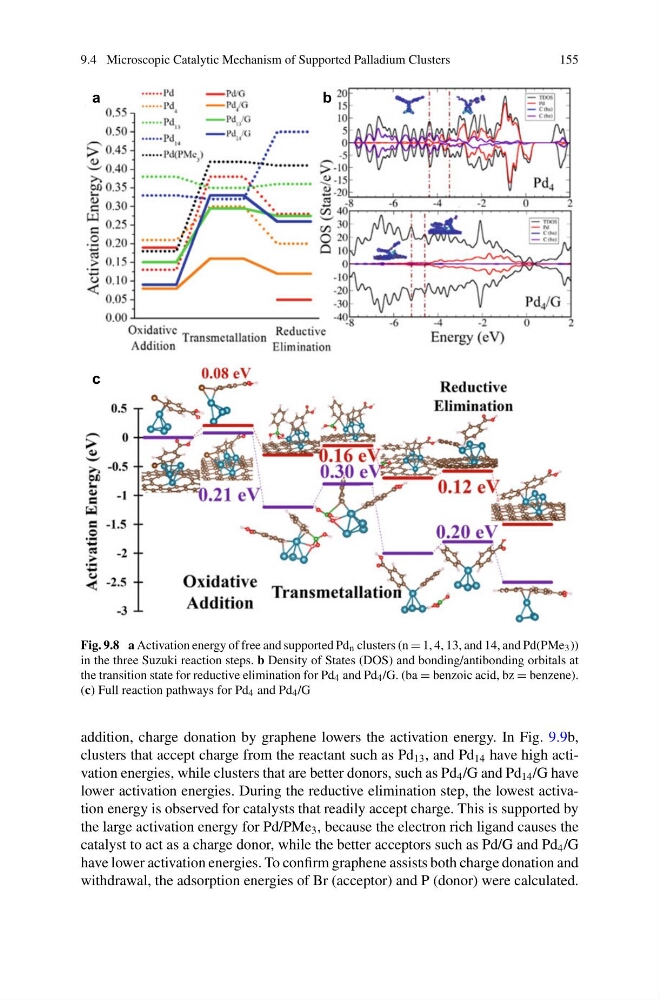
Fig. 9.8 a Activation energy of free and supported Pd n clusters (n = 1, 4, 13, and 14, and Pd(PMe 3 ))
in the three Suzuki reaction steps. b Density of States (DOS) and bonding/antibonding orbitals at
the transition state for reductive elimination for Pd 4 and Pd 4 /G. (ba = benzoic acid, bz = benzene).
(c) Full reaction pathways for Pd 4 and Pd 4 /G
addition, charge donation by graphene lowers the activation energy. In Fig. 9.9b,
clusters that accept charge from the reactant such as Pd 13 , and Pd 14 have high activation energies, while clusters that are better donors, such as Pd 4 /G and Pd 14 /G have
lower activation energies. During the reductive elimination step, the lowest activation energy is observed for catalysts that readily accept charge. This is supported by
the large activation energy for Pd/PMe 3 , because the electron rich ligand causes the
catalyst to act as a charge donor, while the better acceptors such as Pd/G and Pd 4 /G
have lower activation energies. To confirm graphene assists both charge donation and
withdrawal, the adsorption energies of Br (acceptor) and P (donor) were calculated.
155
a
c
b
Fig. 9.8 a Activation energy of free and supported Pd n clusters (n = 1, 4, 13, and 14, and Pd(PMe 3 ))
in the three Suzuki reaction steps. b Density of States (DOS) and bonding/antibonding orbitals at
the transition state for reductive elimination for Pd 4 and Pd 4 /G. (ba = benzoic acid, bz = benzene).
(c) Full reaction pathways for Pd 4 and Pd 4 /G
addition, charge donation by graphene lowers the activation energy. In Fig. 9.9b,
clusters that accept charge from the reactant such as Pd 13 , and Pd 14 have high activation energies, while clusters that are better donors, such as Pd 4 /G and Pd 14 /G have
lower activation energies. During the reductive elimination step, the lowest activation energy is observed for catalysts that readily accept charge. This is supported by
the large activation energy for Pd/PMe 3 , because the electron rich ligand causes the
catalyst to act as a charge donor, while the better acceptors such as Pd/G and Pd 4 /G
have lower activation energies. To confirm graphene assists both charge donation and
withdrawal, the adsorption energies of Br (acceptor) and P (donor) were calculated.