

146
9 Carbon-Carbon Cross-Coupling Reactions
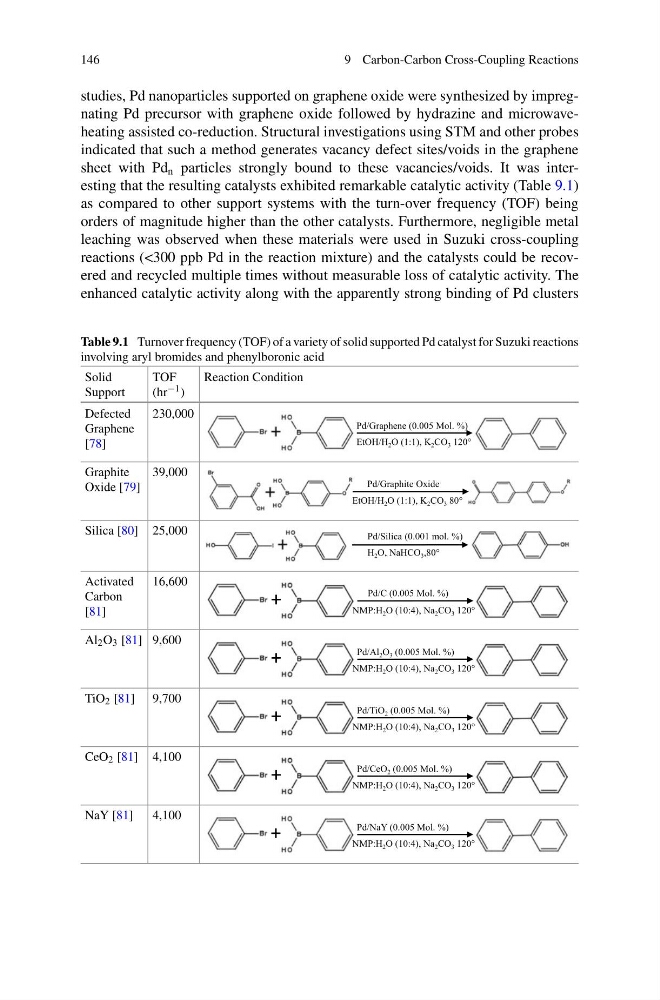
studies, Pd nanoparticles supported on graphene oxide were synthesized by impregnating Pd precursor with graphene oxide followed by hydrazine and microwaveheating assisted co-reduction. Structural investigations using STM and other probes
indicated that such a method generates vacancy defect sites/voids in the graphene
sheet with Pd n particles strongly bound to these vacancies/voids. It was interesting that the resulting catalysts exhibited remarkable catalytic activity (Table 9.1)
as compared to other support systems with the turn-over frequency (TOF) being
orders of magnitude higher than the other catalysts. Furthermore, negligible metal
leaching was observed when these materials were used in Suzuki cross-coupling
reactions (<300 ppb Pd in the reaction mixture) and the catalysts could be recovered and recycled multiple times without measurable loss of catalytic activity. The
enhanced catalytic activity along with the apparently strong binding of Pd clusters
Table 9.1 Turnover frequency (TOF) of a variety of solid supported Pd catalyst for Suzuki reactions
involving aryl bromides and phenylboronic acid
Solid
Support
TOF
(hr −1 )
Reaction Condition
Defected
Graphene
[78]
230,000
Pd/Graphene (0.005 Mol. %)
EtOH/H 2 O (1:1), K 2 CO 3 120°
Graphite
Oxide [79]
39,000
Pd/Graphite Oxide
EtOH/H 2 O (1:1), K 2 CO 3 80°
Silica [80] 25,000
Pd/Silica (0.001 mol. %)
H 2 O, NaHCO 3 ,80°
Activated
Carbon
[81]
16,600
+
Pd/C (0.005 Mol. %)
NMP:H 2 O (10:4), Na 2 CO 3 120°
Al 2 O 3 [81] 9,600
+
Pd/Al 2 O 3 (0.005 Mol. %)
NMP:H 2 O (10:4), Na 2 CO 3 120°
TiO 2 [81] 9,700
+
Pd/TiO 2 (0.005 Mol. %)
NMP:H 2 O (10:4), Na 2 CO 3 120°
CeO 2 [81] 4,100
+
Pd/CeO 2 (0.005 Mol. %)
NMP:H 2 O (10:4), Na 2 CO 3 120°
NaY [81]
4,100
+
Pd/NaY (0.005 Mol. %)
NMP:H 2 O (10:4), Na 2 CO 3 120°
9 Carbon-Carbon Cross-Coupling Reactions
studies, Pd nanoparticles supported on graphene oxide were synthesized by impregnating Pd precursor with graphene oxide followed by hydrazine and microwaveheating assisted co-reduction. Structural investigations using STM and other probes
indicated that such a method generates vacancy defect sites/voids in the graphene
sheet with Pd n particles strongly bound to these vacancies/voids. It was interesting that the resulting catalysts exhibited remarkable catalytic activity (Table 9.1)
as compared to other support systems with the turn-over frequency (TOF) being
orders of magnitude higher than the other catalysts. Furthermore, negligible metal
leaching was observed when these materials were used in Suzuki cross-coupling
reactions (<300 ppb Pd in the reaction mixture) and the catalysts could be recovered and recycled multiple times without measurable loss of catalytic activity. The
enhanced catalytic activity along with the apparently strong binding of Pd clusters
Table 9.1 Turnover frequency (TOF) of a variety of solid supported Pd catalyst for Suzuki reactions
involving aryl bromides and phenylboronic acid
Solid
Support
TOF
(hr −1 )
Reaction Condition
Defected
Graphene
[78]
230,000
Pd/Graphene (0.005 Mol. %)
EtOH/H 2 O (1:1), K 2 CO 3 120°
Graphite
Oxide [79]
39,000
Pd/Graphite Oxide
EtOH/H 2 O (1:1), K 2 CO 3 80°
Silica [80] 25,000
Pd/Silica (0.001 mol. %)
H 2 O, NaHCO 3 ,80°
Activated
Carbon
[81]
16,600
+
Pd/C (0.005 Mol. %)
NMP:H 2 O (10:4), Na 2 CO 3 120°
Al 2 O 3 [81] 9,600
+
Pd/Al 2 O 3 (0.005 Mol. %)
NMP:H 2 O (10:4), Na 2 CO 3 120°
TiO 2 [81] 9,700
+
Pd/TiO 2 (0.005 Mol. %)
NMP:H 2 O (10:4), Na 2 CO 3 120°
CeO 2 [81] 4,100
+
Pd/CeO 2 (0.005 Mol. %)
NMP:H 2 O (10:4), Na 2 CO 3 120°
NaY [81]
4,100
+
Pd/NaY (0.005 Mol. %)
NMP:H 2 O (10:4), Na 2 CO 3 120°