

132
8 Energetic Reactions with Hydrocarbons
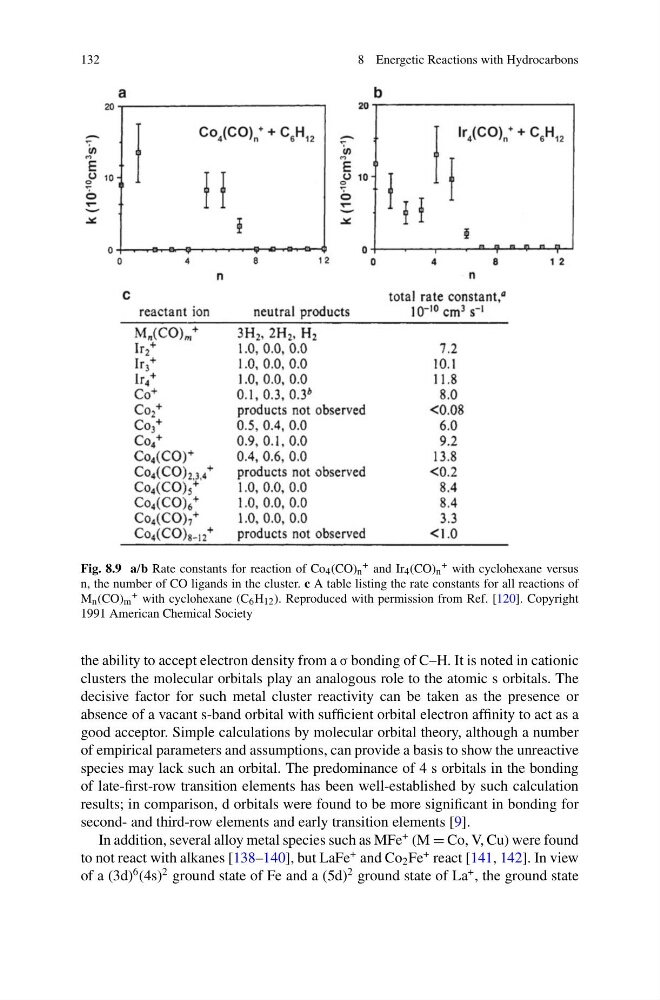
Fig. 8.9 a/b Rate constants for reaction of Co 4 (CO) n
+ and Ir 4 (CO) n
+ with cyclohexane versus
n, the number of CO ligands in the cluster. c A table listing the rate constants for all reactions of
M n (CO) m
+ with cyclohexane (C 6 H 12 ). Reproduced with permission from Ref. [120]. Copyright
1991 American Chemical Society
the ability to accept electron density from a σ bonding of C–H. It is noted in cationic
clusters the molecular orbitals play an analogous role to the atomic s orbitals. The
decisive factor for such metal cluster reactivity can be taken as the presence or
absence of a vacant s-band orbital with sufficient orbital electron affinity to act as a
good acceptor. Simple calculations by molecular orbital theory, although a number
of empirical parameters and assumptions, can provide a basis to show the unreactive
species may lack such an orbital. The predominance of 4 s orbitals in the bonding
of late-first-row transition elements has been well-established by such calculation
results; in comparison, d orbitals were found to be more significant in bonding for
second- and third-row elements and early transition elements [9].
In addition, several alloy metal species such as MFe
+ (M = Co, V, Cu) were found
to not react with alkanes [138–140], but LaFe
+ and Co 2 Fe
+ react [141, 142]. In view
of a (3d)
6 (4s)
2 ground state of Fe and a (5d)
2 ground state of La
+ , the ground state
8 Energetic Reactions with Hydrocarbons
Fig. 8.9 a/b Rate constants for reaction of Co 4 (CO) n
+ and Ir 4 (CO) n
+ with cyclohexane versus
n, the number of CO ligands in the cluster. c A table listing the rate constants for all reactions of
M n (CO) m
+ with cyclohexane (C 6 H 12 ). Reproduced with permission from Ref. [120]. Copyright
1991 American Chemical Society
the ability to accept electron density from a σ bonding of C–H. It is noted in cationic
clusters the molecular orbitals play an analogous role to the atomic s orbitals. The
decisive factor for such metal cluster reactivity can be taken as the presence or
absence of a vacant s-band orbital with sufficient orbital electron affinity to act as a
good acceptor. Simple calculations by molecular orbital theory, although a number
of empirical parameters and assumptions, can provide a basis to show the unreactive
species may lack such an orbital. The predominance of 4 s orbitals in the bonding
of late-first-row transition elements has been well-established by such calculation
results; in comparison, d orbitals were found to be more significant in bonding for
second- and third-row elements and early transition elements [9].
In addition, several alloy metal species such as MFe
+ (M = Co, V, Cu) were found
to not react with alkanes [138–140], but LaFe
+ and Co 2 Fe
+ react [141, 142]. In view
of a (3d)
6 (4s)
2 ground state of Fe and a (5d)
2 ground state of La
+ , the ground state