

7.3 Reactivity of CO with Iron Oxides
107
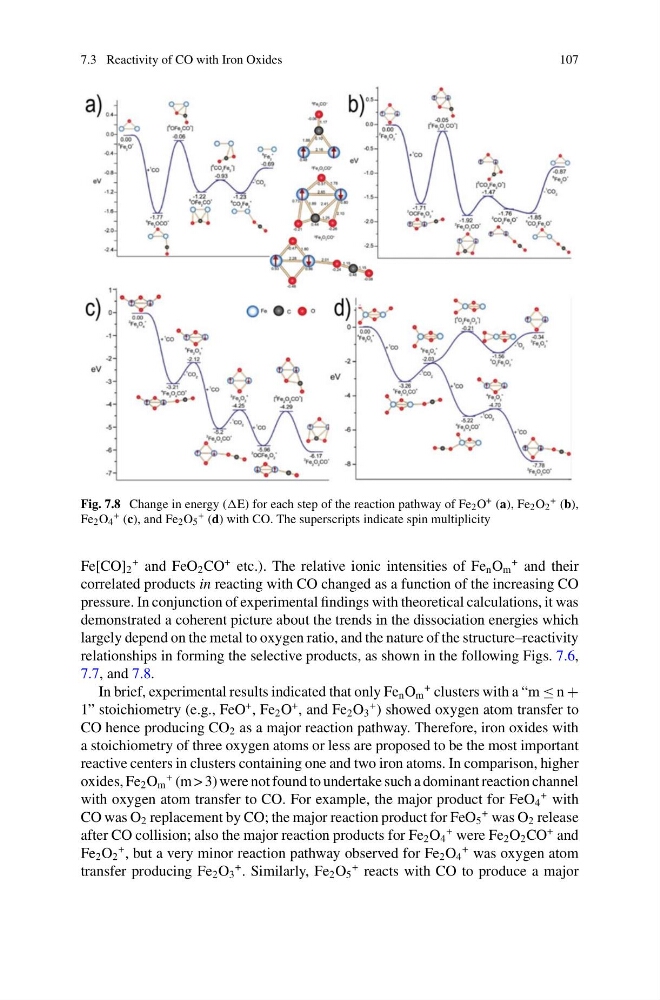
Fig. 7.8 Change in energy (E) for each step of the reaction pathway of Fe 2 O + (a), Fe 2 O 2
+ (b),
Fe 2 O 4
+ (c), and Fe 2 O 5
+ (d) with CO. The superscripts indicate spin multiplicity
Fe[CO] 2
+ and FeO 2 CO
+ etc.). The relative ionic intensities of Fe n O m
+ and their
correlated products in reacting with CO changed as a function of the increasing CO
pressure. In conjunction of experimental findings with theoretical calculations, it was
demonstrated a coherent picture about the trends in the dissociation energies which
largely depend on the metal to oxygen ratio, and the nature of the structure–reactivity
relationships in forming the selective products, as shown in the following Figs. 7.6,
7.7, and 7.8.
In brief, experimental results indicated that only Fe n O m
+ clusters with a “m ≤ n +
1” stoichiometry (e.g., FeO
+ , Fe 2 O
+ , and Fe 2 O 3
+ ) showed oxygen atom transfer to
CO hence producing CO 2 as a major reaction pathway. Therefore, iron oxides with
a stoichiometry of three oxygen atoms or less are proposed to be the most important
reactive centers in clusters containing one and two iron atoms. In comparison, higher
oxides, Fe 2 O m
+ (m > 3) were not found to undertake such a dominant reaction channel
with oxygen atom transfer to CO. For example, the major product for FeO 4
+ with
CO was O 2 replacement by CO; the major reaction product for FeO 5
+ was O 2 release
after CO collision; also the major reaction products for Fe 2 O 4
+ were Fe 2 O 2 CO
+ and
Fe 2 O 2
+ , but a very minor reaction pathway observed for Fe 2 O 4
+ was oxygen atom
transfer producing Fe 2 O 3
+ . Similarly, Fe 2 O 5
+ reacts with CO to produce a major
107
Fig. 7.8 Change in energy (E) for each step of the reaction pathway of Fe 2 O + (a), Fe 2 O 2
+ (b),
Fe 2 O 4
+ (c), and Fe 2 O 5
+ (d) with CO. The superscripts indicate spin multiplicity
Fe[CO] 2
+ and FeO 2 CO
+ etc.). The relative ionic intensities of Fe n O m
+ and their
correlated products in reacting with CO changed as a function of the increasing CO
pressure. In conjunction of experimental findings with theoretical calculations, it was
demonstrated a coherent picture about the trends in the dissociation energies which
largely depend on the metal to oxygen ratio, and the nature of the structure–reactivity
relationships in forming the selective products, as shown in the following Figs. 7.6,
7.7, and 7.8.
In brief, experimental results indicated that only Fe n O m
+ clusters with a “m ≤ n +
1” stoichiometry (e.g., FeO
+ , Fe 2 O
+ , and Fe 2 O 3
+ ) showed oxygen atom transfer to
CO hence producing CO 2 as a major reaction pathway. Therefore, iron oxides with
a stoichiometry of three oxygen atoms or less are proposed to be the most important
reactive centers in clusters containing one and two iron atoms. In comparison, higher
oxides, Fe 2 O m
+ (m > 3) were not found to undertake such a dominant reaction channel
with oxygen atom transfer to CO. For example, the major product for FeO 4
+ with
CO was O 2 replacement by CO; the major reaction product for FeO 5
+ was O 2 release
after CO collision; also the major reaction products for Fe 2 O 4
+ were Fe 2 O 2 CO
+ and
Fe 2 O 2
+ , but a very minor reaction pathway observed for Fe 2 O 4
+ was oxygen atom
transfer producing Fe 2 O 3
+ . Similarly, Fe 2 O 5
+ reacts with CO to produce a major