

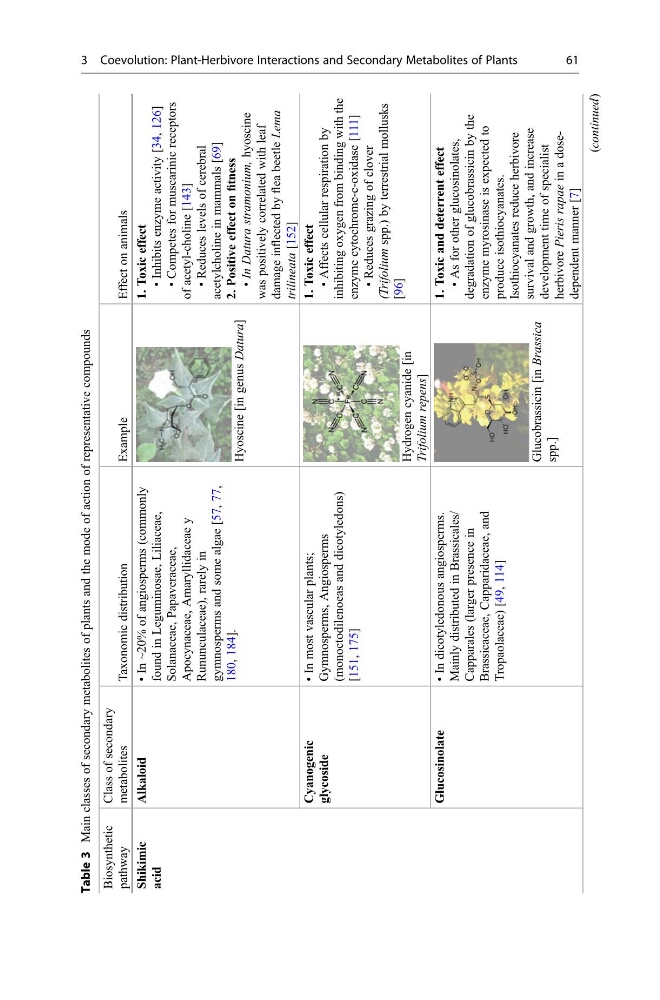
Table 3
Main classes of secondary metabolites of plants and the mode of action of representative compounds
Biosynthetic
pathway
Class of secondary
metabolites
Taxonomic distribution
Example
Effect on animals
Shikimic
acid
Alkaloid
• In ~20% of angiosperms (commonly
found in Leguminosae, Liliaceae,
Solanaceae, Papaveraceae,
Apocynaceae, Amaryllidaceae y
Rununculaceae), rarely in
gymnosperms and some algae [57, 77,
180, 184].
Hyoscine [in genus Datura]
1. Toxic effect
• Inhibits enzyme activity [34, 126]
• Competes for muscarinic receptors
of acetyl-choline [143]
• Reduces levels of cerebral
acetylcholine in mammals [69]
2. Positive effect on
fitness
• In Datura stramonium, hyoscine
was positively correlated with leaf
damage inflected by
flea beetle Lema
trilineata [152]
Cyanogenic
glycoside
• In most vascular plants;
Gymnosperms, Angiosperms
(monoctodilenoeas and dicotyledons)
[151, 175]
Hydrogen cyanide [in
Trifolium repens]
1. Toxic effect
• Affects cellular respiration by
inhibiting oxygen from binding with the
enzyme cytochrome-c-oxidase [111]
• Reduces grazing of clover
(Trifolium spp.) by terrestrial mollusks
[96]
Glucosinolate
• In dicotyledonous angiosperms.
Mainly distributed in Brassicales/
Capparales (larger presence in
Brassicaceae, Capparidaceae, and
Tropaolaceae) [49, 114]
Glucobrassicin [in Brassica
spp.]
1. Toxic and deterrent effect
• As for other glucosinolates,
degradation of glucobrassicin by the
enzyme myrosinase is expected to
produce isothiocyanates.
Isothiocyanates reduce herbivore
survival and growth, and increase
development time of specialist
herbivore Pieris rapae in a dosedependent manner [7]
(continued)
3 Coevolution: Plant-Herbivore Interactions and Secondary Metabolites of Plants
61
Main classes of secondary metabolites of plants and the mode of action of representative compounds
Biosynthetic
pathway
Class of secondary
metabolites
Taxonomic distribution
Example
Effect on animals
Shikimic
acid
Alkaloid
• In ~20% of angiosperms (commonly
found in Leguminosae, Liliaceae,
Solanaceae, Papaveraceae,
Apocynaceae, Amaryllidaceae y
Rununculaceae), rarely in
gymnosperms and some algae [57, 77,
180, 184].
Hyoscine [in genus Datura]
1. Toxic effect
• Inhibits enzyme activity [34, 126]
• Competes for muscarinic receptors
of acetyl-choline [143]
• Reduces levels of cerebral
acetylcholine in mammals [69]
2. Positive effect on
fitness
• In Datura stramonium, hyoscine
was positively correlated with leaf
damage inflected by
flea beetle Lema
trilineata [152]
Cyanogenic
glycoside
• In most vascular plants;
Gymnosperms, Angiosperms
(monoctodilenoeas and dicotyledons)
[151, 175]
Hydrogen cyanide [in
Trifolium repens]
1. Toxic effect
• Affects cellular respiration by
inhibiting oxygen from binding with the
enzyme cytochrome-c-oxidase [111]
• Reduces grazing of clover
(Trifolium spp.) by terrestrial mollusks
[96]
Glucosinolate
• In dicotyledonous angiosperms.
Mainly distributed in Brassicales/
Capparales (larger presence in
Brassicaceae, Capparidaceae, and
Tropaolaceae) [49, 114]
Glucobrassicin [in Brassica
spp.]
1. Toxic and deterrent effect
• As for other glucosinolates,
degradation of glucobrassicin by the
enzyme myrosinase is expected to
produce isothiocyanates.
Isothiocyanates reduce herbivore
survival and growth, and increase
development time of specialist
herbivore Pieris rapae in a dosedependent manner [7]
(continued)
3 Coevolution: Plant-Herbivore Interactions and Secondary Metabolites of Plants
61