

beetles are clearly dominated (>75%) by monophagous [54, 122, 149]. By
contrast, across all phytophagous insects, it is estimated that <10% are polyphagous [11, 20]. Coleoptera, Lepidoptera, Diptera, and Hymenoptera are the richest
taxonomic orders of insects (Fig. 2) and at the same time comprise most of
the specialized phytophagous (or parasitoids) that entangle long-standing relationships with plants. In Table 2 are shown representative phylogenetic studies
of the association of angiosperm host-plants and specialized phytophagous
insects. The evolutionary patterns inferred from specialized associations of
plants and phytophagous insects indicate that host use is often highly
conserved, i.e., closely related herbivores feed on closely related plants
(e.g., [53]). Besides coadaptation, the conserved host use depicted by taxonomic
congruence can either reflect parallel cladogenesis/cospeciation (Box 3) or
sequential evolution (i.e., herbivores follows the evolution of plants while the
plant evolution is not affected by herbivores, [94]). Nonetheless, although the
inference of the accurate evolutionary path behind matching phylogenies may be
challenging, and the extent to which those paths lead to adaptive radiations is not
always clear (see [119]), patterns of host use seems to be correlated with
speciation.
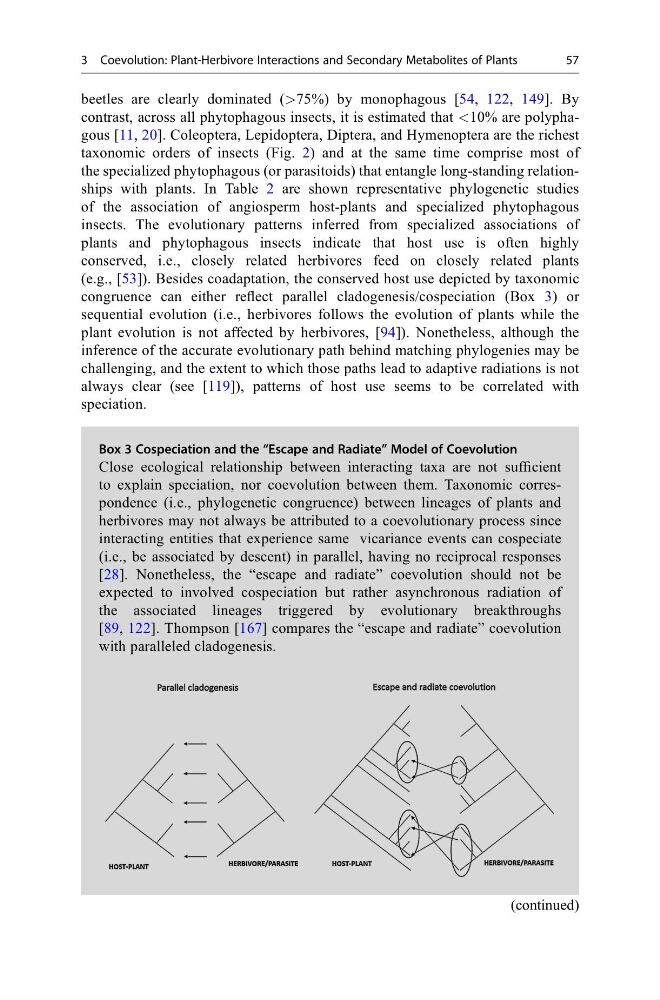
Box 3 Cospeciation and the “Escape and Radiate” Model of Coevolution
Close ecological relationship between interacting taxa are not sufficient
to explain speciation, nor coevolution between them. Taxonomic correspondence (i.e., phylogenetic congruence) between lineages of plants and
herbivores may not always be attributed to a coevolutionary process since
interacting entities that experience same vicariance events can cospeciate
(i.e., be associated by descent) in parallel, having no reciprocal responses
[28]. Nonetheless, the “escape and radiate” coevolution should not be
expected to involved cospeciation but rather asynchronous radiation of
the associated lineages triggered by evolutionary breakthroughs
[89, 122]. Thompson [167] compares the “escape and radiate” coevolution
with paralleled cladogenesis.
(continued)
3 Coevolution: Plant-Herbivore Interactions and Secondary Metabolites of Plants
57
contrast, across all phytophagous insects, it is estimated that <10% are polyphagous [11, 20]. Coleoptera, Lepidoptera, Diptera, and Hymenoptera are the richest
taxonomic orders of insects (Fig. 2) and at the same time comprise most of
the specialized phytophagous (or parasitoids) that entangle long-standing relationships with plants. In Table 2 are shown representative phylogenetic studies
of the association of angiosperm host-plants and specialized phytophagous
insects. The evolutionary patterns inferred from specialized associations of
plants and phytophagous insects indicate that host use is often highly
conserved, i.e., closely related herbivores feed on closely related plants
(e.g., [53]). Besides coadaptation, the conserved host use depicted by taxonomic
congruence can either reflect parallel cladogenesis/cospeciation (Box 3) or
sequential evolution (i.e., herbivores follows the evolution of plants while the
plant evolution is not affected by herbivores, [94]). Nonetheless, although the
inference of the accurate evolutionary path behind matching phylogenies may be
challenging, and the extent to which those paths lead to adaptive radiations is not
always clear (see [119]), patterns of host use seems to be correlated with
speciation.
Box 3 Cospeciation and the “Escape and Radiate” Model of Coevolution
Close ecological relationship between interacting taxa are not sufficient
to explain speciation, nor coevolution between them. Taxonomic correspondence (i.e., phylogenetic congruence) between lineages of plants and
herbivores may not always be attributed to a coevolutionary process since
interacting entities that experience same vicariance events can cospeciate
(i.e., be associated by descent) in parallel, having no reciprocal responses
[28]. Nonetheless, the “escape and radiate” coevolution should not be
expected to involved cospeciation but rather asynchronous radiation of
the associated lineages triggered by evolutionary breakthroughs
[89, 122]. Thompson [167] compares the “escape and radiate” coevolution
with paralleled cladogenesis.
(continued)
3 Coevolution: Plant-Herbivore Interactions and Secondary Metabolites of Plants
57