

5
Phylogenetic Patterns: Diversification of Interactions and
Molecules
Since plants and arthropods were associated thousands of million years ago, both
lineages and the secondary compounds produced by plants have been widely diversified. Only green plants (~25–30%) and phytophagous insects (26%) account for nearly
half of the known species on the planet [113, 161]. And, known plants’ secondary
metabolites are close to 200,000 different molecules [79], most of which have important ecological roles [105]. The widespread of plants and herbivorous lineages across
diverse ecosystems reflects the dynamic relationship between both groups and the
potential of adaptive evolution to shape current biodiversity.
5.1
The Diversity of Associations and Their Specialization Degree
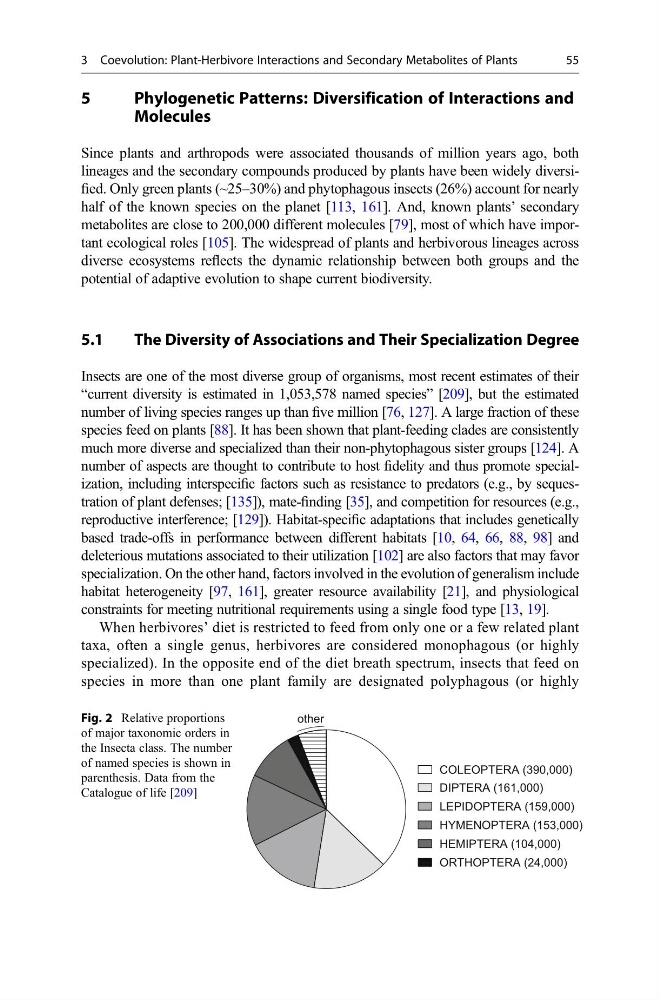
Insects are one of the most diverse group of organisms, most recent estimates of their
“current diversity is estimated in 1,053,578 named species” [209], but the estimated
number of living species ranges up than five million [76, 127]. A large fraction of these
species feed on plants [88]. It has been shown that plant-feeding clades are consistently
much more diverse and specialized than their non-phytophagous sister groups [124]. A
number of aspects are thought to contribute to host fidelity and thus promote specialization, including interspecific factors such as resistance to predators (e.g., by sequestration of plant defenses; [135]), mate-finding [35], and competition for resources (e.g.,
reproductive interference; [129]). Habitat-specific adaptations that includes genetically
based trade-offs in performance between different habitats [10, 64, 66, 88, 98] and
deleterious mutations associated to their utilization [102] are also factors that may favor
specialization. On the other hand, factors involved in the evolution of generalism include
habitat heterogeneity [97, 161], greater resource availability [21], and physiological
constraints for meeting nutritional requirements using a single food type [13, 19].
When herbivores’ diet is restricted to feed from only one or a few related plant
taxa, often a single genus, herbivores are considered monophagous (or highly
specialized). In the opposite end of the diet breath spectrum, insects that feed on
species in more than one plant family are designated polyphagous (or highly
COLEOPTERA (390,000)
DIPTERA (161,000)
LEPIDOPTERA (159,000)
HYMENOPTERA (153,000)
HEMIPTERA (104,000)
ORTHOPTERA (24,000)
other
Fig. 2 Relative proportions
of major taxonomic orders in
the Insecta class. The number
of named species is shown in
parenthesis. Data from the
Catalogue of life [209]
3 Coevolution: Plant-Herbivore Interactions and Secondary Metabolites of Plants
55
Phylogenetic Patterns: Diversification of Interactions and
Molecules
Since plants and arthropods were associated thousands of million years ago, both
lineages and the secondary compounds produced by plants have been widely diversified. Only green plants (~25–30%) and phytophagous insects (26%) account for nearly
half of the known species on the planet [113, 161]. And, known plants’ secondary
metabolites are close to 200,000 different molecules [79], most of which have important ecological roles [105]. The widespread of plants and herbivorous lineages across
diverse ecosystems reflects the dynamic relationship between both groups and the
potential of adaptive evolution to shape current biodiversity.
5.1
The Diversity of Associations and Their Specialization Degree
Insects are one of the most diverse group of organisms, most recent estimates of their
“current diversity is estimated in 1,053,578 named species” [209], but the estimated
number of living species ranges up than five million [76, 127]. A large fraction of these
species feed on plants [88]. It has been shown that plant-feeding clades are consistently
much more diverse and specialized than their non-phytophagous sister groups [124]. A
number of aspects are thought to contribute to host fidelity and thus promote specialization, including interspecific factors such as resistance to predators (e.g., by sequestration of plant defenses; [135]), mate-finding [35], and competition for resources (e.g.,
reproductive interference; [129]). Habitat-specific adaptations that includes genetically
based trade-offs in performance between different habitats [10, 64, 66, 88, 98] and
deleterious mutations associated to their utilization [102] are also factors that may favor
specialization. On the other hand, factors involved in the evolution of generalism include
habitat heterogeneity [97, 161], greater resource availability [21], and physiological
constraints for meeting nutritional requirements using a single food type [13, 19].
When herbivores’ diet is restricted to feed from only one or a few related plant
taxa, often a single genus, herbivores are considered monophagous (or highly
specialized). In the opposite end of the diet breath spectrum, insects that feed on
species in more than one plant family are designated polyphagous (or highly
COLEOPTERA (390,000)
DIPTERA (161,000)
LEPIDOPTERA (159,000)
HYMENOPTERA (153,000)
HEMIPTERA (104,000)
ORTHOPTERA (24,000)
other
Fig. 2 Relative proportions
of major taxonomic orders in
the Insecta class. The number
of named species is shown in
parenthesis. Data from the
Catalogue of life [209]
3 Coevolution: Plant-Herbivore Interactions and Secondary Metabolites of Plants
55