

Moreover, ways to transfer stilbenes into wine to achieve the production of addedvalue wines (stilbene-enriched wines) are also reviewed and discussed.
2
Elicitors to Increase Stilbene Concentration in Grapes
Stilbenes are known to act as phytoalexins, plant defensive substances of low
molecular weight synthesized de novo in response to stress. The process by which
the grapevine is stimulated to produce secondary metabolites is called “elicitation,”
indicating an external stressful stimulus applied to the plant. Therefore, the stilbene
concentration in grapes can be significantly increased by both biotic and abiotic
stresses. The fungi that attack grapevines, such as Botrytis cinerea (gray mold),
Plasmopara viticola (downy mildew), or Erysiphe necator (powdery mildew) are
considered biotic stresses. Meanwhile, abiotic stresses can be classified as chemical
and physical elicitors. Below is a review of how abiotic stress affects the stilbene
content in grapes.
2.1
Chemical Elicitors
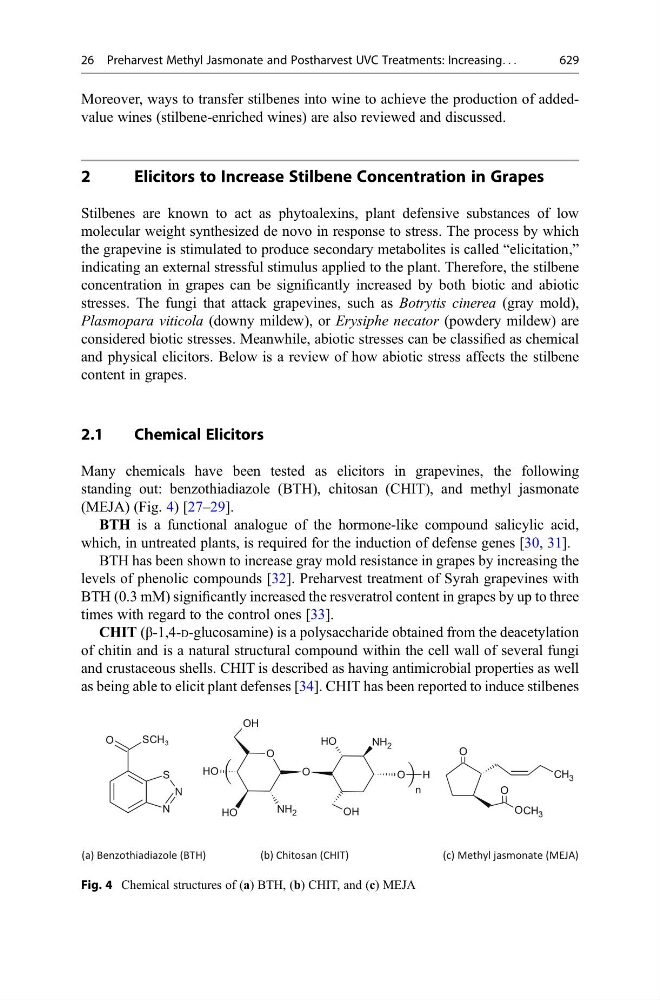
Many chemicals have been tested as elicitors in grapevines, the following
standing out: benzothiadiazole (BTH), chitosan (CHIT), and methyl jasmonate
(MEJA) (Fig. 4) [27–29].
BTH is a functional analogue of the hormone-like compound salicylic acid,
which, in untreated plants, is required for the induction of defense genes [30, 31].
BTH has been shown to increase gray mold resistance in grapes by increasing the
levels of phenolic compounds [32]. Preharvest treatment of Syrah grapevines with
BTH (0.3 mM) significantly increased the resveratrol content in grapes by up to three
times with regard to the control ones [33].
CHIT (β-1,4-D-glucosamine) is a polysaccharide obtained from the deacetylation
of chitin and is a natural structural compound within the cell wall of several fungi
and crustaceous shells. CHIT is described as having antimicrobial properties as well
as being able to elicit plant defenses [34]. CHIT has been reported to induce stilbenes
S
N
N
SCH 3
O
OH
H
NH 2
O
H
O
OH
O
H
O
H
O
NH 2
O
n
O
OCH 3
O
CH 3
(a) Benzothiadiazole (BTH)
(b) Chitosan (CHIT)
(c) Methyl jasmonate (MEJA)
Fig. 4 Chemical structures of (a) BTH, (b) CHIT, and (c) MEJA
26 Preharvest Methyl Jasmonate and Postharvest UVC Treatments: Increasing. . .
629