

leads to the induction of gene expression needed for the establishment of mutualism.
Pathogenic microbes might hijack CSSP during pathogen colonization of plant
tissues. In a large screen of Medicago truncatula containing mutations in the
CSSP, Rey et al. [50] found that a small number of mutants were impaired in both
mutualistic and pathogenic symbioses. Therefore, when considering how plants
respond to microbial presence, we must keep in mind that there are certain signaling
pathways that have pleotropic effects on a variety of symbiotic interactions [48]
(Scheme 1).
3
Early Response to Herbivores
MAMP/PAMPs early perception as has an analogous term for herbivore-associated
molecular patterns (HAMPs). Several elicitors have been isolated from Lepidoptera
and Coleoptera oral secretions (OS), from their salivary and ventral eversible gland
secretions, and from the ovipositor fluids of these species [51–54]. HAMPs and
PAMPs trigger Vm membrane depolarization, a transient intracellular Ca
2+ influx,
the activation of Ca
2+ -dependent protein kinases (CDPKs), and MPK3 (woundinduced protein kinase, WIPK)/MPK6 (salicylic acid-induced protein kinase,
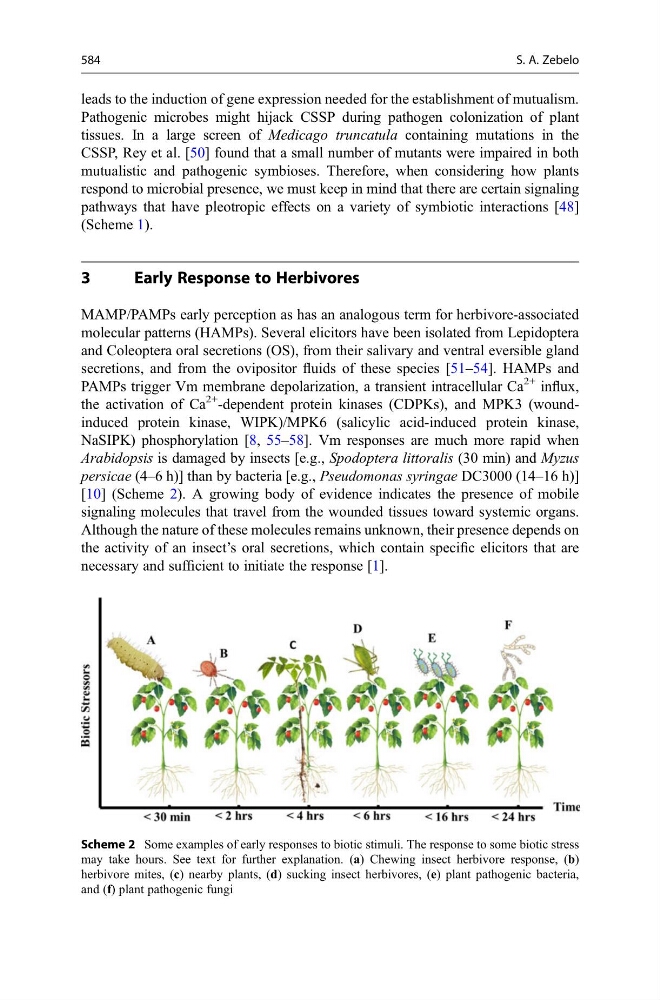
NaSIPK) phosphorylation [8, 55–58]. Vm responses are much more rapid when
Arabidopsis is damaged by insects [e.g., Spodoptera littoralis (30 min) and Myzus
persicae (4–6 h)] than by bacteria [e.g., Pseudomonas syringae DC3000 (14–16 h)]
[10] (Scheme 2). A growing body of evidence indicates the presence of mobile
signaling molecules that travel from the wounded tissues toward systemic organs.
Although the nature of these molecules remains unknown, their presence depends on
the activity of an insect’s oral secretions, which contain specific elicitors that are
necessary and sufficient to initiate the response [1].
Scheme 2 Some examples of early responses to biotic stimuli. The response to some biotic stress
may take hours. See text for further explanation. (a) Chewing insect herbivore response, (b)
herbivore mites, (c) nearby plants, (d) sucking insect herbivores, (e) plant pathogenic bacteria,
and (f) plant pathogenic fungi
584
S. A. Zebelo
Pathogenic microbes might hijack CSSP during pathogen colonization of plant
tissues. In a large screen of Medicago truncatula containing mutations in the
CSSP, Rey et al. [50] found that a small number of mutants were impaired in both
mutualistic and pathogenic symbioses. Therefore, when considering how plants
respond to microbial presence, we must keep in mind that there are certain signaling
pathways that have pleotropic effects on a variety of symbiotic interactions [48]
(Scheme 1).
3
Early Response to Herbivores
MAMP/PAMPs early perception as has an analogous term for herbivore-associated
molecular patterns (HAMPs). Several elicitors have been isolated from Lepidoptera
and Coleoptera oral secretions (OS), from their salivary and ventral eversible gland
secretions, and from the ovipositor fluids of these species [51–54]. HAMPs and
PAMPs trigger Vm membrane depolarization, a transient intracellular Ca
2+ influx,
the activation of Ca
2+ -dependent protein kinases (CDPKs), and MPK3 (woundinduced protein kinase, WIPK)/MPK6 (salicylic acid-induced protein kinase,
NaSIPK) phosphorylation [8, 55–58]. Vm responses are much more rapid when
Arabidopsis is damaged by insects [e.g., Spodoptera littoralis (30 min) and Myzus
persicae (4–6 h)] than by bacteria [e.g., Pseudomonas syringae DC3000 (14–16 h)]
[10] (Scheme 2). A growing body of evidence indicates the presence of mobile
signaling molecules that travel from the wounded tissues toward systemic organs.
Although the nature of these molecules remains unknown, their presence depends on
the activity of an insect’s oral secretions, which contain specific elicitors that are
necessary and sufficient to initiate the response [1].
Scheme 2 Some examples of early responses to biotic stimuli. The response to some biotic stress
may take hours. See text for further explanation. (a) Chewing insect herbivore response, (b)
herbivore mites, (c) nearby plants, (d) sucking insect herbivores, (e) plant pathogenic bacteria,
and (f) plant pathogenic fungi
584
S. A. Zebelo