

In a study, the application of ethanol leaf water extracts of California pepper tree
(Schinus molle L., 4.3–4.7% w/v) reduced the population of elm leaf beetle
(Xanthogaleruca luteola Müller.) by 97% [164]. Some weeds such as ragweed
(Ambrosia trifida L.), chickweed, and Spanish flag (Lantana camara L.) have a
great allelopathic activity against insect pests [173].
5
Allelopathy for Disease Management
Several crops including oilseed, cereal, sugar crops, and especially vegetables are
seriously affected by the plant diseases. The main causing agents of soilborne and
seed-borne diseases are fungi, bacteria, viruses, and certain nematode pathogen. A
decrease in crop stand and production quality has been reported due to incidence of
soilborne diseases with simultaneous reduction in the final yield. Although cultural
operations like setting of infested plant residues to fire and adopting resistant
genotypes against disease may provide some control, still plant diseases may
cause considerable yield losses. The control of diseases through chemical is nonecological and may deteriorate the environment [6]. This indicates demand for the
control of pathogens and diseases and through ecological approaches like allelopathy. A fungus Sclerotinia sclerotiorum in beans was controlled by the application of
water extracts of various cereals, sweet clover, canola, and lentil (Lens culinaris
Medik.) at low concentrations [174].
The bark of sugi (Cryptomeria japonica D.) has been used to control the
root infection diseases in tomato [70]. The growth of bacterial wilt (Pseudomonas
solanacearum Smith) was inhibited by the application of root exudates of
the Chinese chive (Allium tuberosum L.) without adverse effect on tomato [175].
Likewise, the aerial parts of some marigold (Tagetes erecta L.) species produce the
volatile allelochemicals which are useful to control tomato early blight disease (90%
reduction), caused by Alternaria solani [70]. In tomato intercropped with cowpea,
the tomato bacterial wilt, caused by Ralstonia solanacearum, was controlled to a
great extent [175]. The growth of root-knot nematode (Meloidogyne javanica T.) can
be controlled by using the neem leaves/cakes [176]. Volatile sulfur compounds
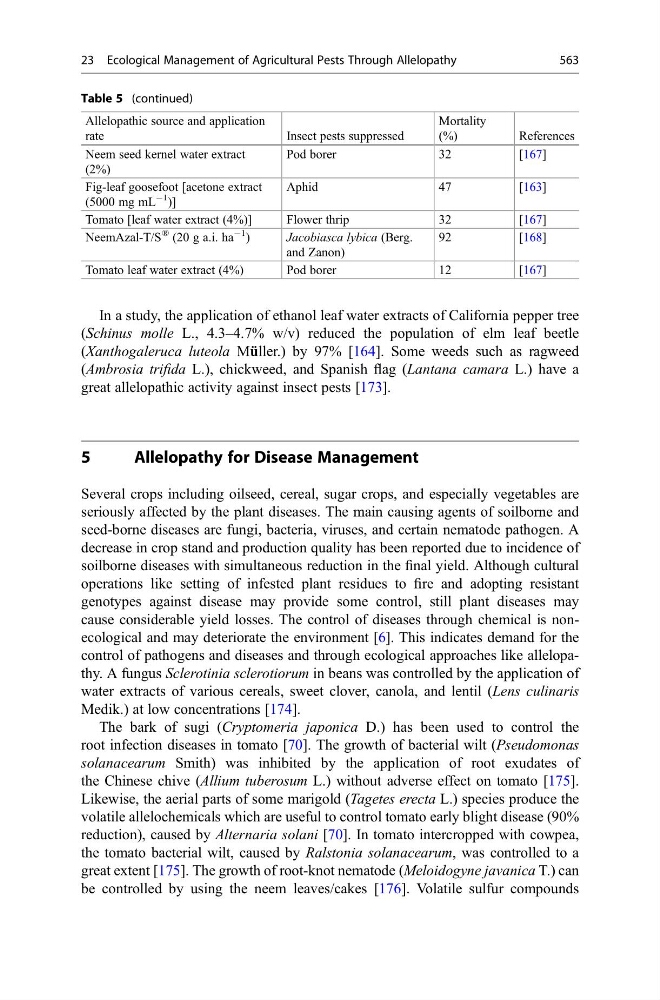
Table 5 (continued)
Allelopathic source and application
rate
Insect pests suppressed
Mortality
(%)
References
Neem seed kernel water extract
(2%)
Pod borer
32
[167]
Fig-leaf goosefoot [acetone extract
(5000 mg mL
À1
)]
Aphid
47
[163]
Tomato [leaf water extract (4%)]
Flower thrip
32
[167]
NeemAzal-T/S
® (20 g a.i. ha
À1
)
Jacobiasca lybica (Berg.
and Zanon)
92
[168]
Tomato leaf water extract (4%)
Pod borer
12
[167]
23 Ecological Management of Agricultural Pests Through Allelopathy
563
(Schinus molle L., 4.3–4.7% w/v) reduced the population of elm leaf beetle
(Xanthogaleruca luteola Müller.) by 97% [164]. Some weeds such as ragweed
(Ambrosia trifida L.), chickweed, and Spanish flag (Lantana camara L.) have a
great allelopathic activity against insect pests [173].
5
Allelopathy for Disease Management
Several crops including oilseed, cereal, sugar crops, and especially vegetables are
seriously affected by the plant diseases. The main causing agents of soilborne and
seed-borne diseases are fungi, bacteria, viruses, and certain nematode pathogen. A
decrease in crop stand and production quality has been reported due to incidence of
soilborne diseases with simultaneous reduction in the final yield. Although cultural
operations like setting of infested plant residues to fire and adopting resistant
genotypes against disease may provide some control, still plant diseases may
cause considerable yield losses. The control of diseases through chemical is nonecological and may deteriorate the environment [6]. This indicates demand for the
control of pathogens and diseases and through ecological approaches like allelopathy. A fungus Sclerotinia sclerotiorum in beans was controlled by the application of
water extracts of various cereals, sweet clover, canola, and lentil (Lens culinaris
Medik.) at low concentrations [174].
The bark of sugi (Cryptomeria japonica D.) has been used to control the
root infection diseases in tomato [70]. The growth of bacterial wilt (Pseudomonas
solanacearum Smith) was inhibited by the application of root exudates of
the Chinese chive (Allium tuberosum L.) without adverse effect on tomato [175].
Likewise, the aerial parts of some marigold (Tagetes erecta L.) species produce the
volatile allelochemicals which are useful to control tomato early blight disease (90%
reduction), caused by Alternaria solani [70]. In tomato intercropped with cowpea,
the tomato bacterial wilt, caused by Ralstonia solanacearum, was controlled to a
great extent [175]. The growth of root-knot nematode (Meloidogyne javanica T.) can
be controlled by using the neem leaves/cakes [176]. Volatile sulfur compounds
Table 5 (continued)
Allelopathic source and application
rate
Insect pests suppressed
Mortality
(%)
References
Neem seed kernel water extract
(2%)
Pod borer
32
[167]
Fig-leaf goosefoot [acetone extract
(5000 mg mL
À1
)]
Aphid
47
[163]
Tomato [leaf water extract (4%)]
Flower thrip
32
[167]
NeemAzal-T/S
® (20 g a.i. ha
À1
)
Jacobiasca lybica (Berg.
and Zanon)
92
[168]
Tomato leaf water extract (4%)
Pod borer
12
[167]
23 Ecological Management of Agricultural Pests Through Allelopathy
563