

understory plants also influence each other allelopathically, which leads to overall
reduction in species richness and diversity. Studies have shown the reduction in
understory species abundance and diversity, forest floor organic matter depletion,
soil erosion and habitat degradation, and reduction in crop production due to
allelopathy in many parts of the world [16]. Moreover, research study has showed
the processes by which allelochemical comes into environment are volatilization
from aerial parts, leaching, root exudation, and residual decomposition of dead plant
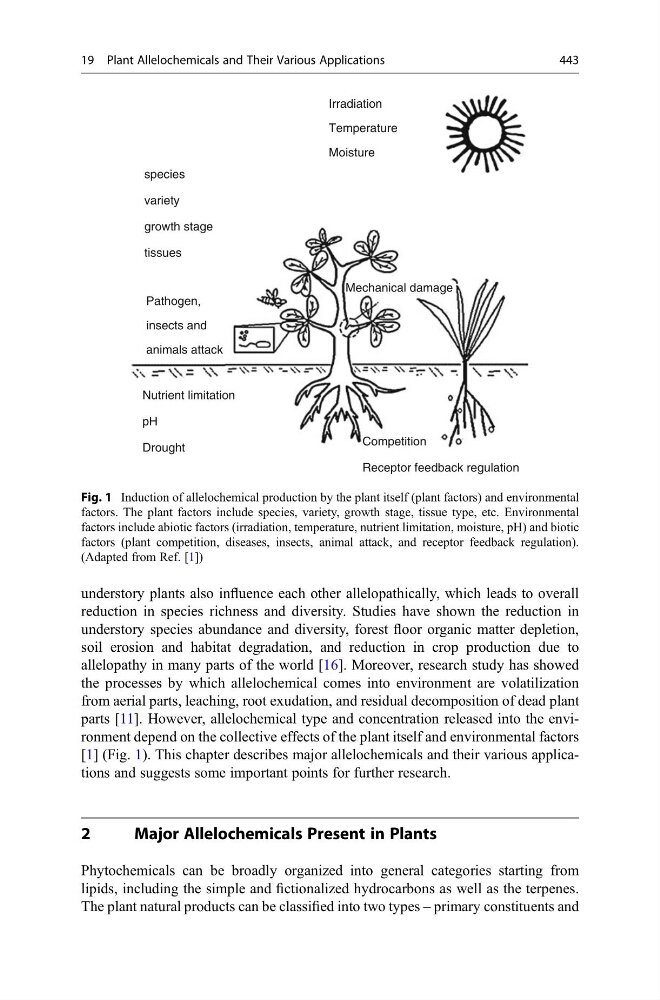
parts [11]. However, allelochemical type and concentration released into the environment depend on the collective effects of the plant itself and environmental factors
[1] (Fig. 1). This chapter describes major allelochemicals and their various applications and suggests some important points for further research.
2
Major Allelochemicals Present in Plants
Phytochemicals can be broadly organized into general categories starting from
lipids, including the simple and fictionalized hydrocarbons as well as the terpenes.
The plant natural products can be classified into two types – primary constituents and
Irradiation
Temperature
Moisture
Mechanical damage
species
variety
growth stage
tissues
Pathogen,
insects and
animals attack
Nutrient limitation
pH
Drought
Competition
Receptor feedback regulation
Fig. 1 Induction of allelochemical production by the plant itself (plant factors) and environmental
factors. The plant factors include species, variety, growth stage, tissue type, etc. Environmental
factors include abiotic factors (irradiation, temperature, nutrient limitation, moisture, pH) and biotic
factors (plant competition, diseases, insects, animal attack, and receptor feedback regulation).
(Adapted from Ref. [1])
19 Plant Allelochemicals and Their Various Applications
443
reduction in species richness and diversity. Studies have shown the reduction in
understory species abundance and diversity, forest floor organic matter depletion,
soil erosion and habitat degradation, and reduction in crop production due to
allelopathy in many parts of the world [16]. Moreover, research study has showed
the processes by which allelochemical comes into environment are volatilization
from aerial parts, leaching, root exudation, and residual decomposition of dead plant
parts [11]. However, allelochemical type and concentration released into the environment depend on the collective effects of the plant itself and environmental factors
[1] (Fig. 1). This chapter describes major allelochemicals and their various applications and suggests some important points for further research.
2
Major Allelochemicals Present in Plants
Phytochemicals can be broadly organized into general categories starting from
lipids, including the simple and fictionalized hydrocarbons as well as the terpenes.
The plant natural products can be classified into two types – primary constituents and
Irradiation
Temperature
Moisture
Mechanical damage
species
variety
growth stage
tissues
Pathogen,
insects and
animals attack
Nutrient limitation
pH
Drought
Competition
Receptor feedback regulation
Fig. 1 Induction of allelochemical production by the plant itself (plant factors) and environmental
factors. The plant factors include species, variety, growth stage, tissue type, etc. Environmental
factors include abiotic factors (irradiation, temperature, nutrient limitation, moisture, pH) and biotic
factors (plant competition, diseases, insects, animal attack, and receptor feedback regulation).
(Adapted from Ref. [1])
19 Plant Allelochemicals and Their Various Applications
443