

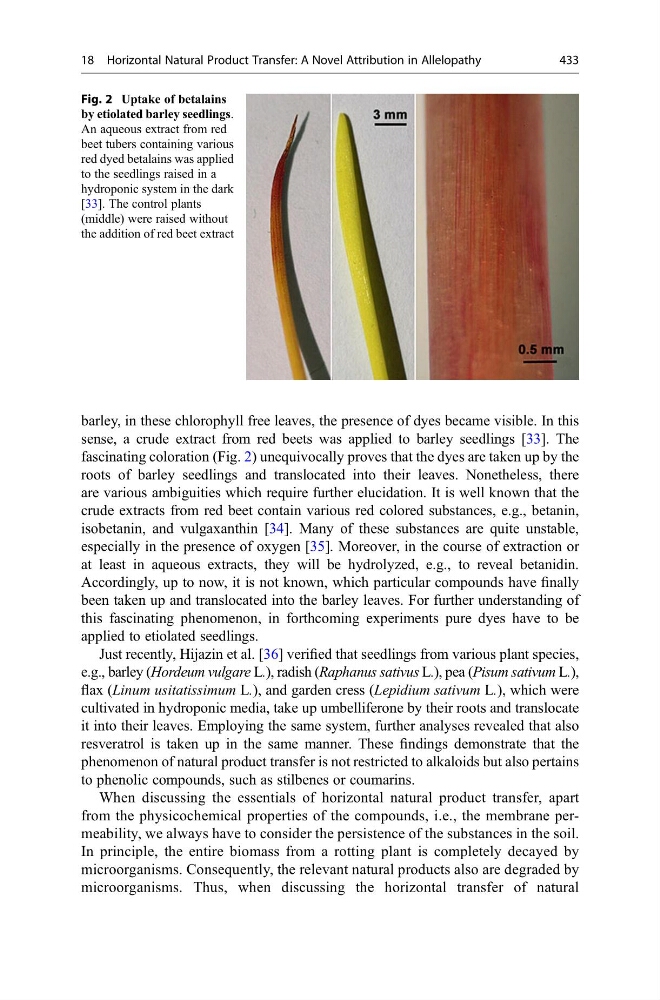
barley, in these chlorophyll free leaves, the presence of dyes became visible. In this
sense, a crude extract from red beets was applied to barley seedlings [33]. The
fascinating coloration (Fig. 2) unequivocally proves that the dyes are taken up by the
roots of barley seedlings and translocated into their leaves. Nonetheless, there
are various ambiguities which require further elucidation. It is well known that the
crude extracts from red beet contain various red colored substances, e.g., betanin,
isobetanin, and vulgaxanthin [34]. Many of these substances are quite unstable,
especially in the presence of oxygen [35]. Moreover, in the course of extraction or
at least in aqueous extracts, they will be hydrolyzed, e.g., to reveal betanidin.
Accordingly, up to now, it is not known, which particular compounds have finally
been taken up and translocated into the barley leaves. For further understanding of
this fascinating phenomenon, in forthcoming experiments pure dyes have to be
applied to etiolated seedlings.
Just recently, Hijazin et al. [36] verified that seedlings from various plant species,
e.g., barley (Hordeum vulgare L.), radish (Raphanus sativus L.), pea (Pisum sativum L.),
flax (Linum usitatissimum L.), and garden cress (Lepidium sativum L.), which were
cultivated in hydroponic media, take up umbelliferone by their roots and translocate
it into their leaves. Employing the same system, further analyses revealed that also
resveratrol is taken up in the same manner. These findings demonstrate that the
phenomenon of natural product transfer is not restricted to alkaloids but also pertains
to phenolic compounds, such as stilbenes or coumarins.
When discussing the essentials of horizontal natural product transfer, apart
from the physicochemical properties of the compounds, i.e., the membrane permeability, we always have to consider the persistence of the substances in the soil.
In principle, the entire biomass from a rotting plant is completely decayed by
microorganisms. Consequently, the relevant natural products also are degraded by
microorganisms. Thus, when discussing the horizontal transfer of natural
Fig. 2 Uptake of betalains
by etiolated barley seedlings.
An aqueous extract from red
beet tubers containing various
red dyed betalains was applied
to the seedlings raised in a
hydroponic system in the dark
[33]. The control plants
(middle) were raised without
the addition of red beet extract
18 Horizontal Natural Product Transfer: A Novel Attribution in Allelopathy
433
sense, a crude extract from red beets was applied to barley seedlings [33]. The
fascinating coloration (Fig. 2) unequivocally proves that the dyes are taken up by the
roots of barley seedlings and translocated into their leaves. Nonetheless, there
are various ambiguities which require further elucidation. It is well known that the
crude extracts from red beet contain various red colored substances, e.g., betanin,
isobetanin, and vulgaxanthin [34]. Many of these substances are quite unstable,
especially in the presence of oxygen [35]. Moreover, in the course of extraction or
at least in aqueous extracts, they will be hydrolyzed, e.g., to reveal betanidin.
Accordingly, up to now, it is not known, which particular compounds have finally
been taken up and translocated into the barley leaves. For further understanding of
this fascinating phenomenon, in forthcoming experiments pure dyes have to be
applied to etiolated seedlings.
Just recently, Hijazin et al. [36] verified that seedlings from various plant species,
e.g., barley (Hordeum vulgare L.), radish (Raphanus sativus L.), pea (Pisum sativum L.),
flax (Linum usitatissimum L.), and garden cress (Lepidium sativum L.), which were
cultivated in hydroponic media, take up umbelliferone by their roots and translocate
it into their leaves. Employing the same system, further analyses revealed that also
resveratrol is taken up in the same manner. These findings demonstrate that the
phenomenon of natural product transfer is not restricted to alkaloids but also pertains
to phenolic compounds, such as stilbenes or coumarins.
When discussing the essentials of horizontal natural product transfer, apart
from the physicochemical properties of the compounds, i.e., the membrane permeability, we always have to consider the persistence of the substances in the soil.
In principle, the entire biomass from a rotting plant is completely decayed by
microorganisms. Consequently, the relevant natural products also are degraded by
microorganisms. Thus, when discussing the horizontal transfer of natural
Fig. 2 Uptake of betalains
by etiolated barley seedlings.
An aqueous extract from red
beet tubers containing various
red dyed betalains was applied
to the seedlings raised in a
hydroponic system in the dark
[33]. The control plants
(middle) were raised without
the addition of red beet extract
18 Horizontal Natural Product Transfer: A Novel Attribution in Allelopathy
433