

acceptor plants [20]. In the same manner as nicotine, also the PAs leached out from
plant remains into the soil are subsequently taken up by other plants. Obviously, such
transfer of alkaloids is – at least in part – responsible for the numerous and
widespread PA contaminations of spice and medicinal plants reported [16, 17].
2
The Horizontal Natural Product Transfer: A Quite General
Phenomenon
Inspired by the findings of the uptake of nicotine and PA by various acceptor plants,
the concept of “Horizontal Natural Product Transfer” was introduced by Selmar et
al. [21]: when natural products are leached out into the soil from decomposing plant
parts – denoted as donor plants – these compounds could be transferred into the roots
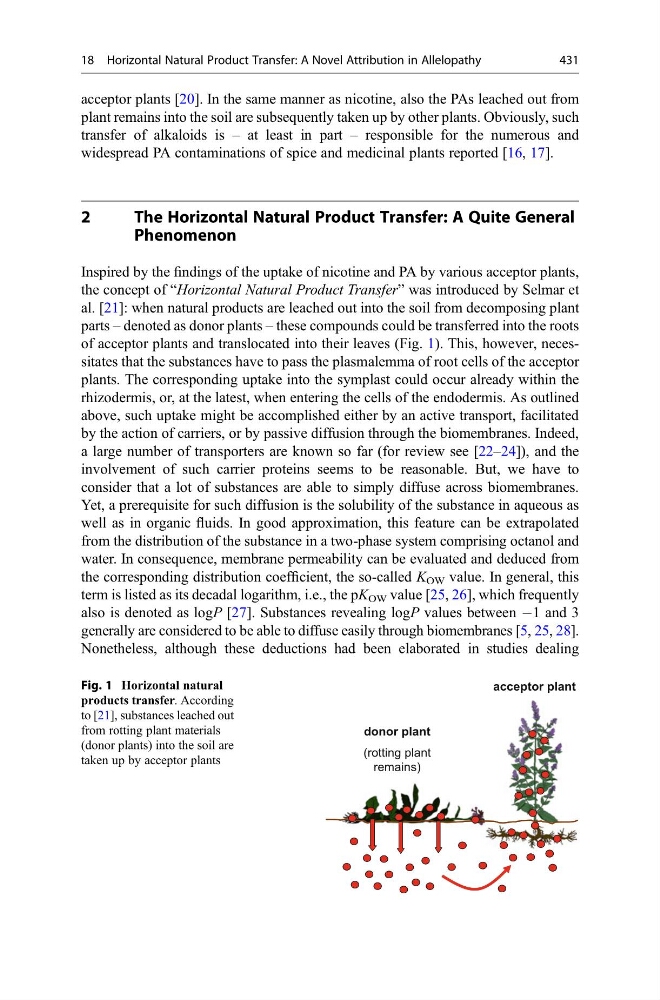
of acceptor plants and translocated into their leaves (Fig. 1). This, however, necessitates that the substances have to pass the plasmalemma of root cells of the acceptor
plants. The corresponding uptake into the symplast could occur already within the
rhizodermis, or, at the latest, when entering the cells of the endodermis. As outlined
above, such uptake might be accomplished either by an active transport, facilitated
by the action of carriers, or by passive diffusion through the biomembranes. Indeed,
a large number of transporters are known so far (for review see [22–24]), and the
involvement of such carrier proteins seems to be reasonable. But, we have to
consider that a lot of substances are able to simply diffuse across biomembranes.
Yet, a prerequisite for such diffusion is the solubility of the substance in aqueous as
well as in organic fluids. In good approximation, this feature can be extrapolated
from the distribution of the substance in a two-phase system comprising octanol and
water. In consequence, membrane permeability can be evaluated and deduced from
the corresponding distribution coefficient, the so-called K OW value. In general, this
term is listed as its decadal logarithm, i.e., the pK OW value [25, 26], which frequently
also is denoted as logP [27]. Substances revealing logP values between À1 and 3
generally are considered to be able to diffuse easily through biomembranes [5, 25, 28].
Nonetheless, although these deductions had been elaborated in studies dealing
donor plant
(rotting plant
remains)
acceptor plant
Fig. 1 Horizontal natural
products transfer. According
to [21], substances leached out
from rotting plant materials
(donor plants) into the soil are
taken up by acceptor plants
18 Horizontal Natural Product Transfer: A Novel Attribution in Allelopathy
431
plant remains into the soil are subsequently taken up by other plants. Obviously, such
transfer of alkaloids is – at least in part – responsible for the numerous and
widespread PA contaminations of spice and medicinal plants reported [16, 17].
2
The Horizontal Natural Product Transfer: A Quite General
Phenomenon
Inspired by the findings of the uptake of nicotine and PA by various acceptor plants,
the concept of “Horizontal Natural Product Transfer” was introduced by Selmar et
al. [21]: when natural products are leached out into the soil from decomposing plant
parts – denoted as donor plants – these compounds could be transferred into the roots
of acceptor plants and translocated into their leaves (Fig. 1). This, however, necessitates that the substances have to pass the plasmalemma of root cells of the acceptor
plants. The corresponding uptake into the symplast could occur already within the
rhizodermis, or, at the latest, when entering the cells of the endodermis. As outlined
above, such uptake might be accomplished either by an active transport, facilitated
by the action of carriers, or by passive diffusion through the biomembranes. Indeed,
a large number of transporters are known so far (for review see [22–24]), and the
involvement of such carrier proteins seems to be reasonable. But, we have to
consider that a lot of substances are able to simply diffuse across biomembranes.
Yet, a prerequisite for such diffusion is the solubility of the substance in aqueous as
well as in organic fluids. In good approximation, this feature can be extrapolated
from the distribution of the substance in a two-phase system comprising octanol and
water. In consequence, membrane permeability can be evaluated and deduced from
the corresponding distribution coefficient, the so-called K OW value. In general, this
term is listed as its decadal logarithm, i.e., the pK OW value [25, 26], which frequently
also is denoted as logP [27]. Substances revealing logP values between À1 and 3
generally are considered to be able to diffuse easily through biomembranes [5, 25, 28].
Nonetheless, although these deductions had been elaborated in studies dealing
donor plant
(rotting plant
remains)
acceptor plant
Fig. 1 Horizontal natural
products transfer. According
to [21], substances leached out
from rotting plant materials
(donor plants) into the soil are
taken up by acceptor plants
18 Horizontal Natural Product Transfer: A Novel Attribution in Allelopathy
431