

TPSs are highly non-specific, and thus terpenoids are always emitted in diverse
mixtures [34, 44]. Terpenoids are involved in plant defense, either through direct
toxicity or in indirect defense systems, as recruiting signals for natural enemies of
antagonists [13, 34, 45]. At the same time, their presence in ripe fruit scent has been
demonstrated to attract bats [38] and primates [46].
2.1.2 Fatty Acid Derivatives
Fatty acid derivatives such as saturated and unsaturated hydrocarbons and alcohols,
esters, and aldehydes, ketones, and carboxylic acids are among the largest classes of
volatile secondary metabolites in flowers [47]. Volatile fatty acid derivatives are
primarily synthesized by degrading C18 linoleic and linolenic acids into C12 and C6
alcohols (e.g., n-hexanol, 2- or 3-hexenol), aldehydes (e.g., n-hexanal, 2- or
3-hexenal), and carboxylic acids (e.g., 3-hexenyl acetate) [33, 48–50]. These compounds and their derivatives are very common in plant green tissue and are often
collectively called “green leaf volatiles” [13].
Fatty acid derivatives are highly common in fruits of wild and cultivated species
[14, 15, 39, 40, 51]. Some fatty acid derivatives such as various green leaf volatiles
can be found in both ripe and unripe fruits and are possibly involved in fruit defense
[16]. In contrast, aliphatic esters tend to be more common in ripe [18, 51–53] and
even more in overripe [54] fruits. Interestingly, while the synthesis of most plant
VOCs is based on self-biosynthetic machinery and precursors, esters are at least
partially synthesized by bacteria-produced precursors: Esters are synthesized by a
condensation of a carboxylic acid and an alcohol, and alcohols are often the limiting
factor in ester synthesis in fruits [53]. Ethanol, a precursor of ethyl esters, is a product
of sugar fermentation by microbes [55], and treatment of fruits with antibiotics leads
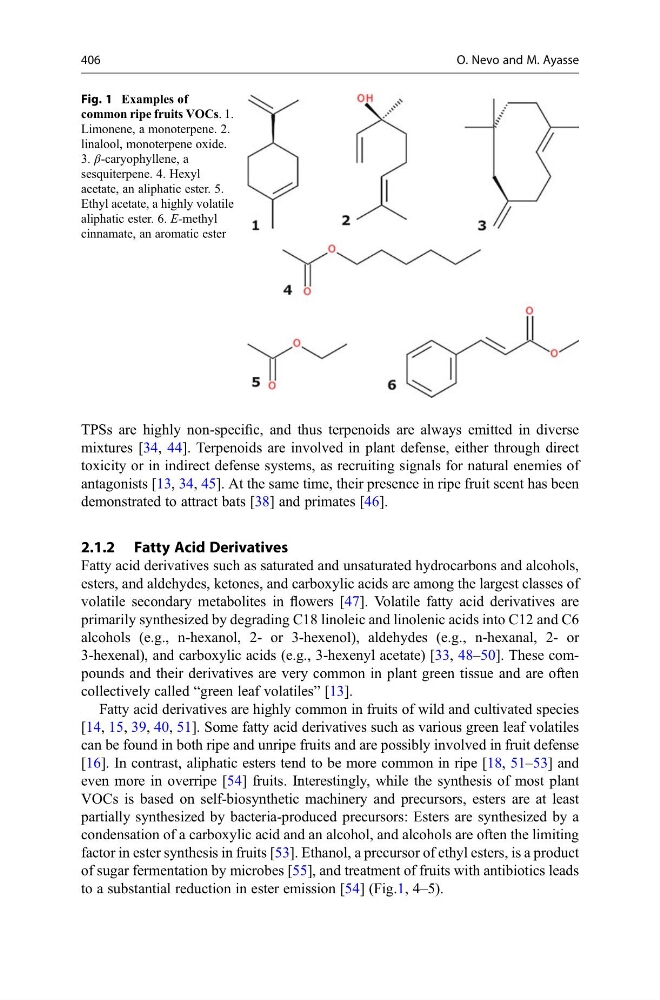
to a substantial reduction in ester emission [54] (Fig.1, 4–5).
Fig. 1 Examples of
common ripe fruits VOCs. 1.
Limonene, a monoterpene. 2.
linalool, monoterpene oxide.
3. β-caryophyllene, a
sesquiterpene. 4. Hexyl
acetate, an aliphatic ester. 5.
Ethyl acetate, a highly volatile
aliphatic ester. 6. E-methyl
cinnamate, an aromatic ester
406
O. Nevo and M. Ayasse
mixtures [34, 44]. Terpenoids are involved in plant defense, either through direct
toxicity or in indirect defense systems, as recruiting signals for natural enemies of
antagonists [13, 34, 45]. At the same time, their presence in ripe fruit scent has been
demonstrated to attract bats [38] and primates [46].
2.1.2 Fatty Acid Derivatives
Fatty acid derivatives such as saturated and unsaturated hydrocarbons and alcohols,
esters, and aldehydes, ketones, and carboxylic acids are among the largest classes of
volatile secondary metabolites in flowers [47]. Volatile fatty acid derivatives are
primarily synthesized by degrading C18 linoleic and linolenic acids into C12 and C6
alcohols (e.g., n-hexanol, 2- or 3-hexenol), aldehydes (e.g., n-hexanal, 2- or
3-hexenal), and carboxylic acids (e.g., 3-hexenyl acetate) [33, 48–50]. These compounds and their derivatives are very common in plant green tissue and are often
collectively called “green leaf volatiles” [13].
Fatty acid derivatives are highly common in fruits of wild and cultivated species
[14, 15, 39, 40, 51]. Some fatty acid derivatives such as various green leaf volatiles
can be found in both ripe and unripe fruits and are possibly involved in fruit defense
[16]. In contrast, aliphatic esters tend to be more common in ripe [18, 51–53] and
even more in overripe [54] fruits. Interestingly, while the synthesis of most plant
VOCs is based on self-biosynthetic machinery and precursors, esters are at least
partially synthesized by bacteria-produced precursors: Esters are synthesized by a
condensation of a carboxylic acid and an alcohol, and alcohols are often the limiting
factor in ester synthesis in fruits [53]. Ethanol, a precursor of ethyl esters, is a product
of sugar fermentation by microbes [55], and treatment of fruits with antibiotics leads
to a substantial reduction in ester emission [54] (Fig.1, 4–5).
Fig. 1 Examples of
common ripe fruits VOCs. 1.
Limonene, a monoterpene. 2.
linalool, monoterpene oxide.
3. β-caryophyllene, a
sesquiterpene. 4. Hexyl
acetate, an aliphatic ester. 5.
Ethyl acetate, a highly volatile
aliphatic ester. 6. E-methyl
cinnamate, an aromatic ester
406
O. Nevo and M. Ayasse