

preference in sifakas although the reason remains unknown [38]. In some primates
and rodents, nutrition from specialized cecal microbiota converts diverse plant
materials such as fibers into absorbable nutrients [60, 61].
Protein (also N) is always limited for herbivores, and they must select protein-rich
leaves particularly when average protein concentrations from leaves available in the
habitat are low [62]. In fact, protein and N contents of leaves affect herbivore’s
preference positively in 14 of 28 cases. Herbivores usually prefer leaves including
more proteins and less fibers [33, 37, 44–46, 62]. Therefore, the ratio of proteins and
fibers are the most important criterion of their tree-leaf selections. Of 10 food
selection studies based on the protein/fiber ratio of tree leaves, four are positive,
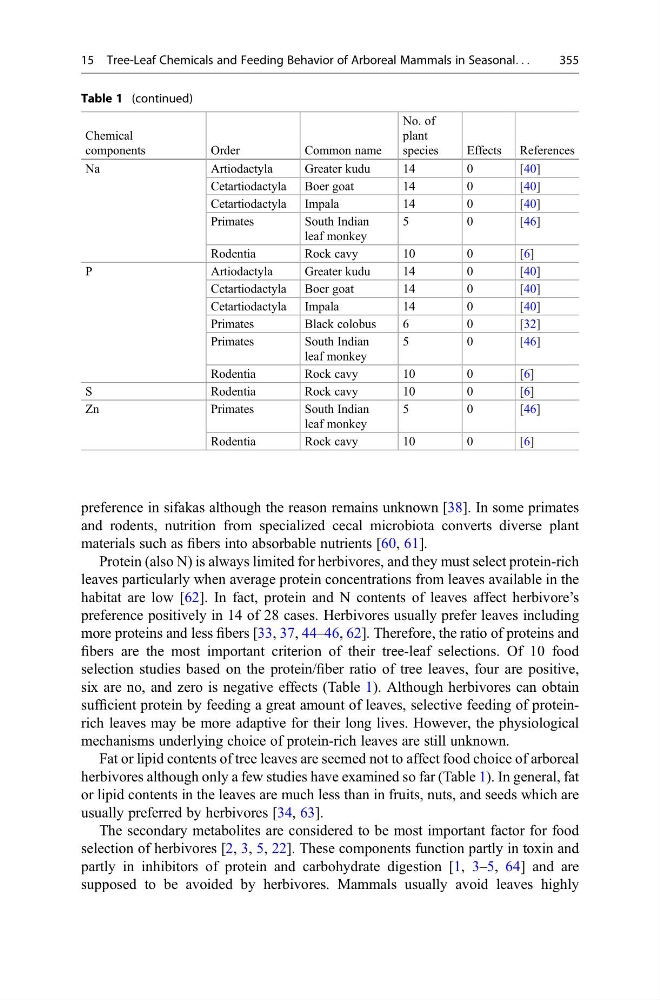
six are no, and zero is negative effects (Table 1). Although herbivores can obtain
sufficient protein by feeding a great amount of leaves, selective feeding of proteinrich leaves may be more adaptive for their long lives. However, the physiological
mechanisms underlying choice of protein-rich leaves are still unknown.
Fat or lipid contents of tree leaves are seemed not to affect food choice of arboreal
herbivores although only a few studies have examined so far (Table 1). In general, fat
or lipid contents in the leaves are much less than in fruits, nuts, and seeds which are
usually preferred by herbivores [34, 63].
The secondary metabolites are considered to be most important factor for food
selection of herbivores [2, 3, 5, 22]. These components function partly in toxin and
partly in inhibitors of protein and carbohydrate digestion [1, 3–5, 64] and are
supposed to be avoided by herbivores. Mammals usually avoid leaves highly
Table 1 (continued)
Chemical
components
Order
Common name
No. of
plant
species
Effects References
Na
Artiodactyla
Greater kudu
14
0
[40]
Cetartiodactyla Boer goat
14
0
[40]
Cetartiodactyla Impala
14
0
[40]
Primates
South Indian
leaf monkey
5
0
[ 46]
Rodentia
Rock cavy
10
0
[6]
P
Artiodactyla
Greater kudu
14
0
[40]
Cetartiodactyla Boer goat
14
0
[40]
Cetartiodactyla Impala
14
0
[40]
Primates
Black colobus
6
0
[32]
Primates
South Indian
leaf monkey
5
0
[ 46]
Rodentia
Rock cavy
10
0
[6]
S
Rodentia
Rock cavy
10
0
[6]
Zn
Primates
South Indian
leaf monkey
5
0
[ 46]
Rodentia
Rock cavy
10
0
[6]
15 Tree-Leaf Chemicals and Feeding Behavior of Arboreal Mammals in Seasonal. . .
355
and rodents, nutrition from specialized cecal microbiota converts diverse plant
materials such as fibers into absorbable nutrients [60, 61].
Protein (also N) is always limited for herbivores, and they must select protein-rich
leaves particularly when average protein concentrations from leaves available in the
habitat are low [62]. In fact, protein and N contents of leaves affect herbivore’s
preference positively in 14 of 28 cases. Herbivores usually prefer leaves including
more proteins and less fibers [33, 37, 44–46, 62]. Therefore, the ratio of proteins and
fibers are the most important criterion of their tree-leaf selections. Of 10 food
selection studies based on the protein/fiber ratio of tree leaves, four are positive,
six are no, and zero is negative effects (Table 1). Although herbivores can obtain
sufficient protein by feeding a great amount of leaves, selective feeding of proteinrich leaves may be more adaptive for their long lives. However, the physiological
mechanisms underlying choice of protein-rich leaves are still unknown.
Fat or lipid contents of tree leaves are seemed not to affect food choice of arboreal
herbivores although only a few studies have examined so far (Table 1). In general, fat
or lipid contents in the leaves are much less than in fruits, nuts, and seeds which are
usually preferred by herbivores [34, 63].
The secondary metabolites are considered to be most important factor for food
selection of herbivores [2, 3, 5, 22]. These components function partly in toxin and
partly in inhibitors of protein and carbohydrate digestion [1, 3–5, 64] and are
supposed to be avoided by herbivores. Mammals usually avoid leaves highly
Table 1 (continued)
Chemical
components
Order
Common name
No. of
plant
species
Effects References
Na
Artiodactyla
Greater kudu
14
0
[40]
Cetartiodactyla Boer goat
14
0
[40]
Cetartiodactyla Impala
14
0
[40]
Primates
South Indian
leaf monkey
5
0
[ 46]
Rodentia
Rock cavy
10
0
[6]
P
Artiodactyla
Greater kudu
14
0
[40]
Cetartiodactyla Boer goat
14
0
[40]
Cetartiodactyla Impala
14
0
[40]
Primates
Black colobus
6
0
[32]
Primates
South Indian
leaf monkey
5
0
[ 46]
Rodentia
Rock cavy
10
0
[6]
S
Rodentia
Rock cavy
10
0
[6]
Zn
Primates
South Indian
leaf monkey
5
0
[ 46]
Rodentia
Rock cavy
10
0
[6]
15 Tree-Leaf Chemicals and Feeding Behavior of Arboreal Mammals in Seasonal. . .
355