

following mechanisms can cause their toxicity: i) interference with functional sites
in proteins; (ii) displacement of essential elements in the enzymes, leading to loss of
enzymatic activity; and (iii) increase in ROS levels [119, 150, 151]. Increased ROS
production can be a result of inhibition of electron transport chains in chloroplasts
and mitochondria, metal-induced denaturation of antioxidant enzymes, or exhaustion of a pool of reduced glutathione [55, 119]. Excess of heavy metals increase ROS
production in subcellular organelles such as peroxisomes, chloroplasts, and mitochondria, which constitute together the predominant sources of ROS production in
plants [116].
Some of heavy metals (Cu, Fe, Cr) belongs to transition metals with changeable
valence; therefore, they can participate, in cellular redox reactions, affecting directly
ROS production [119]. These metals at high doses may stimulate ROS production
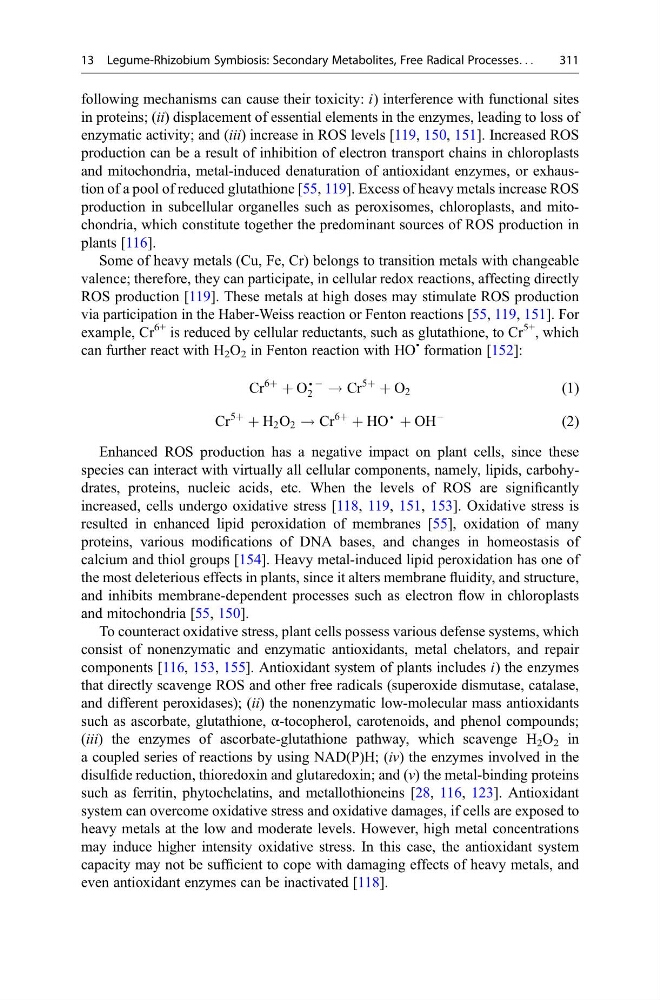
via participation in the Haber-Weiss reaction or Fenton reactions [55, 119, 151]. For
example, Cr
6+ is reduced by cellular reductants, such as glutathione, to Cr
5+ , which
can further react with H 2 O 2 in Fenton reaction with HO
• formation [152]:
Сr
6þ
þ O • À
2 ! Сr
5þ
þ О 2
(1)
Сr
5þ
þ Н 2 О 2 ! Сr
6þ
þ HO • þ OH
À
(2)
Enhanced ROS production has a negative impact on plant cells, since these
species can interact with virtually all cellular components, namely, lipids, carbohydrates, proteins, nucleic acids, etc. When the levels of ROS are significantly
increased, cells undergo oxidative stress [118, 119, 151, 153]. Oxidative stress is
resulted in enhanced lipid peroxidation of membranes [55], oxidation of many
proteins, various modifications of DNA bases, and changes in homeostasis of
calcium and thiol groups [154]. Heavy metal-induced lipid peroxidation has one of
the most deleterious effects in plants, since it alters membrane fluidity, and structure,
and inhibits membrane-dependent processes such as electron flow in chloroplasts
and mitochondria [55, 150].
To counteract oxidative stress, plant cells possess various defense systems, which
consist of nonenzymatic and enzymatic antioxidants, metal chelators, and repair
components [116, 153, 155]. Antioxidant system of plants includes i) the enzymes
that directly scavenge ROS and other free radicals (superoxide dismutase, catalase,
and different peroxidases); (ii) the nonenzymatic low-molecular mass antioxidants
such as ascorbate, glutathione, α-tocopherol, carotenoids, and phenol compounds;
(iii) the enzymes of ascorbate-glutathione pathway, which scavenge H 2 O 2 in
a coupled series of reactions by using NAD(P)H; (iv) the enzymes involved in the
disulfide reduction, thioredoxin and glutaredoxin; and (v) the metal-binding proteins
such as ferritin, phytochelatins, and metallothioneins [28, 116, 123]. Antioxidant
system can overcome oxidative stress and oxidative damages, if cells are exposed to
heavy metals at the low and moderate levels. However, high metal concentrations
may induce higher intensity oxidative stress. In this case, the antioxidant system
capacity may not be sufficient to cope with damaging effects of heavy metals, and
even antioxidant enzymes can be inactivated [118].
13 Legume-Rhizobium Symbiosis: Secondary Metabolites, Free Radical Processes. . .
311
in proteins; (ii) displacement of essential elements in the enzymes, leading to loss of
enzymatic activity; and (iii) increase in ROS levels [119, 150, 151]. Increased ROS
production can be a result of inhibition of electron transport chains in chloroplasts
and mitochondria, metal-induced denaturation of antioxidant enzymes, or exhaustion of a pool of reduced glutathione [55, 119]. Excess of heavy metals increase ROS
production in subcellular organelles such as peroxisomes, chloroplasts, and mitochondria, which constitute together the predominant sources of ROS production in
plants [116].
Some of heavy metals (Cu, Fe, Cr) belongs to transition metals with changeable
valence; therefore, they can participate, in cellular redox reactions, affecting directly
ROS production [119]. These metals at high doses may stimulate ROS production
via participation in the Haber-Weiss reaction or Fenton reactions [55, 119, 151]. For
example, Cr
6+ is reduced by cellular reductants, such as glutathione, to Cr
5+ , which
can further react with H 2 O 2 in Fenton reaction with HO
• formation [152]:
Сr
6þ
þ O • À
2 ! Сr
5þ
þ О 2
(1)
Сr
5þ
þ Н 2 О 2 ! Сr
6þ
þ HO • þ OH
À
(2)
Enhanced ROS production has a negative impact on plant cells, since these
species can interact with virtually all cellular components, namely, lipids, carbohydrates, proteins, nucleic acids, etc. When the levels of ROS are significantly
increased, cells undergo oxidative stress [118, 119, 151, 153]. Oxidative stress is
resulted in enhanced lipid peroxidation of membranes [55], oxidation of many
proteins, various modifications of DNA bases, and changes in homeostasis of
calcium and thiol groups [154]. Heavy metal-induced lipid peroxidation has one of
the most deleterious effects in plants, since it alters membrane fluidity, and structure,
and inhibits membrane-dependent processes such as electron flow in chloroplasts
and mitochondria [55, 150].
To counteract oxidative stress, plant cells possess various defense systems, which
consist of nonenzymatic and enzymatic antioxidants, metal chelators, and repair
components [116, 153, 155]. Antioxidant system of plants includes i) the enzymes
that directly scavenge ROS and other free radicals (superoxide dismutase, catalase,
and different peroxidases); (ii) the nonenzymatic low-molecular mass antioxidants
such as ascorbate, glutathione, α-tocopherol, carotenoids, and phenol compounds;
(iii) the enzymes of ascorbate-glutathione pathway, which scavenge H 2 O 2 in
a coupled series of reactions by using NAD(P)H; (iv) the enzymes involved in the
disulfide reduction, thioredoxin and glutaredoxin; and (v) the metal-binding proteins
such as ferritin, phytochelatins, and metallothioneins [28, 116, 123]. Antioxidant
system can overcome oxidative stress and oxidative damages, if cells are exposed to
heavy metals at the low and moderate levels. However, high metal concentrations
may induce higher intensity oxidative stress. In this case, the antioxidant system
capacity may not be sufficient to cope with damaging effects of heavy metals, and
even antioxidant enzymes can be inactivated [118].
13 Legume-Rhizobium Symbiosis: Secondary Metabolites, Free Radical Processes. . .
311