

(an allelochemical from tobacco) causes an oxidative damage through enhanced
generation of ROS, as indicated by increased lipid peroxidation, disruption of
membrane integrity, and impacted mitosis, and thus ultimately results in growth
inhibition of the L. sativa plants [63].
It has been observed that allelopathic species are more successful as invaders.
Invasion of aggressive allelopathic species causes habitat loss of local species.
This is not only a global problem but also has economic, biodiversity, and
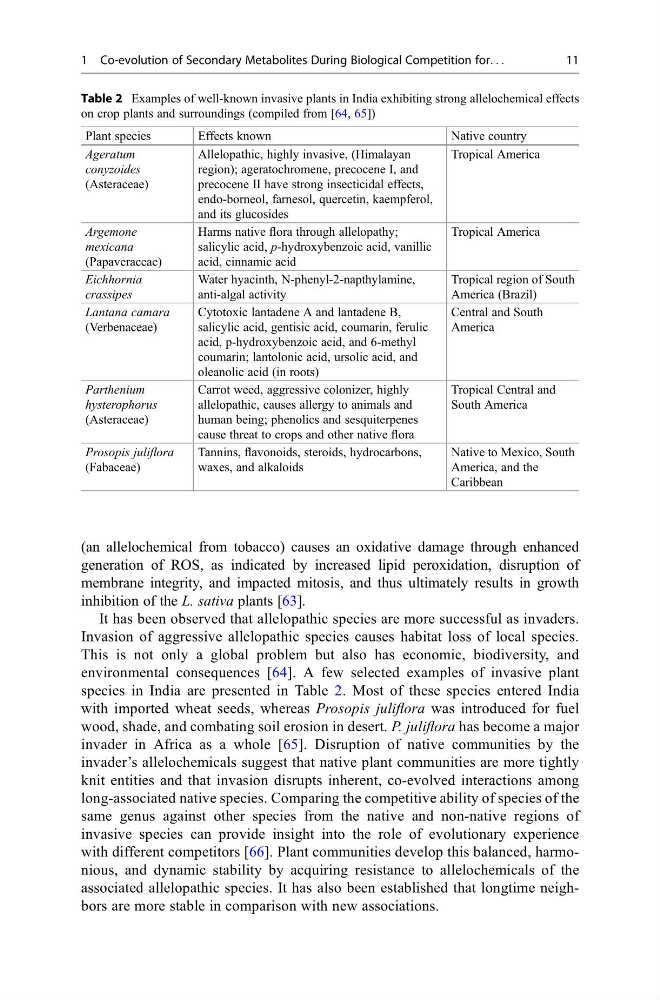
environmental consequences [64]. A few selected examples of invasive plant
species in India are presented in Table 2. Most of these species entered India
with imported wheat seeds, whereas Prosopis juliflora was introduced for fuel
wood, shade, and combating soil erosion in desert. P. juliflora has become a major
invader in Africa as a whole [65]. Disruption of native communities by the
invader’s allelochemicals suggest that native plant communities are more tightly
knit entities and that invasion disrupts inherent, co-evolved interactions among
long-associated native species. Comparing the competitive ability of species of the
same genus against other species from the native and non-native regions of
invasive species can provide insight into the role of evolutionary experience
with different competitors [66]. Plant communities develop this balanced, harmonious, and dynamic stability by acquiring resistance to allelochemicals of the
associated allelopathic species. It has also been established that longtime neighbors are more stable in comparison with new associations.
Table 2 Examples of well-known invasive plants in India exhibiting strong allelochemical effects
on crop plants and surroundings (compiled from [64, 65])
Plant species
Effects known
Native country
Ageratum
conyzoides
(Asteraceae)
Allelopathic, highly invasive, (Himalayan
region); ageratochromene, precocene I, and
precocene II have strong insecticidal effects,
endo-borneol, farnesol, quercetin, kaempferol,
and its glucosides
Tropical America
Argemone
mexicana
(Papaveraceae)
Harms native flora through allelopathy;
salicylic acid, p-hydroxybenzoic acid, vanillic
acid, cinnamic acid
Tropical America
Eichhornia
crassipes
Water hyacinth, N-phenyl-2-napthylamine,
anti-algal activity
Tropical region of South
America (Brazil)
Lantana camara
(Verbenaceae)
Cytotoxic lantadene A and lantadene B,
salicylic acid, gentisic acid, coumarin, ferulic
acid, p-hydroxybenzoic acid, and 6-methyl
coumarin; lantolonic acid, ursolic acid, and
oleanolic acid (in roots)
Central and South
America
Parthenium
hysterophorus
(Asteraceae)
Carrot weed, aggressive colonizer, highly
allelopathic, causes allergy to animals and
human being; phenolics and sesquiterpenes
cause threat to crops and other native flora
Tropical Central and
South America
Prosopis juliflora
(Fabaceae)
Tannins, flavonoids, steroids, hydrocarbons,
waxes, and alkaloids
Native to Mexico, South
America, and the
Caribbean
1 Co-evolution of Secondary Metabolites During Biological Competition for. . .
11
generation of ROS, as indicated by increased lipid peroxidation, disruption of
membrane integrity, and impacted mitosis, and thus ultimately results in growth
inhibition of the L. sativa plants [63].
It has been observed that allelopathic species are more successful as invaders.
Invasion of aggressive allelopathic species causes habitat loss of local species.
This is not only a global problem but also has economic, biodiversity, and
environmental consequences [64]. A few selected examples of invasive plant
species in India are presented in Table 2. Most of these species entered India
with imported wheat seeds, whereas Prosopis juliflora was introduced for fuel
wood, shade, and combating soil erosion in desert. P. juliflora has become a major
invader in Africa as a whole [65]. Disruption of native communities by the
invader’s allelochemicals suggest that native plant communities are more tightly
knit entities and that invasion disrupts inherent, co-evolved interactions among
long-associated native species. Comparing the competitive ability of species of the
same genus against other species from the native and non-native regions of
invasive species can provide insight into the role of evolutionary experience
with different competitors [66]. Plant communities develop this balanced, harmonious, and dynamic stability by acquiring resistance to allelochemicals of the
associated allelopathic species. It has also been established that longtime neighbors are more stable in comparison with new associations.
Table 2 Examples of well-known invasive plants in India exhibiting strong allelochemical effects
on crop plants and surroundings (compiled from [64, 65])
Plant species
Effects known
Native country
Ageratum
conyzoides
(Asteraceae)
Allelopathic, highly invasive, (Himalayan
region); ageratochromene, precocene I, and
precocene II have strong insecticidal effects,
endo-borneol, farnesol, quercetin, kaempferol,
and its glucosides
Tropical America
Argemone
mexicana
(Papaveraceae)
Harms native flora through allelopathy;
salicylic acid, p-hydroxybenzoic acid, vanillic
acid, cinnamic acid
Tropical America
Eichhornia
crassipes
Water hyacinth, N-phenyl-2-napthylamine,
anti-algal activity
Tropical region of South
America (Brazil)
Lantana camara
(Verbenaceae)
Cytotoxic lantadene A and lantadene B,
salicylic acid, gentisic acid, coumarin, ferulic
acid, p-hydroxybenzoic acid, and 6-methyl
coumarin; lantolonic acid, ursolic acid, and
oleanolic acid (in roots)
Central and South
America
Parthenium
hysterophorus
(Asteraceae)
Carrot weed, aggressive colonizer, highly
allelopathic, causes allergy to animals and
human being; phenolics and sesquiterpenes
cause threat to crops and other native flora
Tropical Central and
South America
Prosopis juliflora
(Fabaceae)
Tannins, flavonoids, steroids, hydrocarbons,
waxes, and alkaloids
Native to Mexico, South
America, and the
Caribbean
1 Co-evolution of Secondary Metabolites During Biological Competition for. . .
11