

lycopersici after 2 days. When used in spore germination tests, 0.45 mg/ml was
found to completely inhibit the germination of Fusarium spores [16]. The biological
effects of 6-PP are numerous, reduced production of the mycotoxin deoxynivalenol
by Fusarium graminearum and antifungal properties by reducing the mycelial
growth rate of R. solani and F. oxysporum f. sp. lycopersici [91, 92].
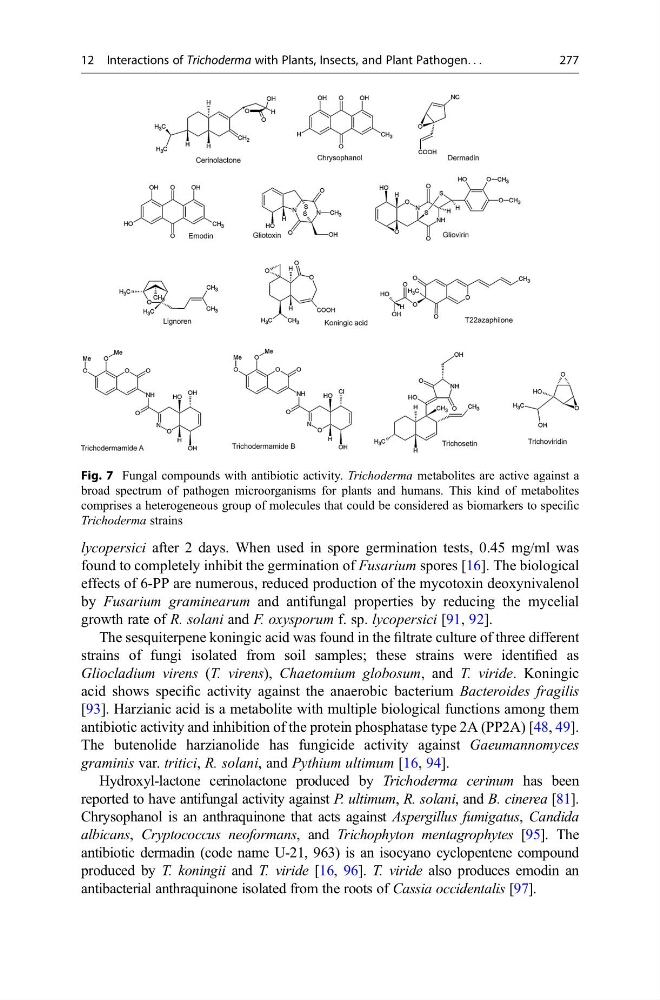
The sesquiterpene koningic acid was found in the filtrate culture of three different
strains of fungi isolated from soil samples; these strains were identified as
Gliocladium virens (T. virens), Chaetomium globosum, and T. viride. Koningic
acid shows specific activity against the anaerobic bacterium Bacteroides fragilis
[93]. Harzianic acid is a metabolite with multiple biological functions among them
antibiotic activity and inhibition of the protein phosphatase type 2A (PP2A) [48, 49].
The butenolide harzianolide has fungicide activity against Gaeumannomyces
graminis var. tritici, R. solani, and Pythium ultimum [16, 94].
Hydroxyl-lactone cerinolactone produced by Trichoderma cerinum has been
reported to have antifungal activity against P. ultimum, R. solani, and B. cinerea [81].
Chrysophanol is an anthraquinone that acts against Aspergillus fumigatus, Candida
albicans, Cryptococcus neoformans, and Trichophyton mentagrophytes [95]. The
antibiotic dermadin (code name U-21, 963) is an isocyano cyclopentene compound
produced by T. koningii and T. viride [16, 96]. T. viride also produces emodin an
antibacterial anthraquinone isolated from the roots of Cassia occidentalis [97].
Fig. 7 Fungal compounds with antibiotic activity. Trichoderma metabolites are active against a
broad spectrum of pathogen microorganisms for plants and humans. This kind of metabolites
comprises a heterogeneous group of molecules that could be considered as biomarkers to specific
Trichoderma strains
12 Interactions of Trichoderma with Plants, Insects, and Plant Pathogen. . .
277
found to completely inhibit the germination of Fusarium spores [16]. The biological
effects of 6-PP are numerous, reduced production of the mycotoxin deoxynivalenol
by Fusarium graminearum and antifungal properties by reducing the mycelial
growth rate of R. solani and F. oxysporum f. sp. lycopersici [91, 92].
The sesquiterpene koningic acid was found in the filtrate culture of three different
strains of fungi isolated from soil samples; these strains were identified as
Gliocladium virens (T. virens), Chaetomium globosum, and T. viride. Koningic
acid shows specific activity against the anaerobic bacterium Bacteroides fragilis
[93]. Harzianic acid is a metabolite with multiple biological functions among them
antibiotic activity and inhibition of the protein phosphatase type 2A (PP2A) [48, 49].
The butenolide harzianolide has fungicide activity against Gaeumannomyces
graminis var. tritici, R. solani, and Pythium ultimum [16, 94].
Hydroxyl-lactone cerinolactone produced by Trichoderma cerinum has been
reported to have antifungal activity against P. ultimum, R. solani, and B. cinerea [81].
Chrysophanol is an anthraquinone that acts against Aspergillus fumigatus, Candida
albicans, Cryptococcus neoformans, and Trichophyton mentagrophytes [95]. The
antibiotic dermadin (code name U-21, 963) is an isocyano cyclopentene compound
produced by T. koningii and T. viride [16, 96]. T. viride also produces emodin an
antibacterial anthraquinone isolated from the roots of Cassia occidentalis [97].
Fig. 7 Fungal compounds with antibiotic activity. Trichoderma metabolites are active against a
broad spectrum of pathogen microorganisms for plants and humans. This kind of metabolites
comprises a heterogeneous group of molecules that could be considered as biomarkers to specific
Trichoderma strains
12 Interactions of Trichoderma with Plants, Insects, and Plant Pathogen. . .
277