

were important in development of large trees. This hard-to-decay lignified wood is
decomposed by lignin-decomposing fungi (Ascomycetes and Basidiomycetes), the
evolution details of which are still not clear [31, 32]. Adaptation of plants to land also
gave rise to synthesis of volatile secondary metabolites. Plant volatiles can be
produced by both anabolic and catabolic processes.
3
Biology of Survival
Three important aspects of plant discussed in this section are pollination, hostparasite relationship with its angiosperm parasite, and plant-plant interactions.
Autotoxins are phenolics from root exudates or decaying plant debris which inhibit
the growth of own plants; the phenomenon is known as “autotoxicity” and exhibited
by several crop plants such as alfalfa, cucumber, rice, and wheat. Several secondary
metabolites including phenolics play important roles in plant-plant interaction by
inhibiting root ion and water uptake, membrane permeability and cell cycle, protein
biosynthesis, respiration, photosynthesis, and many other physiological processes
[33, 34]. These phenolics also influence the quality and quantity of soil microorganism which in turn affects the plant growth and health by mutualistic and pathogenic
effect as well as by modulating nutrient cycle [35].
Pollination is an important biological process in plant’s life. Some plants totally
depend on pollinators for pollination and reward the pollinators by nectar [36,
37]. However, there are many organisms that feed on nectar without helping the
plant in pollination. They are called as robbers. These robbers can range from being
insects to birds to mammals. Among insects different species of bees are the main
robbers, like Xylocopa spp., Bombus spp., Trigona spp., etc. The robbers and
pollinators are usually attracted toward a plant by its floral traits and in particular
nectar. Nectar is rich in sugars and amino acids and also secondary metabolites, such
as alkaloids, phenolics, and nonprotein amino acids. These secondary metabolites
Present day
Green Algae
Common ancestor
embryophyta
Charophytae
Aquatic
Algae
Terrestrial
Algae
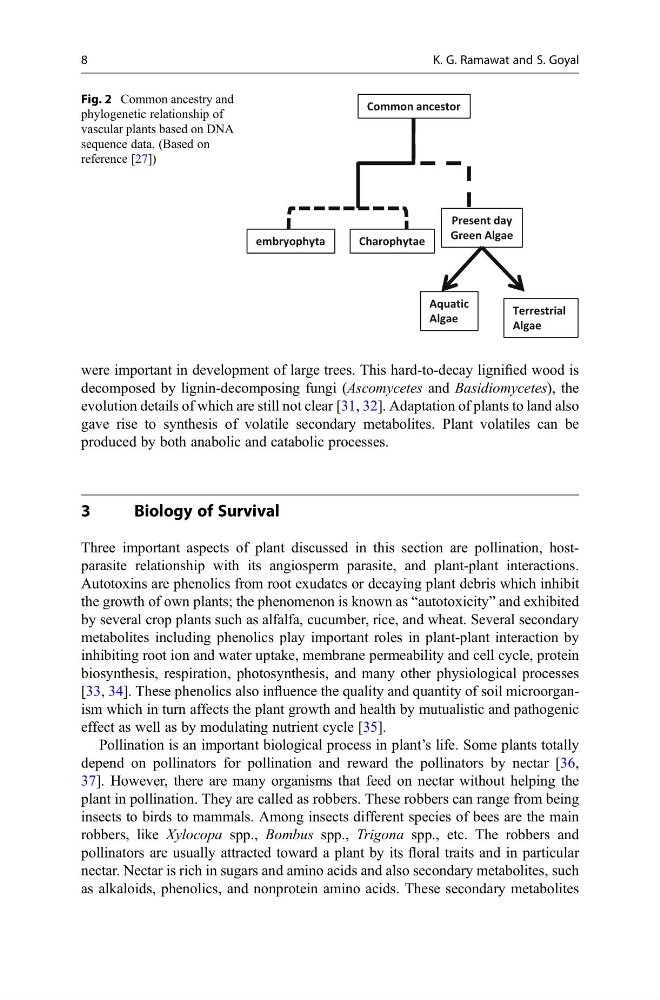
Fig. 2 Common ancestry and
phylogenetic relationship of
vascular plants based on DNA
sequence data. (Based on
reference [27])
8
K. G. Ramawat and S. Goyal
decomposed by lignin-decomposing fungi (Ascomycetes and Basidiomycetes), the
evolution details of which are still not clear [31, 32]. Adaptation of plants to land also
gave rise to synthesis of volatile secondary metabolites. Plant volatiles can be
produced by both anabolic and catabolic processes.
3
Biology of Survival
Three important aspects of plant discussed in this section are pollination, hostparasite relationship with its angiosperm parasite, and plant-plant interactions.
Autotoxins are phenolics from root exudates or decaying plant debris which inhibit
the growth of own plants; the phenomenon is known as “autotoxicity” and exhibited
by several crop plants such as alfalfa, cucumber, rice, and wheat. Several secondary
metabolites including phenolics play important roles in plant-plant interaction by
inhibiting root ion and water uptake, membrane permeability and cell cycle, protein
biosynthesis, respiration, photosynthesis, and many other physiological processes
[33, 34]. These phenolics also influence the quality and quantity of soil microorganism which in turn affects the plant growth and health by mutualistic and pathogenic
effect as well as by modulating nutrient cycle [35].
Pollination is an important biological process in plant’s life. Some plants totally
depend on pollinators for pollination and reward the pollinators by nectar [36,
37]. However, there are many organisms that feed on nectar without helping the
plant in pollination. They are called as robbers. These robbers can range from being
insects to birds to mammals. Among insects different species of bees are the main
robbers, like Xylocopa spp., Bombus spp., Trigona spp., etc. The robbers and
pollinators are usually attracted toward a plant by its floral traits and in particular
nectar. Nectar is rich in sugars and amino acids and also secondary metabolites, such
as alkaloids, phenolics, and nonprotein amino acids. These secondary metabolites
Present day
Green Algae
Common ancestor
embryophyta
Charophytae
Aquatic
Algae
Terrestrial
Algae
Fig. 2 Common ancestry and
phylogenetic relationship of
vascular plants based on DNA
sequence data. (Based on
reference [27])
8
K. G. Ramawat and S. Goyal