

ascorbate peroxidase enzymes in tomato (Lycopersicum esculentum L. cv. Jubilee)
seedlings grown under abiotic stress conditions [76].
3
Fungal Metabolites Involved in the Biocontrol Activity of
Trichoderma Species
Plant beneficial microorganisms can provide an initial barrier against pathogen
attack on the root. The protection by Trichoderma spp. has been reported for several
plants against several plant pathogens [77]. There are several mycoparasitic species
that are able to attack and lyse plant pathogenic fungi such as Alternaria alternata,
Botrytis cinerea, Rhizoctonia solani, Sclerotinia sclerotiorum, Pythium spp., and
Fusarium spp. [30, 78]. For example, T. ovalisporum DIS 70a, T. stilbohypoxyli DIS
259j, and T. theobromicola DIS 376f delayed the disease development caused by P.
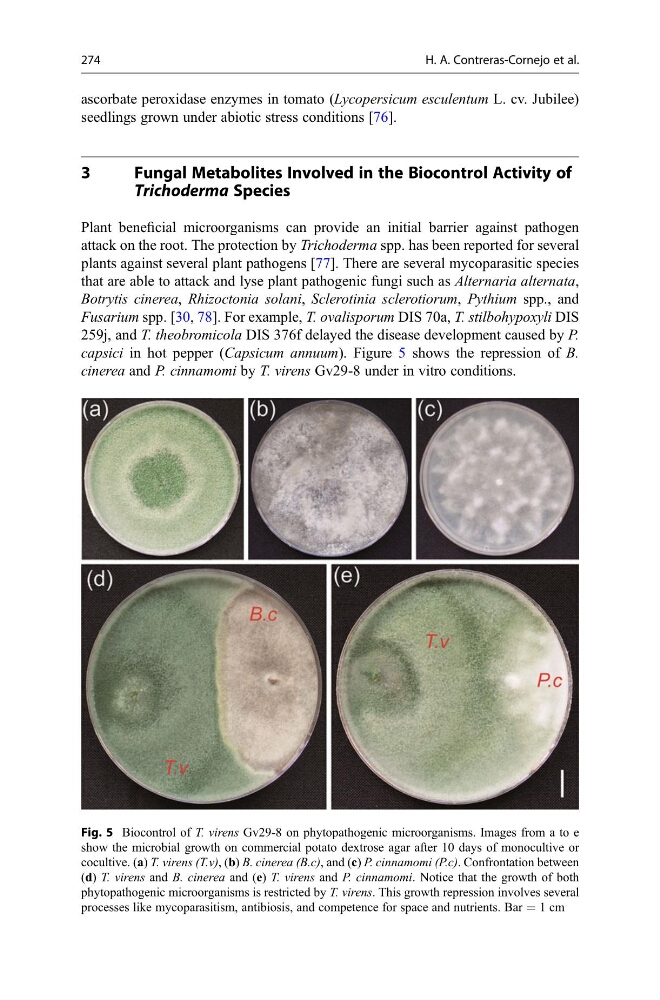
capsici in hot pepper (Capsicum annuum). Figure 5 shows the repression of B.
cinerea and P. cinnamomi by T. virens Gv29-8 under in vitro conditions.
Fig. 5 Biocontrol of T. virens Gv29-8 on phytopathogenic microorganisms. Images from a to e
show the microbial growth on commercial potato dextrose agar after 10 days of monocultive or
cocultive. (a) T. virens (T.v), (b) B. cinerea (B.c), and (c) P. cinnamomi (P.c). Confrontation between
(d) T. virens and B. cinerea and (e) T. virens and P. cinnamomi. Notice that the growth of both
phytopathogenic microorganisms is restricted by T. virens. This growth repression involves several
processes like mycoparasitism, antibiosis, and competence for space and nutrients. Bar = 1 cm
274
H. A. Contreras-Cornejo et al.
seedlings grown under abiotic stress conditions [76].
3
Fungal Metabolites Involved in the Biocontrol Activity of
Trichoderma Species
Plant beneficial microorganisms can provide an initial barrier against pathogen
attack on the root. The protection by Trichoderma spp. has been reported for several
plants against several plant pathogens [77]. There are several mycoparasitic species
that are able to attack and lyse plant pathogenic fungi such as Alternaria alternata,
Botrytis cinerea, Rhizoctonia solani, Sclerotinia sclerotiorum, Pythium spp., and
Fusarium spp. [30, 78]. For example, T. ovalisporum DIS 70a, T. stilbohypoxyli DIS
259j, and T. theobromicola DIS 376f delayed the disease development caused by P.
capsici in hot pepper (Capsicum annuum). Figure 5 shows the repression of B.
cinerea and P. cinnamomi by T. virens Gv29-8 under in vitro conditions.
Fig. 5 Biocontrol of T. virens Gv29-8 on phytopathogenic microorganisms. Images from a to e
show the microbial growth on commercial potato dextrose agar after 10 days of monocultive or
cocultive. (a) T. virens (T.v), (b) B. cinerea (B.c), and (c) P. cinnamomi (P.c). Confrontation between
(d) T. virens and B. cinerea and (e) T. virens and P. cinnamomi. Notice that the growth of both
phytopathogenic microorganisms is restricted by T. virens. This growth repression involves several
processes like mycoparasitism, antibiosis, and competence for space and nutrients. Bar = 1 cm
274
H. A. Contreras-Cornejo et al.