

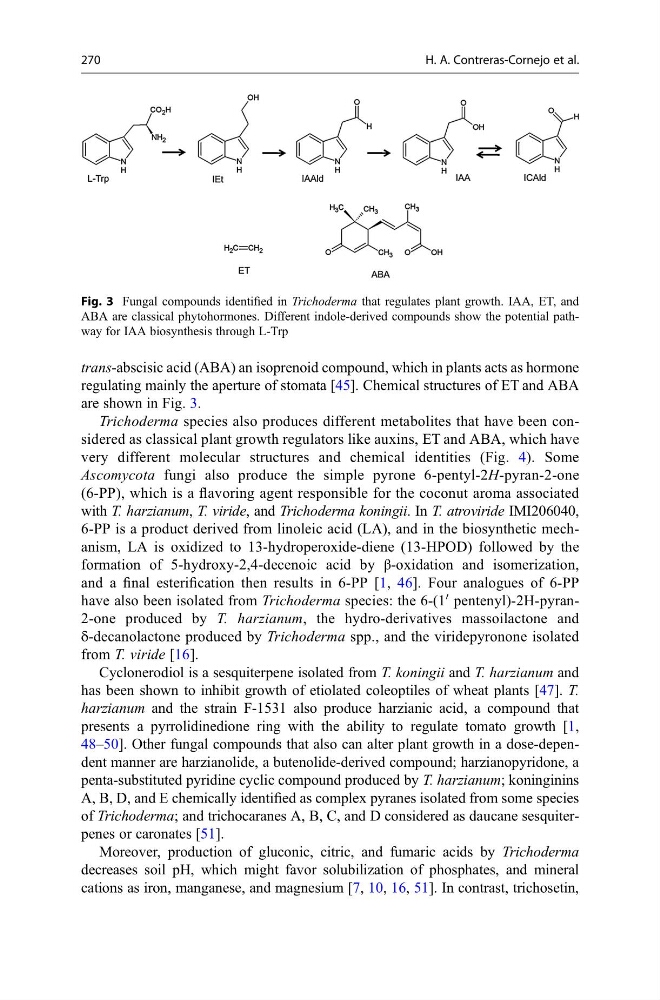
trans-abscisic acid (ABA) an isoprenoid compound, which in plants acts as hormone
regulating mainly the aperture of stomata [45]. Chemical structures of ET and ABA
are shown in Fig. 3.
Trichoderma species also produces different metabolites that have been considered as classical plant growth regulators like auxins, ET and ABA, which have
very different molecular structures and chemical identities (Fig. 4). Some
Ascomycota fungi also produce the simple pyrone 6-pentyl-2H-pyran-2-one
(6-PP), which is a flavoring agent responsible for the coconut aroma associated
with T. harzianum, T. viride, and Trichoderma koningii. In T. atroviride IMI206040,
6-PP is a product derived from linoleic acid (LA), and in the biosynthetic mechanism, LA is oxidized to 13-hydroperoxide-diene (13-HPOD) followed by the
formation of 5-hydroxy-2,4-decenoic acid by β-oxidation and isomerization,
and a final esterification then results in 6-PP [1, 46]. Four analogues of 6-PP
have also been isolated from Trichoderma species: the 6-(1
0 pentenyl)-2H-pyran2-one produced by T. harzianum, the hydro-derivatives massoilactone and
δ-decanolactone produced by Trichoderma spp., and the viridepyronone isolated
from T. viride [16].
Cyclonerodiol is a sesquiterpene isolated from T. koningii and T. harzianum and
has been shown to inhibit growth of etiolated coleoptiles of wheat plants [47]. T.
harzianum and the strain F-1531 also produce harzianic acid, a compound that
presents a pyrrolidinedione ring with the ability to regulate tomato growth [1,
48–50]. Other fungal compounds that also can alter plant growth in a dose-dependent manner are harzianolide, a butenolide-derived compound; harzianopyridone, a
penta-substituted pyridine cyclic compound produced by T. harzianum; koninginins
A, B, D, and E chemically identified as complex pyranes isolated from some species
of Trichoderma; and trichocaranes A, B, C, and D considered as daucane sesquiterpenes or caronates [51].
Moreover, production of gluconic, citric, and fumaric acids by Trichoderma
decreases soil pH, which might favor solubilization of phosphates, and mineral
cations as iron, manganese, and magnesium [7, 10, 16, 51]. In contrast, trichosetin,
Fig. 3 Fungal compounds identified in Trichoderma that regulates plant growth. IAA, ET, and
ABA are classical phytohormones. Different indole-derived compounds show the potential pathway for IAA biosynthesis through L-Trp
270
H. A. Contreras-Cornejo et al.
regulating mainly the aperture of stomata [45]. Chemical structures of ET and ABA
are shown in Fig. 3.
Trichoderma species also produces different metabolites that have been considered as classical plant growth regulators like auxins, ET and ABA, which have
very different molecular structures and chemical identities (Fig. 4). Some
Ascomycota fungi also produce the simple pyrone 6-pentyl-2H-pyran-2-one
(6-PP), which is a flavoring agent responsible for the coconut aroma associated
with T. harzianum, T. viride, and Trichoderma koningii. In T. atroviride IMI206040,
6-PP is a product derived from linoleic acid (LA), and in the biosynthetic mechanism, LA is oxidized to 13-hydroperoxide-diene (13-HPOD) followed by the
formation of 5-hydroxy-2,4-decenoic acid by β-oxidation and isomerization,
and a final esterification then results in 6-PP [1, 46]. Four analogues of 6-PP
have also been isolated from Trichoderma species: the 6-(1
0 pentenyl)-2H-pyran2-one produced by T. harzianum, the hydro-derivatives massoilactone and
δ-decanolactone produced by Trichoderma spp., and the viridepyronone isolated
from T. viride [16].
Cyclonerodiol is a sesquiterpene isolated from T. koningii and T. harzianum and
has been shown to inhibit growth of etiolated coleoptiles of wheat plants [47]. T.
harzianum and the strain F-1531 also produce harzianic acid, a compound that
presents a pyrrolidinedione ring with the ability to regulate tomato growth [1,
48–50]. Other fungal compounds that also can alter plant growth in a dose-dependent manner are harzianolide, a butenolide-derived compound; harzianopyridone, a
penta-substituted pyridine cyclic compound produced by T. harzianum; koninginins
A, B, D, and E chemically identified as complex pyranes isolated from some species
of Trichoderma; and trichocaranes A, B, C, and D considered as daucane sesquiterpenes or caronates [51].
Moreover, production of gluconic, citric, and fumaric acids by Trichoderma
decreases soil pH, which might favor solubilization of phosphates, and mineral
cations as iron, manganese, and magnesium [7, 10, 16, 51]. In contrast, trichosetin,
Fig. 3 Fungal compounds identified in Trichoderma that regulates plant growth. IAA, ET, and
ABA are classical phytohormones. Different indole-derived compounds show the potential pathway for IAA biosynthesis through L-Trp
270
H. A. Contreras-Cornejo et al.